
Mahabharata
Mahabharata
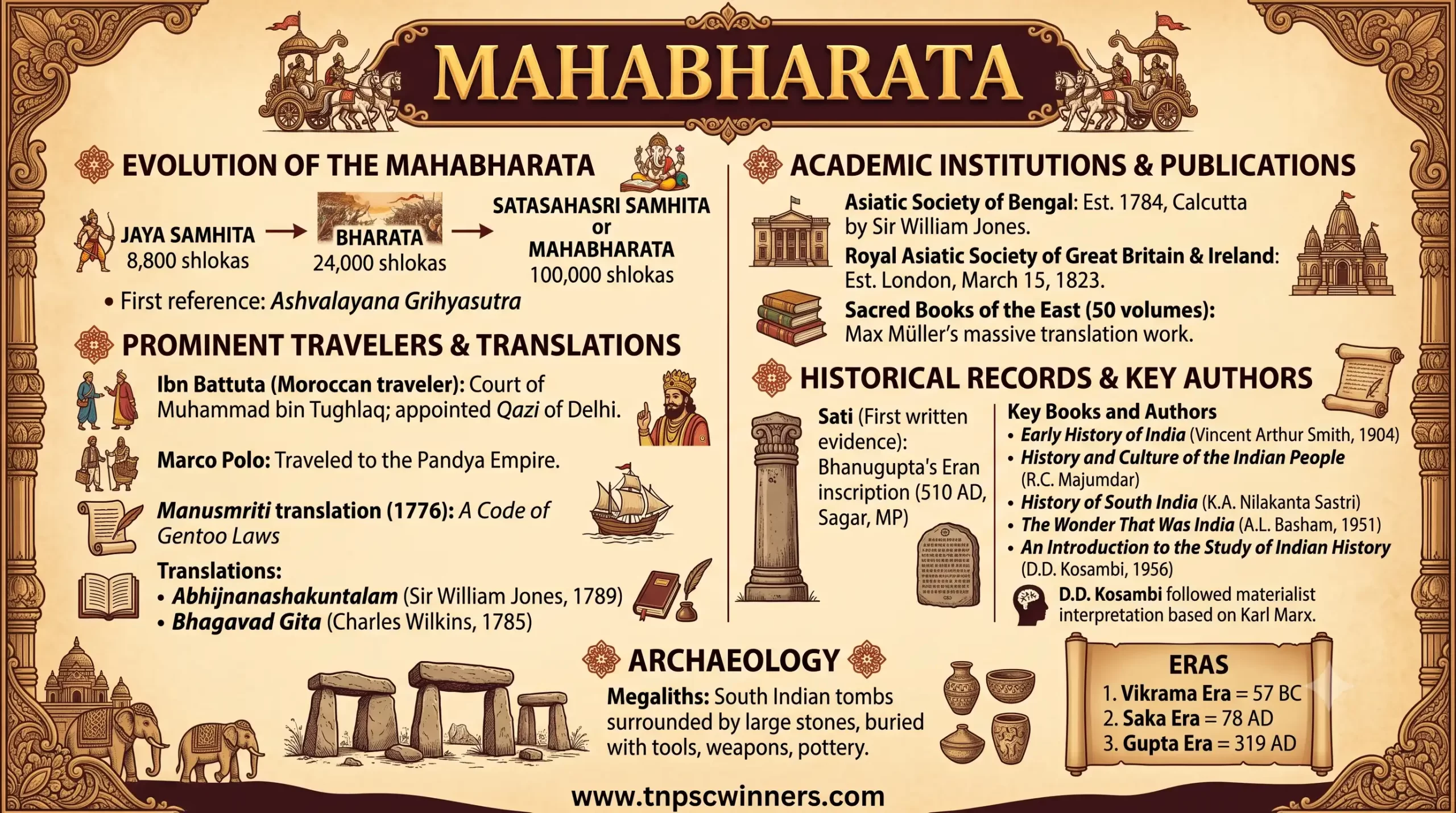
- The first reference to the Mahabharata is found in the *Ashvalayana Grihyasutra*.
- Initially, it contained only 8,800 verses (*shlokas*) and was known as “*Jaya Samhita*”.
- Later, the number of verses rose to 24,000, and it became renowned as “*Bharata*”.
- Finally, as it came to contain 100,000 verses, it was named “*Satasahasri Samhita*” or “*Mahabharata*”.
- To whose court did the Moroccan traveler Ibn Battuta come? Muhammad bin Tughlaq. He was later appointed as the *Qazi* (judge) of Delhi.
- To which kingdom did Marco Polo travel? The Pandya Empire.
- Under what title was the *Manusmriti* translated into English? *A Code of Gentoo Laws* (1776).
- When was the Asiatic Society of Bengal established? In 1784, in Calcutta.
JOIN OUR TELEGRAM CHANNEL – T.ME/TNPSC_WINNERS
- Who founded the Asiatic Society of Bengal? Sir William Jones.
- Who translated *Abhijnanashakuntalam* into English in 1789? Sir William Jones.
- Who translated the *Bhagavad Gita* into English? Charles Wilkins (in 1785).
- When was the Royal Asiatic Society of Great Britain and Ireland established in London? March 15, 1823.
- By whom were ancient Indian texts translated on a massive scale into 50 volumes under the title *Sacred Books of the East*? Max Muller.
- The first written evidence regarding “*Sati*” is found in Bhanugupta’s Eran inscription (Sagar, Madhya Pradesh) dating back to 510 AD.
- Who wrote the book *Early History of India*? Vincent Arthur Smith (1904)
- Who authored the book “History and Culture of the Indian People”? R.C. Majumdar
- Who wrote the “History of South India”? K.A. Nilakanta Sastri
- Who wrote the book “The Wonder That Was India” in 1951? A.L. Basham
- Who wrote the book “An Introduction to the Study of Indian History”? D.D. Kosambi (1956)
- D.D. Kosambi followed the materialist interpretation of history derived from the writings of Karl Marx.
- What are the structures found in South India—tombs surrounded by large stones where the dead were buried along with their tools, weapons, pottery, and other objects—called? Megaliths
- Eras
1. Vikrama Era = 57 BC
2. Saka Era = 78 AD
3. Gupta Era = 319 AD
- IMPORTANT COMMITTEES AND COMMISSION IN INDIA
- LIST OF IMPORTANT COMMITTEES IN INDIA
- ASHOKAS 14 MAJOR ROCK EDICTS
- NAVARATNAS OF AKBAR
- Important committees in British India
- List of Important Battles in Medieval India
- Historical Sources of Ancient India
- IMPORTANT DAYS IN NOVEMBER 2025
- IMPORTANT DAYS IN OCTOBER 2025
- IMPORTANT DAYS IN SEPTEMBER 2025
- IMPORTANT DAYS IN AUGUST 2025
- IMPORTANT DAYS IN JULY 2025
- IMPORTANT DAYS IN JUNE 2025
- IMPORTANT DAYS IN MAY 2025
- IMPORTANT DAYS IN APRIL 2025
- IMPORTANT DAYS IN MARCH 2025
- IMPORTANT DAYS IN FEBRUARY 2025