
Great Revolt of 1857
Learn about the Great Revolt of 1857, including its causes, important leaders, major centres, key events and consequences for TNPSC exams.
Great Revolt of 1857
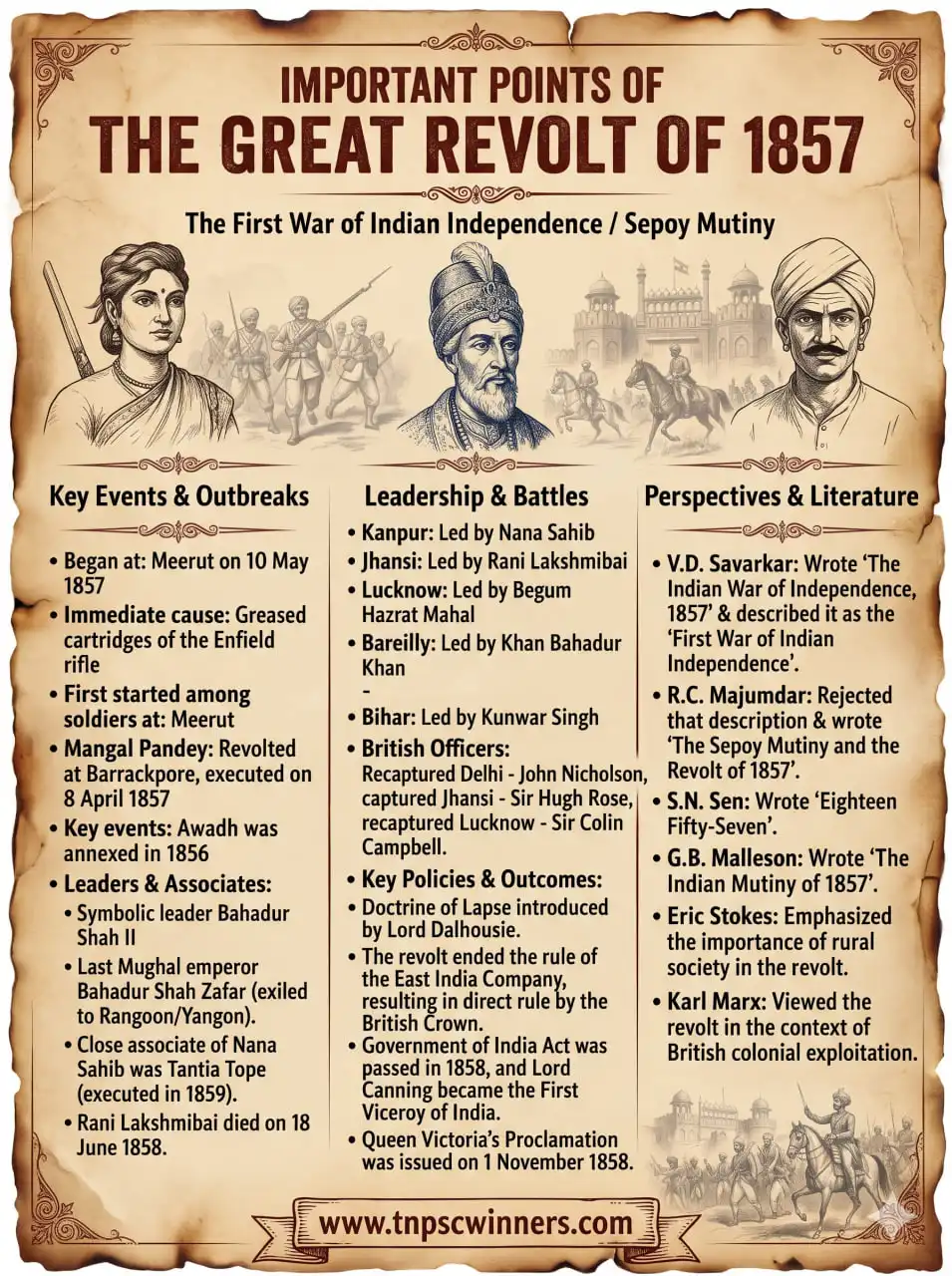
- The Great Revolt of 1857, also known as India’s First War of Independence or the Sepoy Mutiny, was a watershed moment in modern Indian history that brought an end to the British East India Company’s rule and established direct British Crown governance.
The Great Indian Revolt of 1857 – Introduction
- The Revolt of 1857 was the first major organised uprising against British rule in India.
- It began on 10 May 1857 at Meerut.
- The revolt spread to several parts of North and Central India.
- It was primarily a military uprising by Indian sepoys, but later involved rulers, peasants, landlords and ordinary people.
- It is popularly known as:
-
-
-
- Great Revolt of 1857.
- The Sepoy Mutiny.
- The Indian Rebellion of 1857.
- The First War of Indian Independence.
-
-
- The term First War of Indian Independence was popularised by V.D. Savarkar through his book published in 1909.
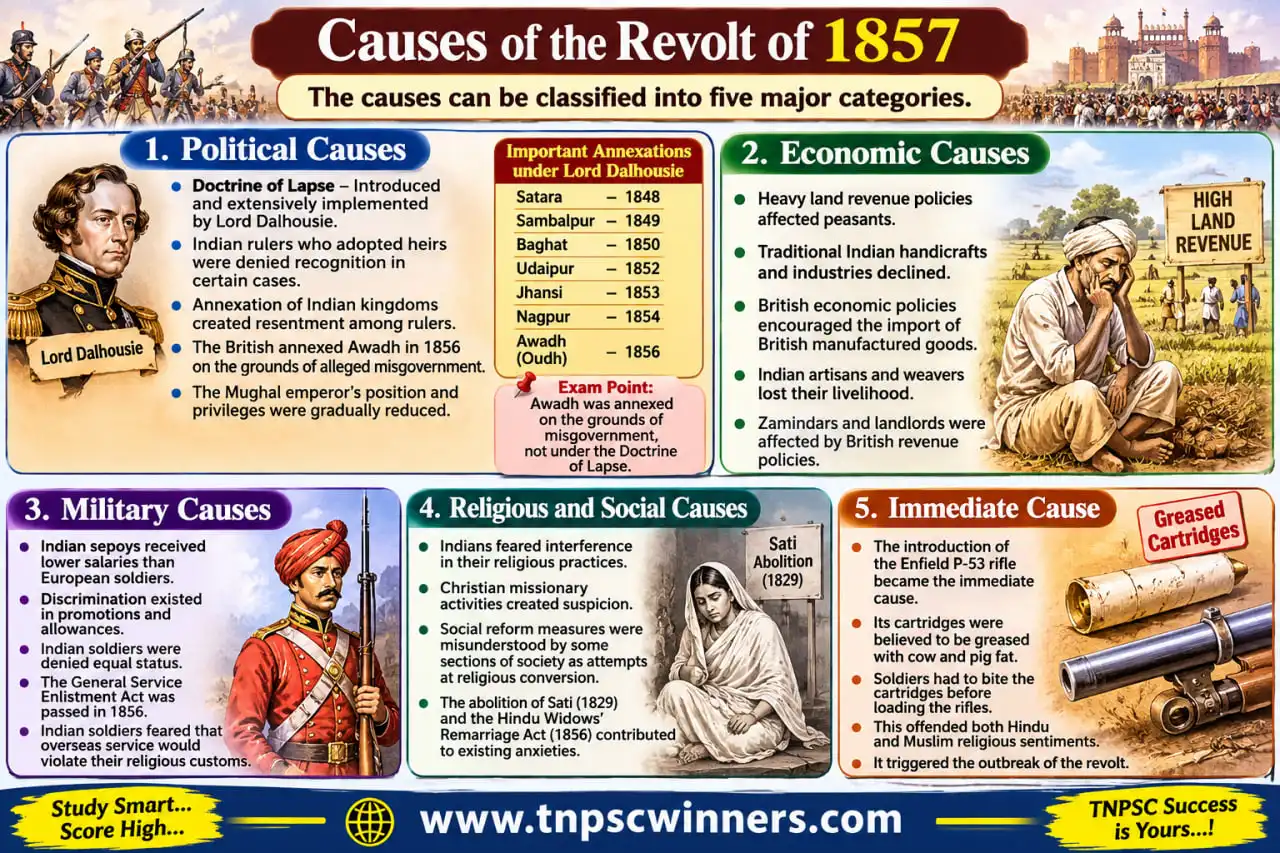
Causes of the Revolt of 1857
- The causes can be classified into five major categories.
Political Causes
- Doctrine of Lapse = Introduced and extensively implemented by Lord Dalhousie.
- Indian rulers who adopted heirs were denied recognition in certain cases.
- Annexation of Indian kingdoms created resentment among rulers.
- The British annexed Awadh in 1856 on the grounds of alleged misgovernment.
- The Mughal emperor’s position and privileges were gradually reduced.
- Great Revolt of 1857
JOIN OUR TELEGRAM CHANNEL – T.ME/TNPSC_WINNERS

Important annexations under Lord Dalhousie
- Satara = 1848
- Sambalpur = 1849
- Baghat = 1850
- Udaipur = 1852
- Jhansi = 1853
- Nagpur = 1854
- Awadh (Oudh) = 1856
- Exam point = Awadh was annexed on the grounds of misgovernment, not under the Doctrine of Lapse.
Economic Causes
- Heavy land revenue policies affected peasants.
- Traditional Indian handicrafts and industries declined.
- British economic policies encouraged the import of British manufactured goods.
- Indian artisans and weavers lost their livelihood.
- Zamindars and landlords were affected by British revenue policies.
- Great Revolt of 1857
Military Causes
- Indian sepoys received lower salaries than European soldiers.
- Discrimination existed in promotions and allowances.
- Indian soldiers were denied equal status.
- The General Service Enlistment Act was passed in 1856.
- Indian soldiers feared that overseas service would violate their religious customs.
Religious and Social Causes
- Indians feared interference in their religious practices.
- Christian missionary activities created suspicion.
- Social reform measures were misunderstood by some sections of society as attempts at religious conversion.
- The abolition of Sati (1829) and the Hindu Widows’ Remarriage Act (1856) contributed to existing anxieties among conservative groups.
Immediate Cause
- The introduction of the Enfield P-53 rifle became the immediate cause.
- Its cartridges were believed to be greased with cow and pig fat.
- Soldiers had to bite the cartridges before loading the rifles.
- This offended both Hindu and Muslim religious sentiments.
- It triggered the outbreak of the revolt.
- Great Revolt of 1857
Beginning of the Revolt
- 29 March 1857 = Mangal Pandey attacked British officers at Barrackpore
- 8 April 1857 = Mangal Pandey was executed
- 24 April 1857 = Indian soldiers at Meerut refused to use the cartridges
- 9 May 1857 = 85 Indian soldiers were court-martialled and imprisoned at Meerut
- 10 May 1857 = Revolt broke out at Meerut
- 11 May 1857 = Rebels reached Delhi and proclaimed Bahadur Shah II as their leader
- Great Revolt of 1857
Important personalities
- Mangal Pandey = Associated with the uprising at Barrackpore.
- Bahadur Shah II (Bahadur Shah Zafar) = Symbolic leader of the revolt.
Important Centres and Leaders of the Revolt of 1857
- Delhi = Bahadur Shah II
- Kanpur = Nana Sahib
- Lucknow = Begum Hazrat Mahal
- Jhansi = Rani Lakshmibai
- Bareilly = Khan Bahadur Khan
- Bihar (Jagdishpur) = Kunwar Singh
- Faizabad = Maulvi Ahmadullah Shah
- Allahabad = Maulvi Liaquat Ali
- Gwalior = Rani Lakshmibai and Tantia Tope
- Mandla (Madhya Pradesh) = Rani Avantibai Lodhi
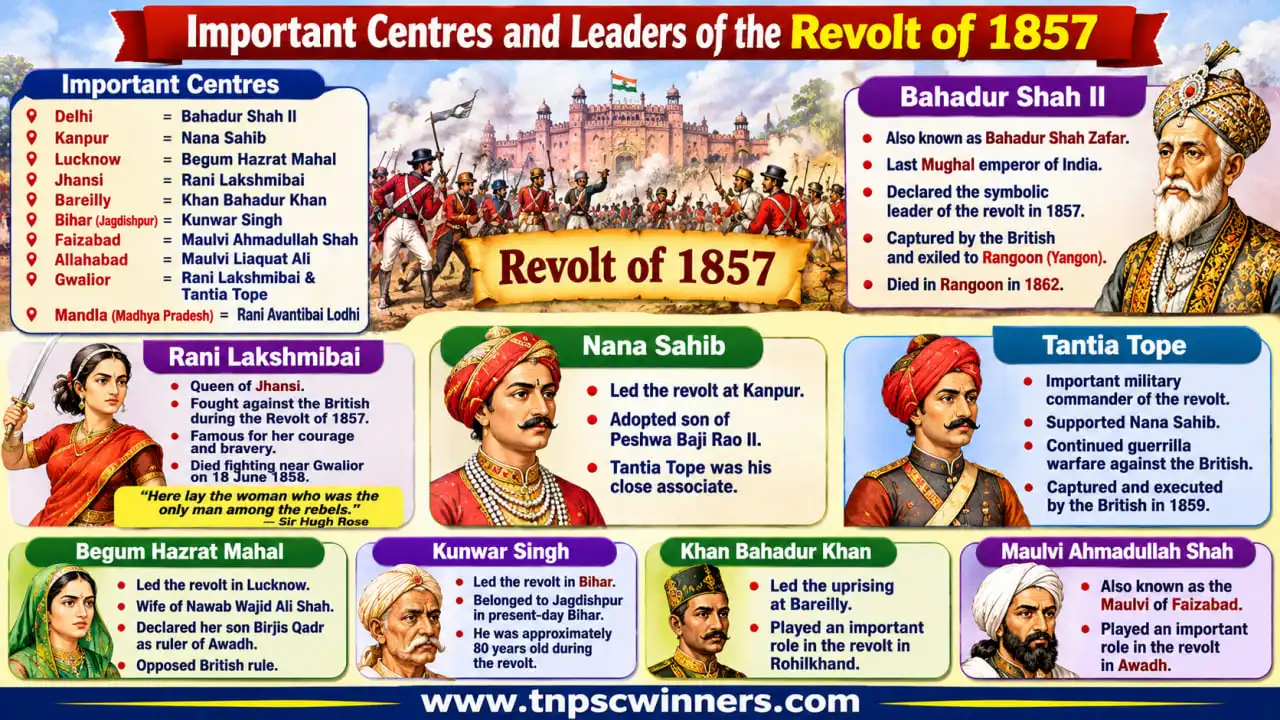
Important Leaders
Bahadur Shah II
- Also known as Bahadur Shah Zafar.
- Last Mughal emperor of India.
- Declared the symbolic leader of the revolt in 1857.
- Captured by the British and exiled to Rangoon (Yangon).
- Died in Rangoon in 1862.
- Great Revolt of 1857
Rani Lakshmibai
- Queen of Jhansi.
- Fought against the British during the Revolt of 1857.
- Famous for her courage and bravery.
- Died fighting near Gwalior on 18 June 1858.
- “Here lay the woman who was the only man among the rebels.” — Sir Hugh Rose, paying tribute to Rani Lakshmibai of Jhansi after the Battle of Gwalior (June 1858).
Nana Sahib
- Led the revolt at Kanpur.
- Adopted son of Peshwa Baji Rao II.
- Tantia Tope was his close associate.
- Great Revolt of 1857
Tantia Tope
- Important military commander of the revolt.
- Supported Nana Sahib.
- Continued guerrilla warfare against the British.
- Captured and executed by the British in 1859.
- Great Revolt of 1857
Begum Hazrat Mahal
- Led the revolt in Lucknow.
- Wife of Nawab Wajid Ali Shah.
- Declared her son Birjis Qadr as ruler of Awadh.
- Opposed British rule.
Kunwar Singh
- Led the revolt in Bihar.
- Belonged to Jagdishpur in present-day Bihar.
- He was approximately 80 years old during the revolt.
Khan Bahadur Khan
- Led the uprising at Bareilly.
- Played an important role in the revolt in Rohilkhand.
Maulvi Ahmadullah Shah
- Also known as the Maulvi of Faizabad.
- Played an important role in the revolt in Awadh.
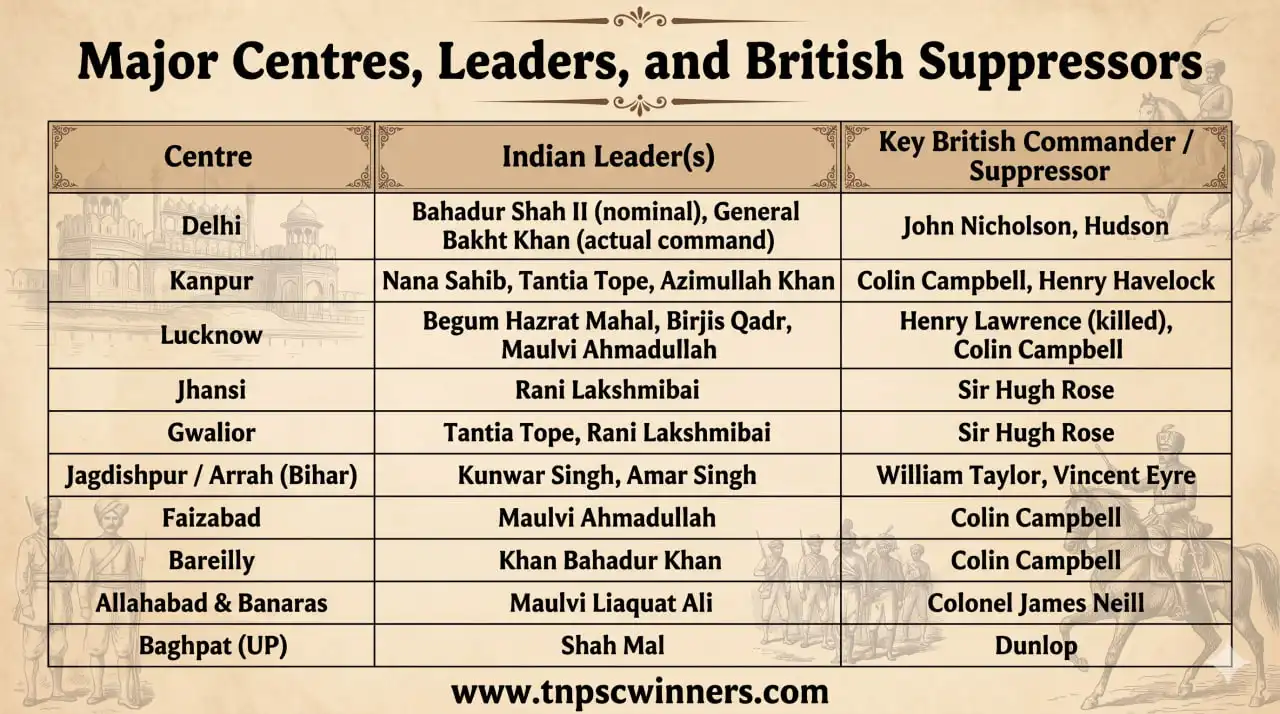
Important British Officers Who Suppressed the Revolt
- General John Nicholson = Recaptured Delhi
- Sir Colin Campbell = Suppressed the revolt in Lucknow
- Sir Hugh Rose = Captured Jhansi and defeated rebel forces
- Henry Havelock = Played a major role in the campaign at Kanpur and Lucknow
- Major William Hodson = Captured Bahadur Shah Zafar’s sons
- James Outram = Participated in the Lucknow campaign
- Great Revolt of 1857
Suppression of the Revolt of 1857
- September 1857 = Delhi was recaptured by British forces.
- Bahadur Shah Zafar was arrested and tried.
- March 1858 = Lucknow was recaptured by the British.
- April 1858 = Jhansi was captured by British forces under Sir Hugh Rose.
- June 1858 = Rani Lakshmibai died fighting near Gwalior.
- April 1859 = Tantia Tope was captured and executed.
- Great Revolt of 1857
Causes of the Failure of the Revolt
- Lack of centralised leadership.
- Absence of a common political objective.
- Lack of coordination among rebel leaders.
- Limited geographical spread, mainly in North and Central India.
- Lack of modern weapons and military resources.
- Many Indian rulers and princely states supported the British.
- Superior military organisation and resources of the British.
- Lack of support from important sections of Indian society.
- Absence of a well-organised national movement.
- Great Revolt of 1857
Consequences of the Revolt of 1857
- The revolt brought major changes in British administration in India.
End of East India Company Rule
- The British Parliament passed the Government of India Act, 1858.
- East India Company rule came to an end.
- India came directly under the British Crown.
- Great Revolt of 1857
Queen’s Proclamation – 1858
- Queen Victoria’s Proclamation was issued on 1 November 1858.
- Lord Canning became the first Viceroy of India.
- The British promised non-interference in religious matters.
- Indian princes were assured that their treaties and rights would be respected.
- The policy of territorial annexation was abandoned.
Changes in Administration
- The office of the Secretary of State for India was created.
- The Board of Control and Court of Directors were abolished.
- The Governor-General of India also became the Viceroy.
- The British Crown assumed direct control over Indian administration.
- Great Revolt of 1857
Military Reorganisation
- The proportion of European soldiers in the Indian army was increased.
- Artillery was largely kept under European control.
- The British followed a policy of recruiting soldiers from selected communities.
- The policy of divide and rule was strengthened.
Important Acts and Events Related to the Revolt
- Doctrine of Lapse = 1848 onwards = Annexation policy under Dalhousie
- General Service Enlistment Act = 1856 = Created resentment among sepoys
- Revolt of 1857 = 1857 = Major uprising against British rule
- Government of India Act = 1858 = Ended East India Company rule
- Queen’s Proclamation = 1858 = Direct Crown rule began
- Indian Councils Act = 1861 = Introduced changes in legislative administration
Important Books Related to the Revolt of 1857
- The Indian War of Independence, 1857 = V.D. Savarkar
- The Sepoy Mutiny and the Revolt of 1857 = R.C. Majumdar
- The Indian Mutiny of 1857 = G.B. Malleson
- The Indian Mutiny = Sir John Kaye
- History of the Indian Mutiny of 1857–58 = G.B. Malleson and John Kaye
Important exam points
- D. Savarkar published The Indian War of Independence, 1857 in 1909.
- British historians commonly described the uprising as the Sepoy Mutiny.
- C. Majumdar questioned the description of the revolt as the First War of Indian Independence.
- Great Revolt of 1857
Important One-Liners for TNPSC Examinations
- The Revolt of 1857 began at – Meerut.
- Date of the outbreak of the revolt – 10 May 1857.
- Immediate cause of the revolt – Greased cartridges of the Enfield rifle.
- The revolt first started among soldiers at – Meerut.
- Mangal Pandey revolted at – Barrackpore.
- Mangal Pandey was executed on – 8 April 1857.
- Symbolic leader of the revolt – Bahadur Shah II.
- Last Mughal emperor – Bahadur Shah Zafar.
- Revolt at Kanpur was led by – Nana Sahib.
- Revolt at Jhansi was led by – Rani Lakshmibai.
- Revolt at Lucknow was led by – Begum Hazrat Mahal.
- Revolt at Bareilly was led by – Khan Bahadur Khan.
- Revolt in Bihar was led by – Kunwar Singh.
- Close associate of Nana Sahib – Tantia Tope.
- British officer who recaptured Delhi – John Nicholson.
- British commander associated with the capture of Jhansi – Sir Hugh Rose.
- British commander who recaptured Lucknow – Sir Colin Campbell.
- Doctrine of Lapse was introduced by – Lord Dalhousie.
- Awadh was annexed in – 1856.
- The Revolt of 1857 ended the rule of – East India Company.
- Government of India Act was passed in – 1858.
- First Viceroy of India – Lord Canning.
- Queen Victoria’s Proclamation was issued on – 1 November 1858.
- Bahadur Shah Zafar was exiled to – Rangoon (Yangon).
- Tantia Tope was executed in – 1859.
- Rani Lakshmibai died on – 18 June 1858.
- Book The Indian War of Independence, 1857 was written by – V.D. Savarkar.
- The revolt was also known as – Sepoy Mutiny.
- The first major uprising against British rule in India – The Revolt of 1857.
- The Revolt of 1857 resulted in direct rule by – The British Crown.
- The book The Indian War of Independence, 1857 was written by – V.D. Savarkar.
- Who described the Revolt of 1857 as the First War of Indian Independence? – V.D. Savarkar.
- Who rejected the description of 1857 as the First War of Indian Independence? – R.C. Majumdar.
- Who wrote Eighteen Fifty-Seven? – S.N. Sen.
- Who wrote The Sepoy Mutiny and the Revolt of 1857? – R.C. Majumdar.
- Who wrote The Indian Mutiny of 1857? – G.B. Malleson.
- Who emphasised the importance of rural society in understanding the revolt? – Eric Stokes.
- Who viewed the revolt in the context of British colonial exploitation? – Karl Marx.
- Great Revolt of 1857
Important Special Names and Titles
- Mangal Pandey = Forerunner of the Revolt of 1857
- Rani Lakshmibai = Heroine of the Revolt of 1857
- Bahadur Shah Zafar = Last Mughal Emperor
- Tantia Tope = Great military commander of the revolt
- Nana Sahib = Leader of the Kanpur revolt
- Kunwar Singh = Hero of the Bihar revolt
- Begum Hazrat Mahal = Heroine of the Lucknow revolt
Revolt of 1857 – Timeline
- 29 March 1857 = Mangal Pandey’s uprising at Barrackpore.
- 8 April 1857 = Execution of Mangal Pandey.
- 10 May 1857 = Revolt began at Meerut.
- 11 May 1857 = Rebels entered Delhi.
- September 1857 = British recaptured Delhi.
- March 1858 = British recaptured Lucknow.
- April 1858 = British captured Jhansi.
- 18 June 1858 = Death of Rani Lakshmibai.
- 1 November 1858 = Queen Victoria’s Proclamation.
- 1859 = Execution of Tantia Tope.
- Great Revolt of 1857
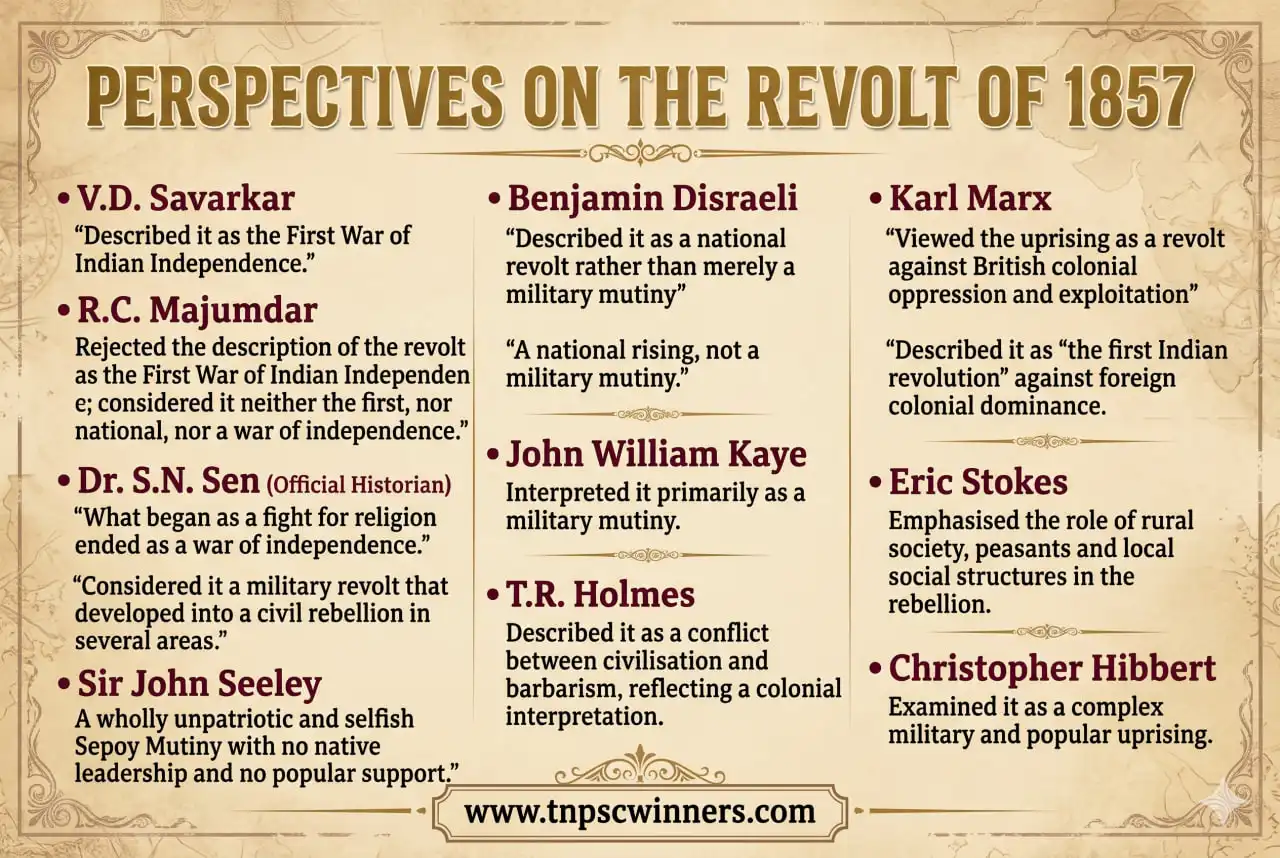
Important Historians and Their Views
- D. Savarkar = Described it as the First War of Indian Independence.
- C. Majumdar = Rejected the description of the revolt as the First War of Indian Independence; considered it neither the first, nor national, nor a war of independence.
- S.N. Sen (Official Historian) = “What began as a fight for religion ended as a war of independence.”
- S.N. Sen (Official Historian) = Considered it a military revolt that developed into a civil rebellion in several areas.
- Sir John Seeley = “A wholly unpatriotic and selfish Sepoy Mutiny with no native leadership and no popular support.”
- Benjamin Disraeli = Described it as a national revolt rather than merely a military mutiny.
- Benjamin Disraeli = “A national rising, not a military mutiny.”
- John William Kaye = Interpreted it primarily as a military mutiny.
- R. Holmes = Described it as a conflict between civilisation and barbarism, reflecting a colonial interpretation.
- Karl Marx = Viewed the uprising as a revolt against British colonial oppression and exploitation.
- Karl Marx = Described it as “the first Indian revolution” against foreign colonial dominance.
- Eric Stokes = Emphasised the role of rural society, peasants and local social structures in the rebellion.
- Christopher Hibbert = Examined it as a complex military and popular uprising.
- Great Revolt of 1857