
World Jellyfish Day 2026
Discover the history, significance, importance and fascinating facts about World Jellyfish Day 2026, observed to celebrate marine biodiversity.
World Jellyfish Day 2026
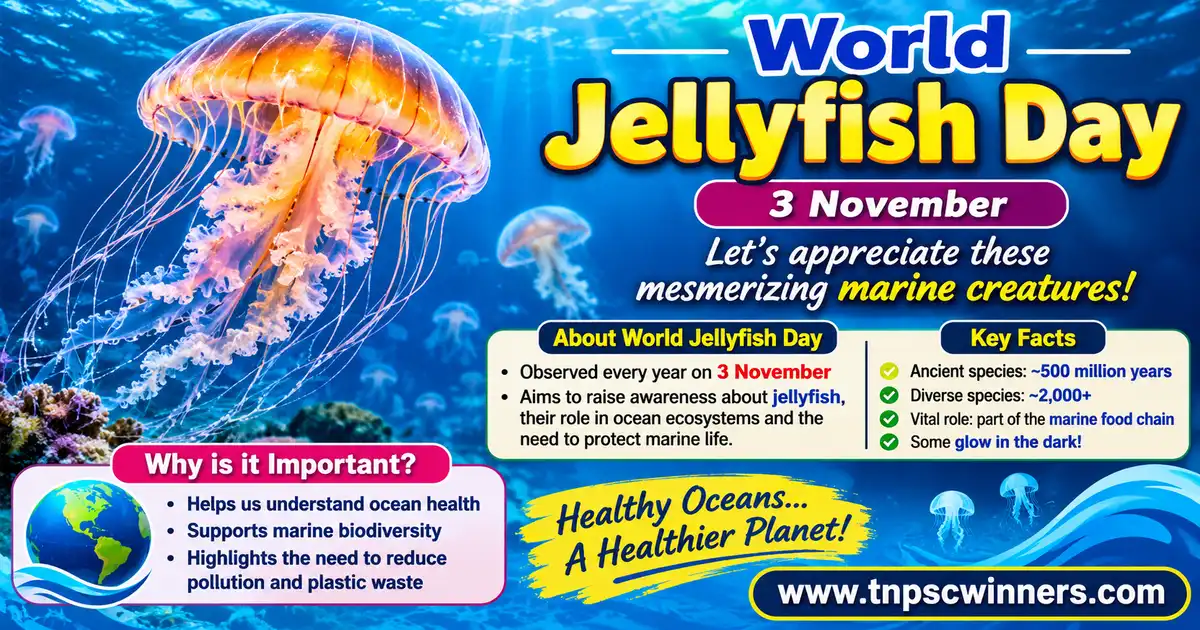
- World Jellyfish Day is observed annually on November 3 to raise global awareness about the evolutionary importance, ecological role, and conservation significance of jellyfish in marine ecosystems.
JOIN OUR TELEGRAM CHANNEL – T.ME/TNPSC_WINNERS

World Jellyfish Day – Introduction
- World Jellyfish Day is observed every year on November 3.
- The day celebrates jellyfish and highlights their importance in marine ecosystems.
- It aims to create awareness about jellyfish diversity, their ecological role and marine conservation.
- It also helps dispel common misconceptions about these fascinating marine organisms.
- The observance has been marked on November 3 since 2014.
- World Jellyfish Day 2026
What are Jellyfish?
- Jellyfish are aquatic, invertebrate animals belonging to the phylum Cnidaria.
- Despite their name, jellyfish are not fish.
- They are mainly found in marine environments across the world’s oceans.
- Their bodies are soft, gelatinous and umbrella-shaped.
- Their bodies consist of approximately 95% water.
- They have tentacles containing specialised stinging cells called cnidocytes.
- World Jellyfish Day 2026
Important Characteristics of Jellyfish
- Kingdom = Animalia
- Phylum = Cnidaria
- Habitat = Mainly marine
- Body = Soft, gelatinous body
- Symmetry = Radial symmetry
- Body composition = Approximately 95% water
- Nervous system = Diffuse nerve net
- Brain = Absent
- Heart = Absent
- Bones = Absent
- Respiration = Gas exchange through body surface
- Movement = Bell contraction and relaxation
- Special cells = Cnidocytes
- Feeding structures = Tentacles
Important Parts of a Jellyfish
- Bell = Umbrella-shaped upper part of the body.
- Tentacles = Used to capture prey and provide defence.
- Cnidocytes = Specialised stinging cells.
- Oral arms = Help transfer food towards the mouth.
- Gastrovascular cavity = Helps in digestion and distribution of nutrients.
- World Jellyfish Day 2026
Life Cycle of Jellyfish
- Planula = Free-swimming larval stage
- Polyp = Attached, cylindrical stage
- Strobila = Polyp undergoing segmentation
- Ephyra = Young jellyfish stage
- Medusa = Adult, free-swimming jellyfish
Ecological Importance of Jellyfish
- Marine food chain = They serve as both predators and prey.
- Food source = They are eaten by sea turtles, ocean sunfish and certain fish.
- Population control = They feed on plankton, fish eggs and small marine organisms.
- Nutrient cycling = Their decomposition contributes to nutrient transfer in marine ecosystems.
- Marine biodiversity = They form an important component of ocean ecosystems.
- Scientific research = Jellyfish are useful in studies of bioluminescence and regenerative biology.
Important Types of Jellyfish
- Moon Jellyfish = Scientific name: Aurelia aurita
- Box Jellyfish = Known for its highly dangerous venom
- Lion’s Mane Jellyfish = One of the largest known jellyfish
- Immortal Jellyfish = Scientific name: Turritopsis dohrnii
- Portuguese Man-of-War = Not a true jellyfish; a siphonophore
- Blue Button = Scientific name: Porpita porpita
- World Jellyfish Day 2026
Interesting Facts About Jellyfish
- Jellyfish have existed for more than 500 million years.
- They appeared long before dinosaurs.
- Jellyfish do not have a brain, heart, bones or blood.
- Some jellyfish species can produce light through bioluminescence.
- The immortal jellyfish (Turritopsis dohrnii) can revert from its adult medusa stage to its polyp stage under certain conditions.
- A large aggregation of jellyfish is commonly called a bloom or swarm.
- Jellyfish are found in all five oceans.
- Some jellyfish can continue to sting even after death.
World Jellyfish Day – Important Facts for TNPSC
- World Jellyfish Day = November 3
- First observed/listed = 2014
- Jellyfish belong to which phylum? = Cnidaria
- Are jellyfish fish? = No
- Body composition = Approximately 95% water
- Special stinging cells = Cnidocytes
- Adult body form = Medusa
- Larval stage = Planula
- Attached stage = Polyp
- Immortal jellyfish = Turritopsis dohrnii
- Moon jellyfish = Aurelia aurita
- Largest well-known jellyfish = Lion’s Mane Jellyfish
- Dangerous jellyfish = Box Jellyfish
- Main habitat = Marine environment
- World Jellyfish Day 2026
Important One-Liners for Competitive Examinations
- World Jellyfish Day – November 3.
- Jellyfish belong to the phylum – Cnidaria.
- Jellyfish are – Invertebrates.
- Jellyfish are not true fish.
- Stinging cells of jellyfish – Cnidocytes.
- Adult jellyfish body form – Medusa.
- Free-swimming larval stage – Planula.
- Attached body form – Polyp.
- Immortal jellyfish – Turritopsis dohrnii.
- Moon jellyfish – Aurelia aurita.
- Jellyfish are composed of approximately – 95% water.
- Study of jellyfish falls under marine biology and zoology.
- World Jellyfish Day 2026