
International Day for Biosphere Reserves 2026
Learn about International Day for Biosphere Reserves 2026, its significance, objectives, UNESCO role and importance of conserving biodiversity and ecosystems.
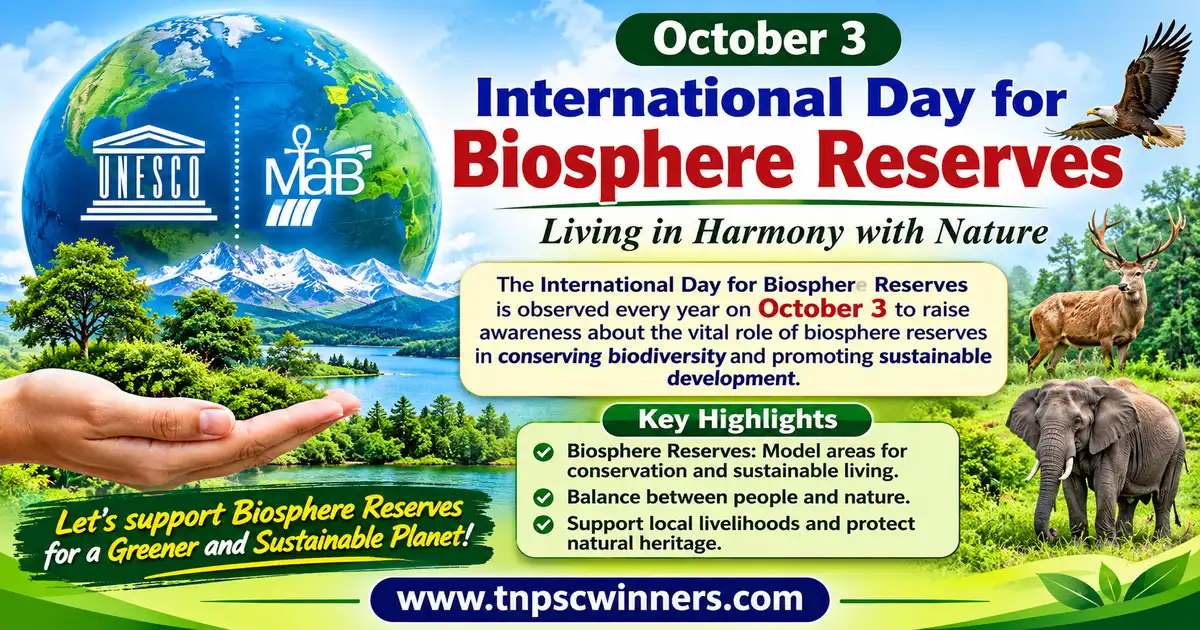
International Day for Biosphere Reserves 2026
- The International Day for Biosphere Reserves is observed globally on November 3 every year. Proclaimed by UNESCO during its 41st General Conference in 2021 (Resolution 41 C/37), it was first observed in 2022 to mark the conclusion of the 50th anniversary of the Man and the Biosphere (MAB) Programme.
JOIN OUR TELEGRAM CHANNEL – T.ME/TNPSC_WINNERS

International Day for Biosphere Reserves – Introduction
- International Day for Biosphere Reserves is observed every year on November 3.
- It aims to create awareness about the importance of biosphere reserves in biodiversity conservation and sustainable development.
- The day highlights the need to maintain a balance between human activities and the conservation of natural resources.
- It promotes harmonious coexistence between humans and nature.
- International Day for Biosphere Reserves 2026
International Day for Biosphere Reserves – Important Facts
- Observance = November 3
- Proclaimed by = UNESCO
- Proclaimed in = 2021
- UNESCO session = 41st General Conference
- First observed = November 3, 2022
- Related programme = Man and the Biosphere (MAB) Programme
- Main objective = Biodiversity conservation and sustainable development
- Global network = World Network of Biosphere Reserves (WNBR)
- The first International Day for Biosphere Reserves was celebrated on November 3, 2022.
What is a Biosphere Reserve?
- A biosphere reserve is a designated area that protects biodiversity while promoting the sustainable use of natural resources.
- It helps conserve plants, animals, ecosystems and genetic diversity.
- It also supports the livelihoods of local communities.
- Biosphere reserves are considered living laboratories for sustainable development.
- International Day for Biosphere Reserves 2026
Three Main Functions of Biosphere Reserves
- Conservation Function = Protects biodiversity, genetic resources, ecosystems, landscapes and cultural diversity.
- Development Function = Promotes environmentally sustainable economic and social development for local communities.
- Logistic Support Function = Supports scientific research, environmental monitoring, education, training and knowledge exchange.
Zonation of a Biosphere Reserve
- Core Zone = Strictly protected area; conservation of ecosystems and biodiversity
- Buffer Zone = Surrounds or adjoins the core zone; research, education and activities compatible with conservation
- Transition Zone = Outer area where local communities undertake sustainable economic and social activities
- International Day for Biosphere Reserves 2026
UNESCO Man and the Biosphere (MAB) Programme
- Launched in 1971 by UNESCO.
- MAB stands for Man and the Biosphere Programme.
- It is an intergovernmental scientific programme.
- Its main objective is to improve the relationship between people and their environment.
- It promotes sustainable development through scientific research and biodiversity conservation.
- Biosphere reserves are important components of this programme.
Important years
- 1971 = UNESCO launched the MAB Programme
- 1976 = World Network of Biosphere Reserves established
- 2021 = UNESCO proclaimed November 3 as International Day for Biosphere Reserves
- 2022 = First International Day celebrated
Biosphere Reserves in India
- India has 18 notified Biosphere Reserves.
- Out of these, 13 are recognised under UNESCO’s World Network of Biosphere Reserves (as of November 2026).
- They cover different ecosystems, including forests, mountains, deserts, coastal regions and islands.
- International Day for Biosphere Reserves 2026
13 UNESCO-Recognised Biosphere Reserves in India
- Nilgiri
- Gulf of Mannar
- Sundarbans
- Nanda Devi
- Nokrek
- Pachmarhi
- Similipal
- Achanakmar-Amarkantak
- Great Nicobar
- Agasthyamalai
- Khangchendzonga
- Panna
- Cold Desert
Important Biosphere Reserves – Special Facts
- Nilgiri = First Biosphere Reserve in India (1986)
- Gulf of Mannar = First Marine Biosphere Reserve in India
- Great Nicobar = Island ecosystem
- Sundarbans = Mangrove ecosystem
- Nanda Devi = Himalayan ecosystem
- Nokrek = Meghalaya
- Khangchendzonga = Sikkim
- Panna = Madhya Pradesh
- Cold Desert = Himachal Pradesh
Important Facts for Tamil Nadu
- Tamil Nadu is associated with three UNESCO-recognised Biosphere Reserves
- International Day for Biosphere Reserves 2026
Nilgiri Biosphere Reserve
- Established in 1986.
- India’s first Biosphere Reserve.
- Spreads across Tamil Nadu, Kerala and Karnataka.
Gulf of Mannar Biosphere Reserve
- Established in 1989.
- Located along the Tamil Nadu coast.
- Known for coral reefs, seagrass beds and marine biodiversity.
Agasthyamalai Biosphere Reserve
- Established in 2001.
- Spreads across Tamil Nadu and Kerala.
- Located in the southern Western Ghats.
Importance of Biosphere Reserves
- Protect endangered species and natural habitats.
- Conserve genetic diversity.
- Promote sustainable agriculture and eco-tourism.
- Support climate change mitigation and adaptation.
- Protect traditional knowledge and cultural diversity.
- Encourage scientific research and environmental education.
- Improve the livelihoods of indigenous and local communities.
- International Day for Biosphere Reserves 2026
Important One-Liners for TNPSC
- International Day for Biosphere Reserves – November 3.
- First International Day for Biosphere Reserves – 2022.
- International Day for Biosphere Reserves was proclaimed by – UNESCO.
- UNESCO General Conference session – 41st Session (2021).
- Man and the Biosphere Programme was launched in – 1971.
- MAB Programme was launched by – UNESCO.
- World Network of Biosphere Reserves was established in – 1976.
- First Biosphere Reserve in India – Nilgiri (1986).
- First Marine Biosphere Reserve in India – Gulf of Mannar.
- Number of Biosphere Reserves in India – 18.
- UNESCO-recognised Biosphere Reserves in India – 13.
- Biosphere Reserves have three zones – Core, Buffer and Transition.
- Biosphere Reserves are considered – Living laboratories for sustainable development.
- Nilgiri Biosphere Reserve covers – Tamil Nadu, Kerala and Karnataka.
- Gulf of Mannar Biosphere Reserve is located in – Tamil Nadu.