
International One Health Day 2026
Learn about International One Health Day 2026, its theme, importance, objectives, and the link between human, animal and environmental health.
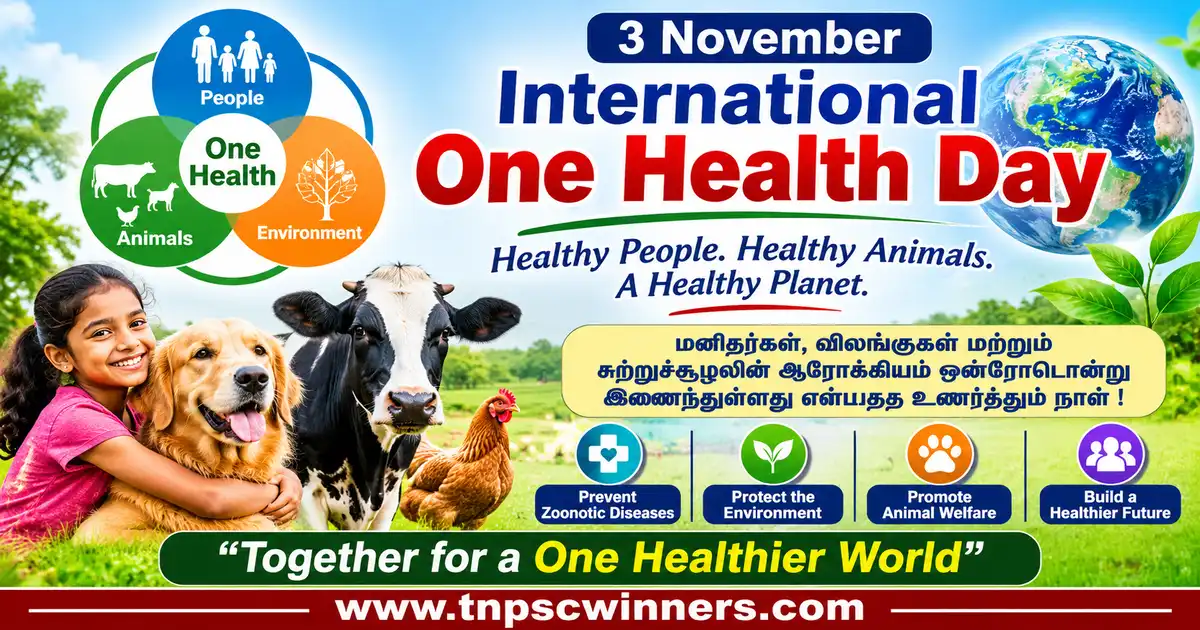
International One Health Day 2026
- International One Health Day is observed annually on November 3 to raise global awareness of the interconnectedness of human health, animal health, and environmental ecosystems
JOIN OUR TELEGRAM CHANNEL – T.ME/TNPSC_WINNERS

International One Health Day – Important Facts
- International One Health Day is observed every year on November 3.
- It promotes the concept of One Health, which recognises the close relationship between human health, animal health and environmental health.
- It encourages cooperation among doctors, veterinarians, environmental scientists and other professionals.
- The main objective is to protect the health of humans, animals, plants and ecosystems through a coordinated approach.
- International One Health Day 2026
What is One Health?
- One Health is an integrated and unifying approach that aims to sustainably balance and optimise the health of people, animals and ecosystems.
- It recognises that the health of humans, domestic animals, wildlife, plants and the environment is interconnected.
- It requires collaboration across multiple disciplines and sectors.
Three Major Components of One Health
- Three Major Components of One Health are = Human Health, Animal Health and Environmental Health.
Human Health
- Prevention of infectious diseases.
- Improvement of public health.
- Prevention of zoonotic diseases.
Animal Health
- Prevention of animal diseases.
- Protection of livestock and wildlife.
- Control of diseases transmitted from animals to humans.
- International One Health Day 2026
Environmental Health
- Protection of biodiversity.
- Prevention of environmental pollution.
- Conservation of ecosystems.
Major Objectives of One Health
- Prevent and control zoonotic diseases.
- Combat antimicrobial resistance (AMR).
- Improve food safety and food security.
- Prevent future pandemics.
- Protect biodiversity and ecosystems.
- Promote sustainable agriculture.
- Control vector-borne diseases.
- Strengthen global disease surveillance and early-warning systems.
- Address the health impacts of climate change.
- Encourage international cooperation in public health.
- International One Health Day 2026
Major Diseases and Issues Addressed by One Health
- Rabies = Transmitted from infected animals to humans
- Bird Flu (Avian Influenza) = Infectious disease affecting birds and sometimes humans
- Swine Flu = Influenza virus associated with pigs
- Ebola = Zoonotic infectious disease
- Nipah Virus = Zoonotic disease associated with animal-to-human transmission
- COVID-19 = Highlighted the importance of coordinated health preparedness
- Antimicrobial Resistance = Resistance to medicines used to treat infections
- Dengue = Vector-borne disease influenced by environmental conditions.
Quadripartite Collaboration – Important for Exams
- Four international organisations jointly promote the One Health approach.
- FAO = Food and Agriculture Organization of the United Nations
- UNEP = United Nations Environment Programme
- WHO = World Health Organization
- WOAH = World Organisation for Animal Health
- International One Health Day 2026
Important facts
- The Quadripartite collaboration was established in March 2022.
- It expanded the earlier Tripartite collaboration of FAO, WHO and WOAH.
- Its main objective is to strengthen cooperation in human, animal, plant and environmental health.
- The four organisations renewed their Memorandum of Understanding in February 2026.
One Health High-Level Expert Panel (OHHLEP)
- Full form = One Health High-Level Expert Panel.
- Established in 2021.
- It provides scientific and strategic advice on the One Health approach.
- It developed the widely recognised One Health definition in 2021.
- It supports the Quadripartite organisations.
One Health Joint Plan of Action (2022–2026)
- Developed by the Quadripartite organisations.
- Aims to strengthen cooperation across human, animal, plant and environmental health.
- Focuses on preventing health threats and promoting sustainable health systems.
- Addresses zoonotic diseases, antimicrobial resistance, food safety and environmental health.
- International One Health Day 2026
Important Facts for TNPSC – Quick Revision
- International One Health Day = November 3
- First observed = 2016
- Main concept = One Health
- One Health connects = Humans, animals and environment
- Three founding organisers = One Health Commission, One Health Initiative Team and One Health Platform Foundation
- One Health definition developed by = OHHLEP
- OHHLEP established = 2021
- Quadripartite collaboration established = March 2022
- Number of organisations in Quadripartite = Four
- FAO headquarters = Rome, Italy
- UNEP headquarters = Nairobi, Kenya
- WHO headquarters = Geneva, Switzerland
- WOAH headquarters = Paris, France
- Main focus = Zoonotic diseases, AMR and environmental health
Important One-Liners for Competitive Examinations
- International One Health Day is observed on November 3.
- The first International One Health Day was celebrated in 2016.
- One Health integrates human, animal and environmental health.
- The One Health approach recognises the interdependence of humans, animals, plants and ecosystems.
- OHHLEP stands for One Health High-Level Expert Panel.
- FAO, UNEP, WHO and WOAH form the Quadripartite collaboration.
- The Quadripartite collaboration was established in 2022.
- Antimicrobial resistance is one of the major challenges addressed by One Health.
- Rabies is an important example of a zoonotic disease.
- One Health promotes multidisciplinary and multisectoral cooperation.
- International One Health Day 2026