
Journal Development in Modern India
Explore the Journal Development in modern India, including important newspapers, founders, editors, and their contributions to the freedom movement.
Journal Development in Modern India
Explore the development of journalism in modern India, including the origin of newspapers, major journals, editors, and their role in the freedom movement.
Journal Development in Modern India
The development of journalism in India began during British rule. Newspapers played an important role in spreading political awareness, social reforms and national consciousness. Indian journalism became a powerful instrument in the freedom struggle. Both English and regional-language newspapers contributed to the growth of nationalism.
Journal Development in Modern India
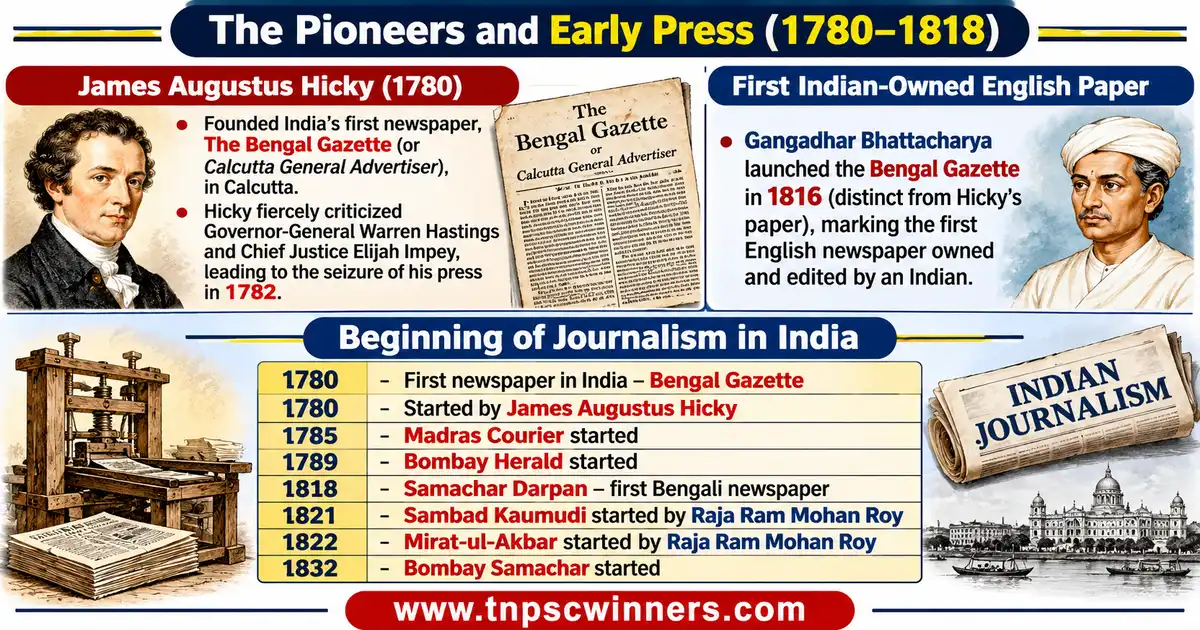
The Pioneers and Early Press (1780–1818)
James Augustus Hicky (1780)
- Founded India’s first newspaper, The Bengal Gazette (or Calcutta General Advertiser), in Calcutta.
- Hicky fiercely criticized Governor-General Warren Hastings and Chief Justice Elijah Impey, leading to the seizure of his press in 1782.
Early Anglo-Indian Press
- Following Hicky, several English-language papers emerged in Calcutta, Madras, and Bombay—including the Calcutta Gazette (1784), The Madras Courier (1785), and The Bombay Herald (1789)—mostly catering to British officials and merchants.
- Journal Development in Modern India
JOIN OUR TELEGRAM CHANNEL – T.ME/TNPSC_WINNERS

First Indian-Owned English Paper
- Gangadhar Bhattacharya launched the Bengal Gazette in 1816 (distinct from Hicky’s paper), marking the first English newspaper owned and edited by an Indian.
Beginning of Journalism in India
- 1780 = First newspaper in India – Bengal Gazette
- 1780 = Started by James Augustus Hicky
- 1785 = Madras Courier started
- 1789 = Bombay Herald started
- 1818 = Samachar Darpan – first Bengali newspaper
- 1821 = Sambad Kaumudi started by Raja Ram Mohan Roy
- 1822 = Mirat-ul-Akbar started by Raja Ram Mohan Roy
- 1832 = Bombay Samachar started
- Journal Development in Modern India
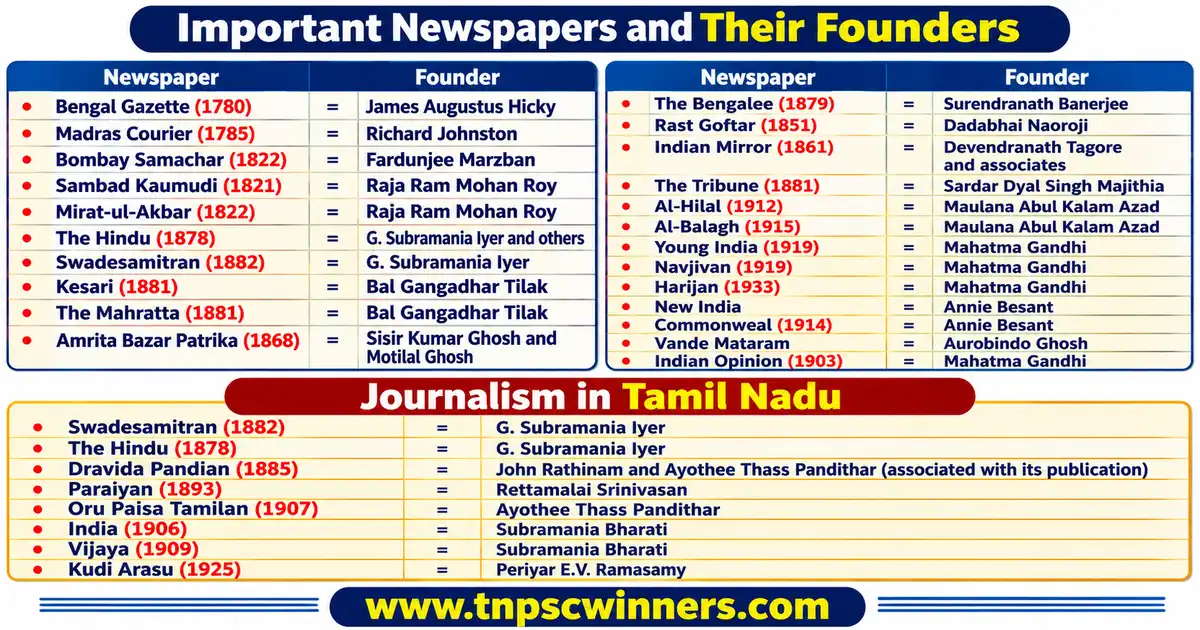
Important Newspapers & Their Founders
- Bengal Gazette (1780) = James Augustus Hicky
- Madras Courier (1785) = Richard Johnston
- Bombay Samachar (1822) = Fardunjee Marzban
- Sambad Kaumudi (1821) = Raja Ram Mohan Roy
- Mirat-ul-Akbar (1822) = Raja Ram Mohan Roy
- The Hindu (1878) = G. Subramania Iyer and others
- Swadesamitran (1882) = G. Subramania Iyer
- Kesari (1881) = Bal Gangadhar Tilak
- The Mahratta (1881) = Bal Gangadhar Tilak
- Amrita Bazar Patrika (1868) = Sisir Kumar Ghosh and Motilal Ghosh
- The Bengalee (1879) = Surendranath Banerjee
- Rast Goftar (1851) = Dadabhai Naoroji
- Indian Mirror (1861) = Devendranath Tagore and associates
- The Tribune (1881) = Sardar Dyal Singh Majithia
- Al-Hilal (1912) = Maulana Abul Kalam Azad
- Al-Balagh (1915) = Maulana Abul Kalam Azad
- Young India (1919) = Mahatma Gandhi
- Navjivan (1919) = Mahatma Gandhi
- Harijan (1933) = Mahatma Gandhi
- New India = Annie Besant
- Commonweal (1914) = Annie Besant
- Vande Mataram = Aurobindo Ghosh
- Indian Opinion (1903) = Mahatma Gandhi
- Journal Development in Modern India
Journalism in Tamil Nadu
- Swadesamitran (1882) = G. Subramania Iyer
- The Hindu (1878) = G. Subramania Iyer
- Dravida Pandian (1885) = John Rathinam and Ayothee Thass Pandithar (associated with its publication)
- Paraiyan (1893) = Rettamalai Srinivasan
- Oru Paisa Tamilan (1907) = Ayothee Thass Pandithar
- India (1906) = Subramania Bharati
- Vijaya (1909) = Subramania Bharati
- Kudi Arasu (1925) = Periyar E.V. Ramasamy
- Journal Development in Modern India
Important Contributions of Indian Journalists
Raja Ram Mohan Roy
- Published Sambad Kaumudi in Bengali.
- Published Mirat-ul-Akbar in Persian.
- Used journalism to promote social and religious reforms.
- Opposed social evils such as Sati.
- Journal Development in Modern India
Bal Gangadhar Tilak
- Started Kesari in Marathi.
- Started The Mahratta in English.
- Used newspapers to promote nationalism and oppose British rule.
Mahatma Gandhi
- Published Indian Opinion in South Africa.
- Published Young India, Navjivan and Harijan.
- Used journalism to promote truth, non-violence and social reform.
Subramania Bharati
- Worked as a journalist and editor.
- Associated with India and Vijaya.
- Promoted patriotism, women’s emancipation and social equality.
- Journal Development in Modern India
Annie Besant
- Published New India and Commonweal.
- Used journalism to promote Home Rule.
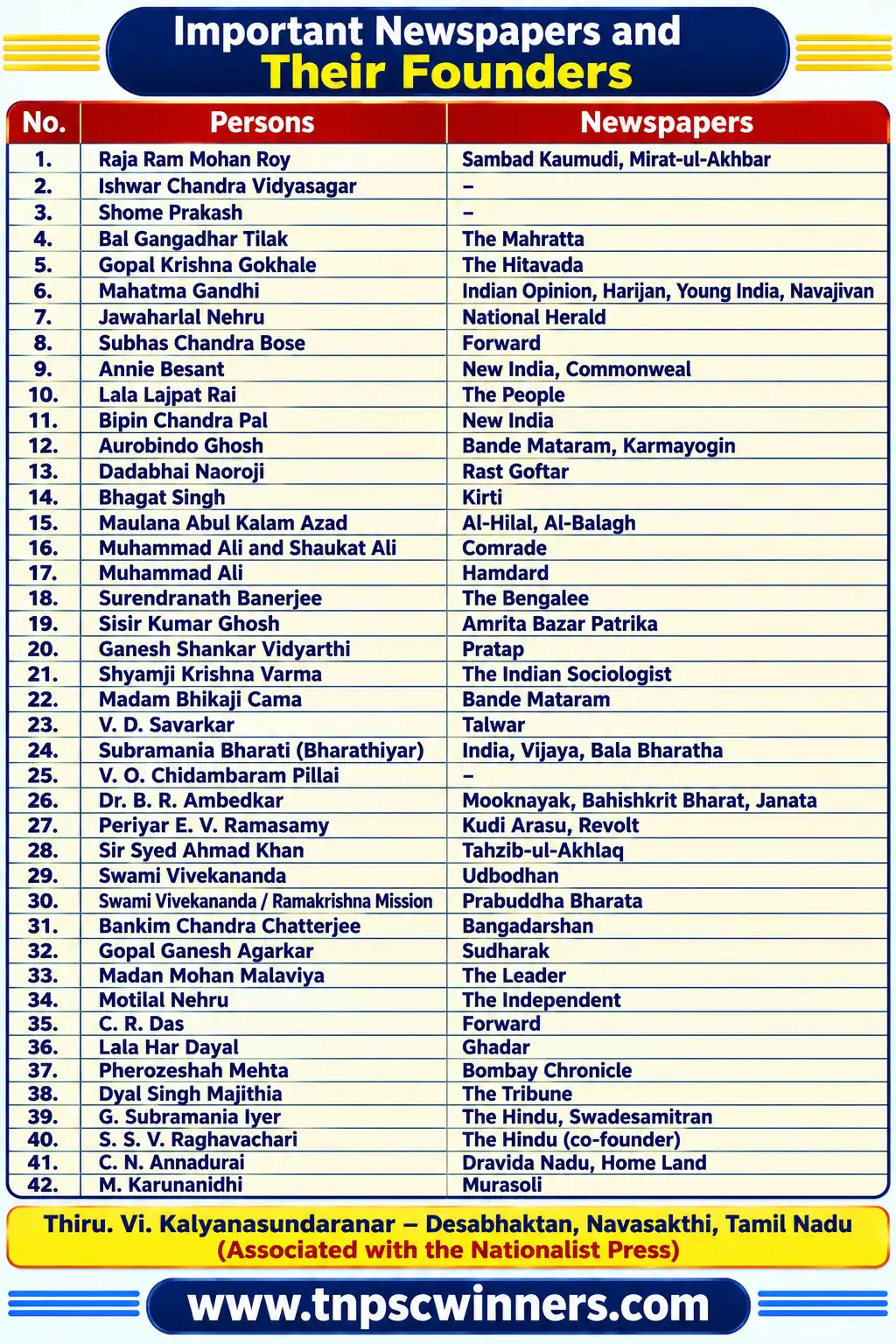
Indian freedom fighters and their newspapers
|
Persons |
Newspapers |
| Raja Ram Mohan Roy | Sambad Kaumudi, Mirat-ul-Akhbar |
| Ishwar Chandra Vidyasagar | Shome Prakash |
| Bal Gangadhar Tilak | The Mahratta |
| Gopal Krishna Gokhale | The Hitavada |
| Mahatma Gandhi | Indian Opinion, Harijan, Young India, Navajivan |
| Jawaharlal Nehru | National Herald |
| Subhas Chandra Bose | Forward |
| Annie Besant | New India, Commonweal |
| Lala Lajpat Rai | The People |
| Bipin Chandra Pal | New India |
| Aurobindo Ghosh | Bande Mataram, Karmayogin |
| Dadabhai Naoroji | Rast Goftar |
| Bhagat Singh | Kirti |
| Maulana Abul Kalam Azad | Al-Hilal, Al-Balagh |
| Muhammad Ali and Shaukat Ali | Comrade |
| Muhammad Ali | Hamdard |
| Surendranath Banerjee | The Bengalee |
| Sisir Kumar Ghosh | Amrita Bazar Patrika |
| Ganesh Shankar Vidyarthi | Pratap |
| Shyamji Krishna Varma | The Indian Sociologist |
| Madam Bhikaji Cama | Bande Mataram |
| V. D. Savarkar | Talwar |
| Subramania Bharati (Bharathiyar) | India, Vijaya, Bala Bharatha |
| V. O. Chidambaram Pillai | Vivekabhanu |
| Dr. B. R. Ambedkar | Mooknayak, Bahishkrit Bharat, Janata |
| Periyar E. V. Ramasamy | Kudi Arasu, Revolt |
| Sir Syed Ahmad Khan | Tahzib-ul-Akhlaq |
| Swami Vivekananda | Udbodhan |
| Swami Vivekananda / Ramakrishna Mission | Prabuddha Bharata |
| Bankim Chandra Chatterjee | Bangadarshan |
| Gopal Ganesh Agarkar | Sudharak, Journal Development in Modern India |
| Madan Mohan Malaviya | The Leader |
| Motilal Nehru | The Independent |
| C. R. Das | Forward |
| Lala Har Dayal | Ghadar |
| Pherozeshah Mehta | Bombay Chronicle |
| Dyal Singh Majithia | The Tribune |
| G. Subramania Iyer | The Hindu, Swadesamitran |
| S. S. V. Raghavachari | The Hindu (co-founder) |
| C. N. Annadurai | Dravida Nadu, Home Land |
| M. Karunanidhi | Murasoli |
| Thiru. Vi. Kalyanasundaranar | Desabhaktan, Navasakthi, Tamil Nadu (associated with the nationalist press) |
First Newspapers in India – Important Facts
|
Category |
Newspaper | Year |
Founder / Publisher |
| First newspaper in India | Hicky’s Bengal Gazette | 1780 | James Augustus Hicky |
| First newspaper in an Indian language | Samachar Darpan (Bengali) | 1818 | Serampore Missionaries |
| First Hindi newspaper | Udant Martand | 1826 | Jugal Kishore Shukla |
| First Hindi daily newspaper | Samachar Sudha Varshan | 1854 | Shyam Sundar Sen |
| First Tamil newspaper / journal | Tamil Magazine | 1831 | Religious Tract Society |
Important Press Acts During British Rule
| Year | Act / Regulation | Significance |
| 1799 | Censorship of Press Act | Introduced by Lord Wellesley |
| 1823 | Licensing Regulations | Introduced restrictions on the press |
| 1835 | Metcalfe Act | Removed several licensing restrictions |
| 1857 | Licensing Act | Imposed restrictions during the Revolt of 1857 |
| 1867 | Press and Registration of Books Act | Regulated the registration of newspapers and printing presses |
| 1878 | Vernacular Press Act | Introduced by Lord Lytton to control Indian-language newspapers |
| 1882 | Repeal of Vernacular Press Act | Repealed by Lord Ripon |
| 1908 | Newspapers (Incitement to Offences) Act | Allowed action against publications encouraging offences |
| 1910 | Indian Press Act | Imposed security requirements and restrictions on newspapers |
| 1921-22 | Sapru Committee | Led to the repeal of the 1908 and 1910 |
| 1931 | Indian Press (Emergency Powers) Act | Increased government control over the press |
Important Facts for TNPSC
- First newspaper in India – Bengal Gazette (1780).
- Father of Indian Journalism = James Augustus Hicky
- Founder of Bengal Gazette – James Augustus Hicky.
- First Bengali newspaper – Samachar Darpan (1818).
- Father of Indian language journalism – Raja Ram Mohan Roy is often associated with its development.
- Kesari newspaper – Bal Gangadhar Tilak.
- Vernacular Press Act – 1878.
- Vernacular Press Act introduced by – Lord Lytton.
- Vernacular Press Act repealed by – Lord Ripon.
- The Hindu newspaper – 1878.
- Swadesamitran – 1882.
- Kudi Arasu – 1925.
- Indian Opinion – Mahatma Gandhi.
- Al-Hilal – Maulana Abul Kalam Azad.
- New India – Annie Besant.
- Paraiyan – Rettamalai Srinivasan.
- Journal Development in Modern India