
Major Wars and Battles of the Mughal Period
Learn about the major wars and battles of the Mughal period, including the First Battle of Panipat, Khanwa, Chanderi, Ghaghra, Haldighati and other important conflicts with dates, opponents and results.
Major Wars and Battles of the Mughal Period
he major wars and battles of the Mughal period, including the First Battle of Panipat, Khanwa, Chanderi, Ghaghra, Haldighati and other important conflicts with dates, opponents and results.
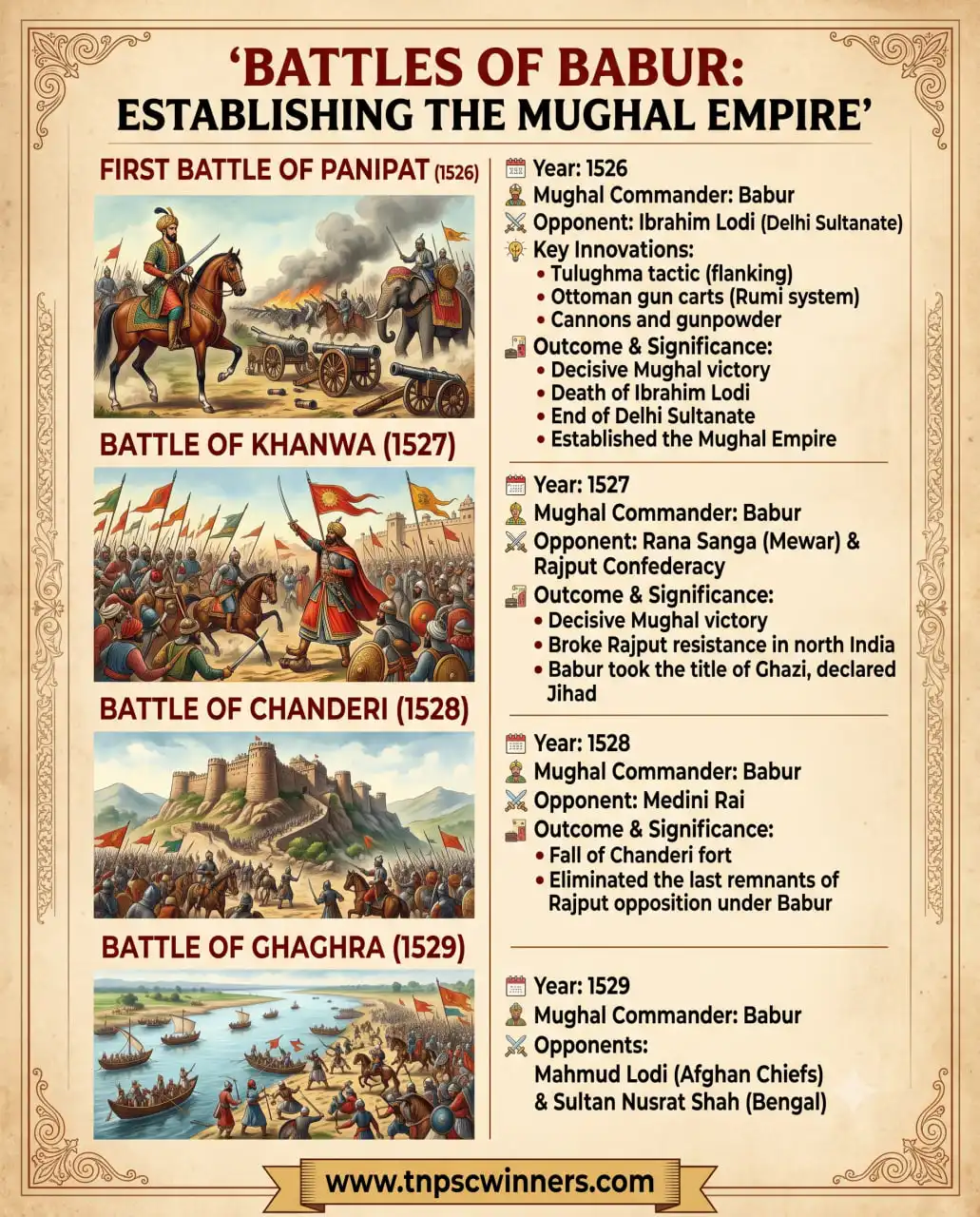
First Battle of Panipat
- Year = 1526
- Mughal Commander(s) = Babur
- Opponent(s) = Ibrahim Lodi
- Outcome & Significance = Defeat and death of Ibrahim Lodi; end of the Delhi Sultanate; established the Mughal Empire. Babur introduced the Tulughma tactic and Ottoman gun carts (Rumi system).
JOIN OUR TELEGRAM CHANNEL – T.ME/TNPSC_WINNERS

Battle of Khanwa
- Year = 1527
- Mughal Commander(s) = Babur
- Opponent(s) = Rana Sanga (Mewar) & Rajput Confederacy
- Outcome & Significance = Decisive Mughal victory; broke Rajput resistance in northern India. Babur took the title of Ghazi and declared Jihad.
Battle of Chanderi
- Year = 1528
- Mughal Commander(s) = Babur
- Opponent(s) = Medini Rai
- Outcome & Significance = Fall of Chanderi fort; eliminated the last remnants of Rajput opposition under Babur.
Battle of Ghaghra
- Year = 1529
- Mughal Commander(s) = Babur
- Opponent(s) = Mahmud Lodi & Sultan Nusrat Shah (Bengal)
- Outcome & Significance = Crushed joint Afghan-Bengali forces; secured Babur’s control over the Gangetic plains.
- Major Wars and Battles of the Mughal Period
Battle of Daurah
- Year = 1532
- Mughal Commander(s) = Humayun
- Opponent(s) = Mahmud Lodi
- Outcome & Significance = Humayun defeated the Afghan resurgence in eastern India.
- Major Wars and Battles of the Mughal Period
Battle of Chausa
- Year = 1539
- Mughal Commander(s) = Humayun
- Opponent(s) = Sher Shah Suri
- Outcome & Significance = Sher Shah ambushed and routed Humayun along the Ganges; Sher Shah assumed the imperial title Farid-ud-din Sher Shah.
Battle of Bilgram (Kannauj)
- Year = 1540
- Mughal Commander(s) = Humayun
- Opponent(s) = Sher Shah Suri
- Outcome & Significance = Complete defeat of Humayun; loss of Delhi and Agra; established the Sur Empire and forced Humayun into exile.
Battle of Machhiwara
- Year = 1555
- Mughal Commander(s) = Humayun, Bairam Khan
- Opponent(s) = Naseeb Khan & Tatar Khan (Afghans)
- Outcome & Significance = Opened the gateway to Punjab for the restoration of the Mughal Empire.
- Major Wars and Battles of the Mughal Period
Battle of Sirhind
- Year = 1555
- Mughal Commander(s) = Humayun, Bairam Khan
- Opponent(s) = Sikandar Shah Suri
- Outcome & Significance = Defeated the main Sur army; Humayun recaptured Delhi and Agra, formally ending the Sur rule.
Second Battle of Panipat
- Year = 1556
- Mughal Commander(s) = Akbar (under Bairam Khan)
- Opponent(s) = Hemu (Hemchandra Vikramaditya)
- Outcome & Significance = Hemu’s artillery captured and Hemu killed after an arrow struck his eye; eliminated the last major Afghan-Hindu threat to Delhi.
- Major Wars and Battles of the Mughal Period
Siege of Chittorgarh
- Year = 1567-68
- Mughal Commander(s) = Akbar
- Opponent(s) = Jaimal & Patta (Rana Udai Singh II)
- Outcome & Significance = Fall of Mewar’s premier hill fortress; legendary resistance leading to Jauhar and Saka; reinforced Mughal dominance in Rajputana.
- Major Wars and Battles of the Mughal Period
Battle of Tukaroi
- Year = 1575
- Mughal Commander(s) = Munim Khan
- Opponent(s) = Daud Khan Karrani (Sultan of Bengal)
- Outcome & Significance = Mughals defeated the Afghan Karrani Dynasty; annexed Bengal and parts of Bihar.
Battle of Haldighati
- Year = 1576
- Mughal Commander(s) = Man Singh I & Asaf Khan
- Opponent(s) = Maharana Pratap (Mewar) & Hakim Khan Sur
- Outcome & Significance = Inconclusive/tactical Mughal victory; Pratap escaped to the hills (Gogunda) to wage guerrilla warfare; Mughals failed to capture him.
Battle of Dewair
- Year = 1582
- Mughal Commander(s) = Mughal Forces
- Opponent(s) = Maharana Pratap (Mewar)
- Outcome & Significance = Maharana Pratap regained several territories.
Siege of Ahmednagar
- Year = 1600
- Mughal Commander(s) = Akbar & Prince Daniyal
- Opponent(s) = Chand Bibi (Nizam Shahi Regent)
- Outcome & Significance = Annexation of Berar and parts of Ahmednagar; marked initial expansion into the Deccan.
Mughal–Mewar Treaty (Campaign)
- Year = 1615
- Mughal Commander(s) = Prince Khurram (Shah Jahan)
- Opponent(s) = Rana Amar Singh I
- Outcome & Significance = Ended decades-long hostilities; Mewar accepted nominal Mughal suzerainty without sending princesses to the Mughal harem.
Deccan Settlement
- Year = 1636
- Mughal Commander(s) = Shah Jahan
- Opponent(s) = Adil Shahis (Bijapur) & Qutb Shahis (Golconda)
- Outcome & Significance = Forced Deccan Sultanates to accept Mughal tributary status and pay tribute.
Battle of Dharmat
- Year = 1658
- Mughal Commander(s) = Aurangzeb & Murad Baksh
- Opponent(s) = Jaswant Singh (Marwar) & Qasim Khan (for Dara Shikoh)
- Outcome & Significance = War of Succession; imperial forces loyal to Dara Shikoh routed.
Battle of Samugarh
- Year = 1658
- Mughal Commander(s) = Aurangzeb & Murad Baksh
- Opponent(s) = Dara Shikoh
- Outcome & Significance = Decisive battle for the throne; Dara Shikoh fled, paving the way for Aurangzeb to imprison Shah Jahan and crown himself.
Battle of Khajwa
- Year = 1659
- Mughal Commander(s) = Aurangzeb
- Opponent(s) = Shah Shuja
- Outcome & Significance = Defeat of Shah Shuja in eastern Uttar Pradesh; Shuja fled into Arakan (Burma).
- Major Wars and Battles of the Mughal Period
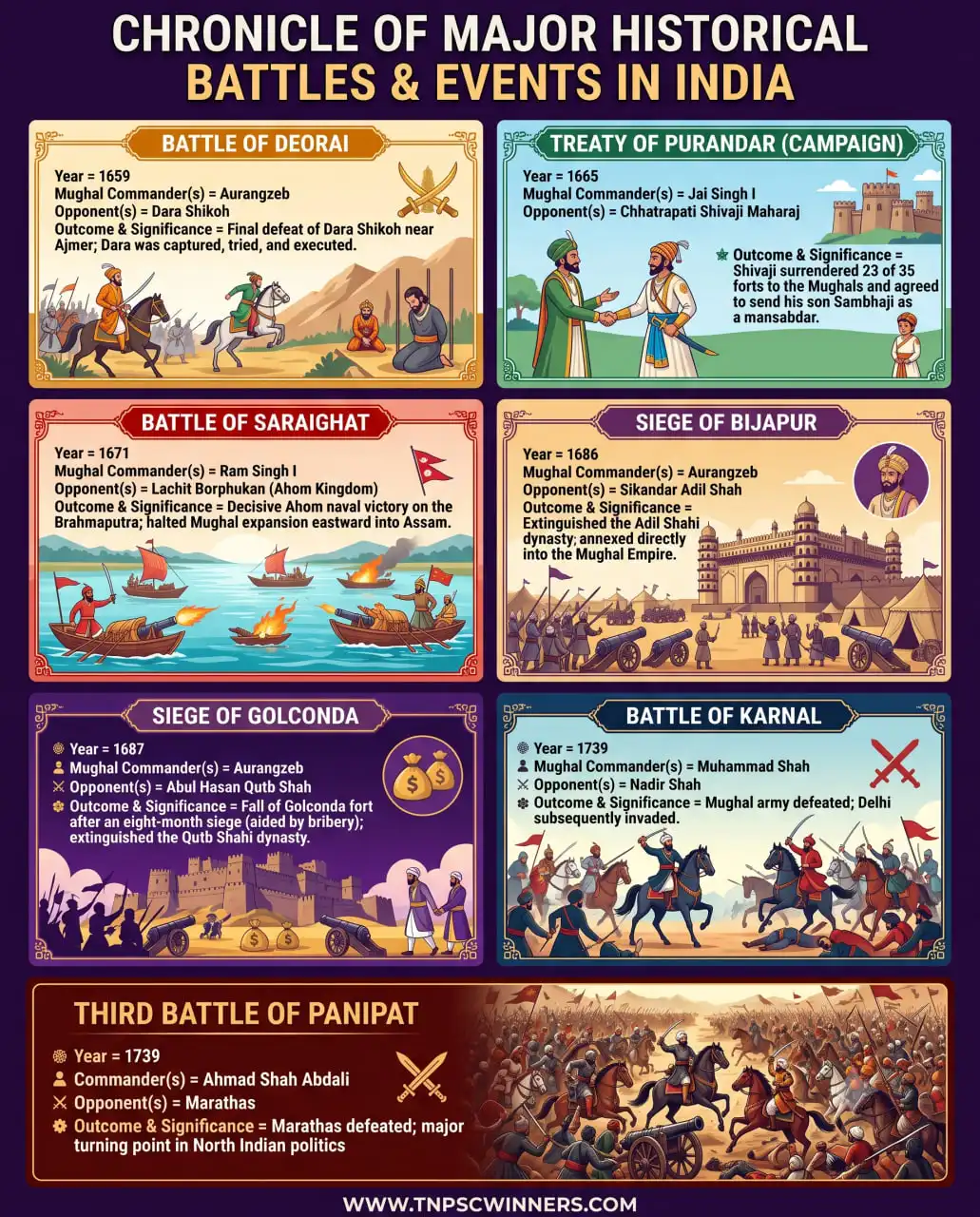
Battle of Deorai
- Year = 1659
- Mughal Commander(s) = Aurangzeb
- Opponent(s) = Dara Shikoh
- Outcome & Significance = Final defeat of Dara Shikoh near Ajmer; Dara was captured, tried, and executed.
Treaty of Purandar (Campaign)
- Year = 1665
- Mughal Commander(s) = Jai Singh I
- Opponent(s) = Chhatrapati Shivaji Maharaj
- Outcome & Significance = Shivaji surrendered 23 of 35 forts to the Mughals and agreed to send his son Sambhaji as a mansabdar.
- Major Wars and Battles of the Mughal Period
Battle of Saraighat
- Year = 1671
- Mughal Commander(s) = Ram Singh I
- Opponent(s) = Lachit Borphukan (Ahom Kingdom)
- Outcome & Significance = Decisive Ahom naval victory on the Brahmaputra; halted Mughal expansion eastward into Assam.
Siege of Bijapur
- Year = 1686
- Mughal Commander(s) = Aurangzeb
- Opponent(s) = Sikandar Adil Shah
- Outcome & Significance = Extinguished the Adil Shahi dynasty; Bijapur annexed directly into the Mughal Empire.
Siege of Golconda
- Year = 1687
- Mughal Commander(s) = Aurangzeb
- Opponent(s) = Abul Hasan Qutb Shah
- Outcome & Significance = Fall of Golconda fort after an eight-month siege (aided by bribery); extinguished the Qutb Shahi dynasty.
Battle of Karnal
- Year = 1739
- Mughal Commander(s) = Muhammad Shah
- Opponent(s) = Nadir Shah
- Outcome & Significance = Mughal army defeated; Delhi subsequently invaded
Third Battle of Panipat
- Year = 1739
- Commander(s) = Ahmad Shah Abdali
- Opponent(s) = Marathas
- Outcome & Significance = Marathas defeated; major turning point in North Indian politics
- Major Wars and Battles of the Mughal Period
Most Important Battles for TNPSC
- First Battle of Panipat – 1526 → Babur vs Ibrahim Lodi
- Battle of Khanwa – 1527 → Babur vs Rana Sanga
- Battle of Chanderi – 1528 → Babur vs Medini Rai
- Battle of Ghaghra – 1529 → Babur vs Afghan/Bengal forces
- Battle of Chausa – 1539 → Sher Shah Suri defeated Humayun
- Battle of Kannauj/Bilgram – 1540 → Sher Shah Suri defeated Humayun
- Second Battle of Panipat – 1556 → Akbar/Bairam Khan vs Hemu
- Battle of Haldighati – 1576 → Maharana Pratap vs Mughal forces
- Battle of Samugarh – 1658 → Aurangzeb vs Dara Shikoh
- Battle of Karnal – 1739 → Nadir Shah vs Muhammad Shah
- Third Battle of Panipat – 1761 → Ahmad Shah Abdali vs Marathas
- Rebellion of 1857 → Bahadur Shah II as symbolic Mughal emperor
- Major Wars and Battles of the Mughal Period