
Shah Jahan – Reign, Architecture, Monuments and Important Facts
Learn about Shah Jahan, his reign, Mughal architecture, Taj Mahal, Red Fort, administrative policies, religious measures and important exam-oriented facts for TNPSC and other competitive exams.
Shah Jahan – Reign, Architecture & Important Facts
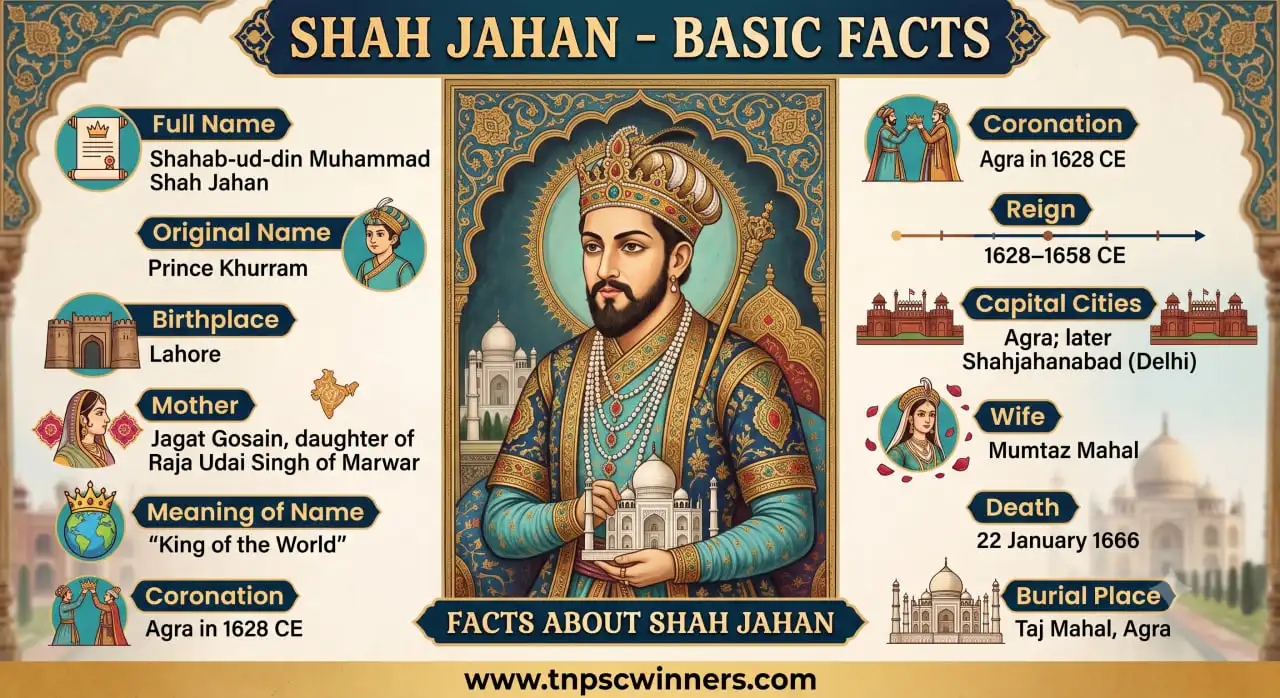
- Full Name = Shahab-ud-din Muhammad Shah Jahan
- Original Name = Prince Khurram
- Dynasty = Mughal Dynasty
- Father = Jahangir
- Mother = Jagat Gosain (Manavati Bai)
- Born = 5 January 1592
- Birthplace = Lahore
- Reign = 1628–1658 CE
- Wife = Mumtaz Mahal
- Capital = Agra; later Shahjahanabad (Delhi)
- Death = 22 January 1666
- Burial Place = Taj Mahal, Agra
JOIN OUR TELEGRAM CHANNEL – T.ME/TNPSC_WINNERS

Prince Khurram
- Shah Jahan was born as Prince Khurram.
- He was the third son of Emperor Jahangir.
- His mother was Jagat Gosain, daughter of Raja Udai Singh of Marwar.
- Shah Jahan, meaning “King of the World.”
- Prince Khurram ascended the Mughal throne in 1628.
- His coronation took place at Agra in 1628.
- Shah Jahan – Reign, Architecture & Important Facts
Important Military Campaigns of Shahjahan
- Ahmadnagar was annexed by the Mughals in 1636.
- Mughal pressure forced Bijapur and Golconda to accept Mughal suzerainty in 1636.
- Kandahar became a major point of conflict between the Mughals and Safavids of Persia.
- The Mughal campaigns against Kandahar in 1649, 1652 and 1653 were unsuccessful.
The “Golden Age” of Mughal Architecture
- Shah Jahan’s reign is considered a major period of development in Mughal architecture.
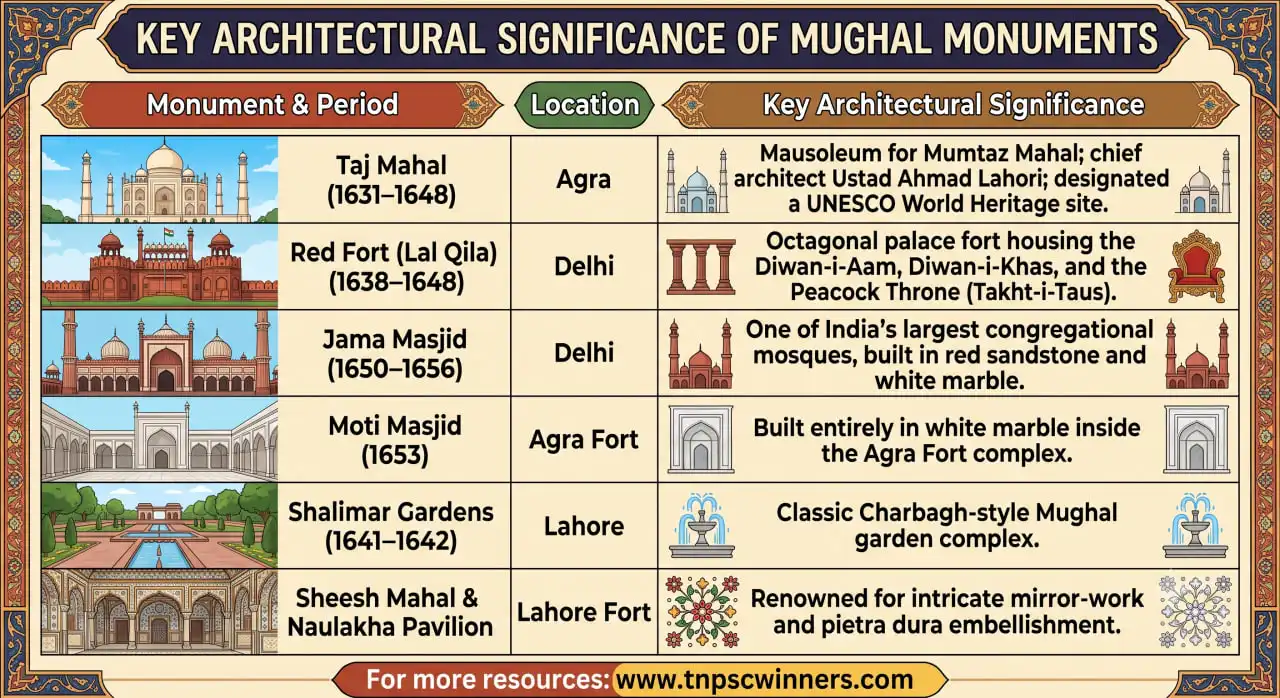
Taj Mahal
- Located at Agra, on the banks of the Yamuna.
- Built in memory of Mumtaz Mahal, who died in 1631.
- Construction began shortly after her death.
- It is famous for its white marble architecture, dome, minarets and pietra dura decoration.
- The Taj Mahal is one of the finest examples of Mughal architecture.
- Designer of the Taj Mahal = Ismail Khan.
- Architects who built the Taj Mahal = Ustad Ahmad Lahori (Ustad Isa), Isa Muhammad Effendi.
- It took 22 years to complete construction.
- It was built using a workforce of approximately 22,000 people.
- Rabindranath Tagore described the Taj Mahal as “a teardrop on the cheek of eternity.”
- Shah Jahan described the Taj Mahal as “a tear shed from the eyes of the sun and the moon.”
- Designated a UNESCO World Heritage site.
- Shah Jahan – Reign, Architecture & Important Facts
Red Fort, Delhi
- Construction began in 1638.
- Located in Shahjahanabad, the new imperial city founded by Shah Jahan.
- The fort is constructed mainly of red sandstone.
- It contains famous structures such as the Diwan-i-Am and Diwan-i-Khas.
Jama Masjid, Delhi
- Built during Shah Jahan’s reign.
- Construction began in 1650 and was completed in 1656.
- It is one of the major surviving monuments of Mughal architecture.
- One of India’s largest congregational mosques, built in red sandstone and white marble.
- Shah Jahan – Reign, Architecture & Important Facts
Moti Masjid, Agra Fort
- Built by Shah Jahan inside the Agra Fort.
- Constructed mainly using white marble.
Shalimar Gardens
- 1641–1642
- Location: Lahore
- Classic ‘Charbagh’-style Mughal garden complex.
Sheesh Mahal and Naulakha Pavilion
- Lahore Fort
- Renowned for intricate mirror-work and ‘pietra dura’ embellishments.
- Shah Jahan – Reign, Architecture & Important Facts
Shahjahanabad
- Shah Jahan shifted the imperial capital from Agra to Delhi.
- He founded the new city of Shahjahanabad in 1639.
- The Red Fort became the principal imperial residence.
- The city developed around the Red Fort and Jama Masjid.
Peacock Throne
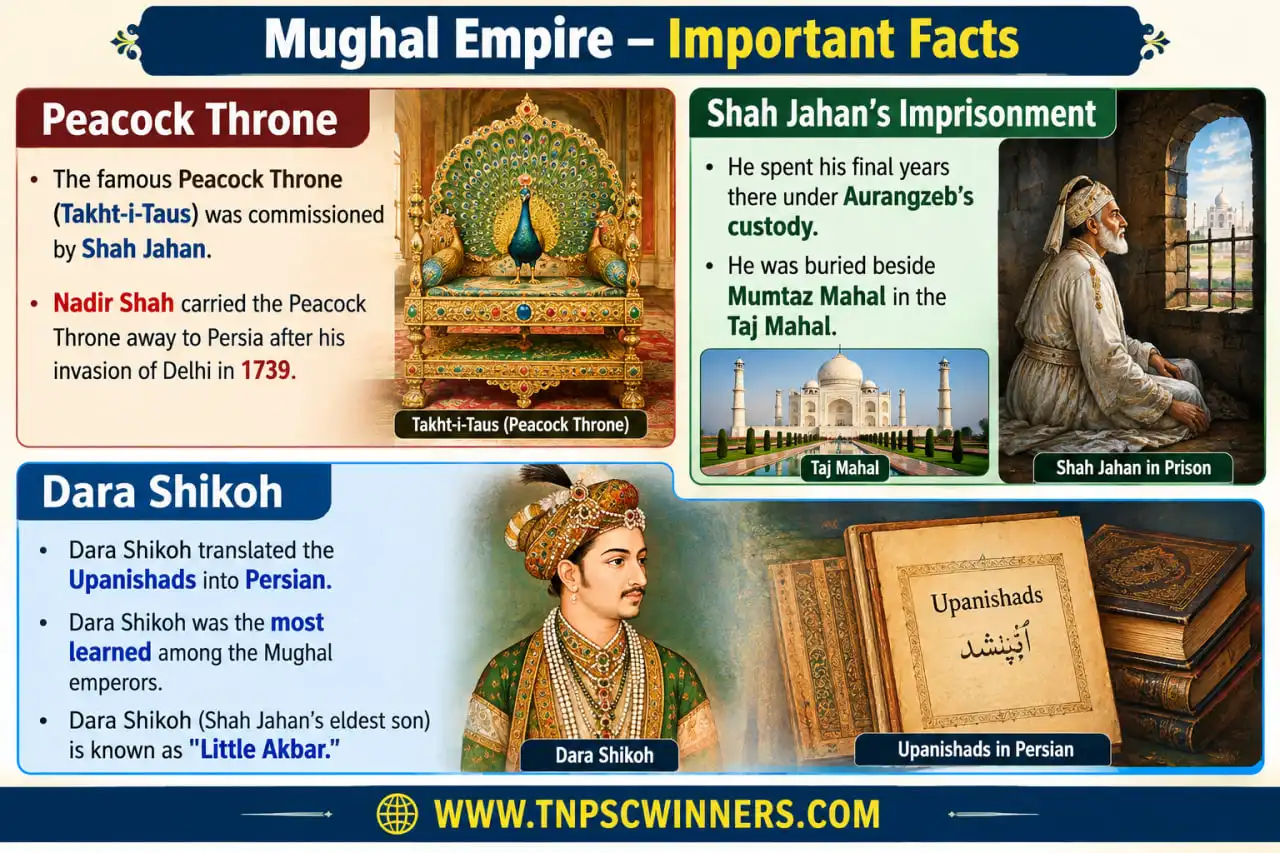
- The famous Peacock Throne (Takht-i-Taus) was commissioned by Shah Jahan.
- It was renowned for its elaborate decoration with gold and precious stones.
- It symbolized the wealth and grandeur of the Mughal court.
- Nadir Shah carried the Peacock Throne away to Persia after his invasion of Delhi in 1739.
Shah Jahan’s Imprisonment
- Aurangzeb deposed Shah Jahan in 1658.
- Shah Jahan was confined in the Agra Fort.
- He spent his final years there under Aurangzeb’s custody.
- He died on 22 January 1666.
- He was buried beside Mumtaz Mahal in the Taj Mahal.
- Shah Jahan – Reign, Architecture & Important Facts
Shah Jahan’s Children
- Shah Jahan’s sons: Dara Shikoh (Crown Prince), Shah Shuja (Governor of Bengal), Aurangzeb (Governor of the Deccan), and Murad Bakhsh (Governor of Malwa).
- Shah Jahan appointed Aurangzeb as the first Governor of the Deccan.
- Dara Shikoh translated the Upanishads into Persian.
- Dara Shikoh was the most learned among the Mughal emperors.
- Dara Shikoh (Shah Jahan’s eldest son) is known as “Little Akbar“
- Shah Jahan’s daughter, Jahanara Begum, is known as “Begum Sahiba.”
- Shah Jahan – Reign, Architecture & Important Facts
Wars of Succession
- Battle of Bahadurpur = February 1658 Dara Shikoh defeated Prince Shuja.
- Battle of Dharmat = April 1658 Aurangzeb defeated Prince Dara Shikoh. King Jaswant Singh fought in support of Dara Shikoh.
- Battle of Samugarh = May 29, 1658 Dara Shikoh was defeated, and Aurangzeb imprisoned Shah Jahan.
- Battle of Deorai = 1659 Dara Shikoh was defeated; both he and his son, Sulaiman Shikoh, were killed.
Foreigners who chronicled Shah Jahan’s reign
- Foreigner who recorded the War of Succession and events at the Mughal court = François Bernier (French physician)
- Foreigner who recorded details about the Peacock Throne and the Koh-i-Noor diamond = Jean-Baptiste Tavernier (French gem merchant)
- Foreigner who recorded the catastrophic famine that struck the Deccan and Gujarat regions between 1630 and 1632 = Peter Mundy (English traveler)
- Shah Jahan – Reign, Architecture & Important Facts
Shah Jahan – General Notes
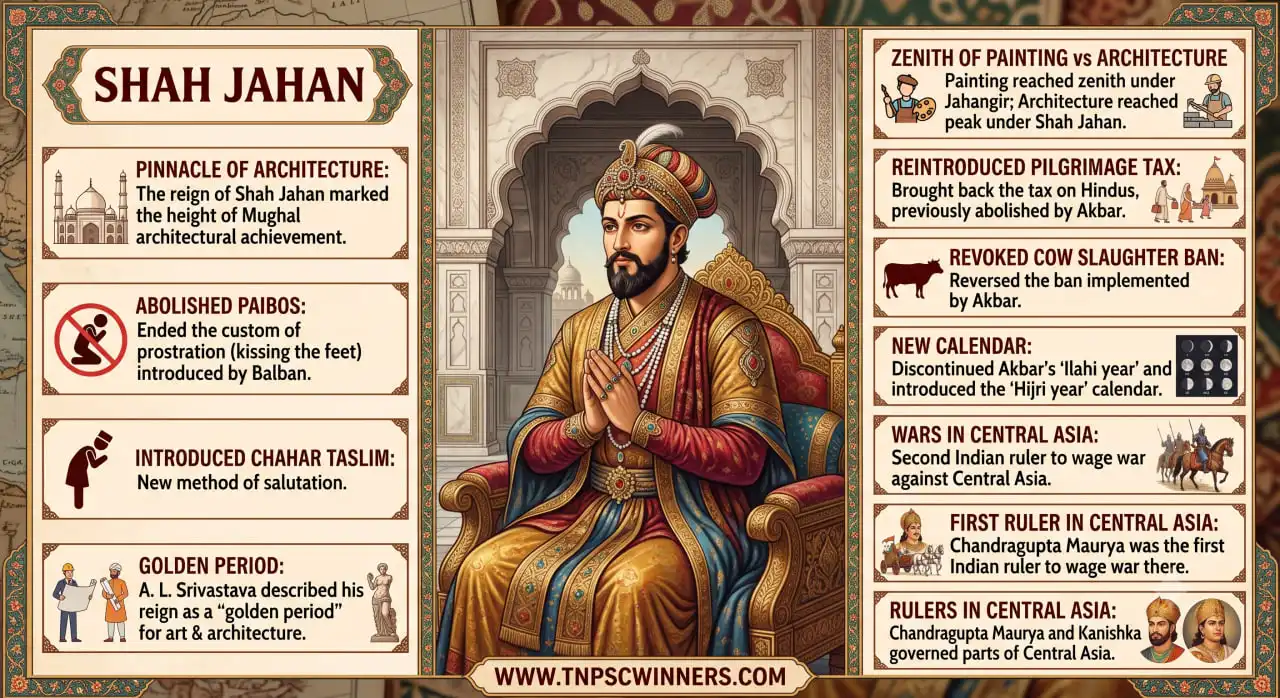
- The reign that marked the pinnacle of architecture = The reign of Shah Jahan.
- He conquered Ahmednagar in 1633 AD; following this victory, he assumed the title “Shah Jahan.”
- He captured the city of Hooghly from the Portuguese.
- Shah Jahan shifted the capital back from Agra to Delhi.
- He abolished the “Paibos” (prostration/kissing the feet) custom introduced by Balban.
- Shah Jahan introduced a new method of salutation known as “Chahar Taslim.”
- He commissioned the creation of the “Peacock Throne.”
- L. Srivastava described Shah Jahan’s reign as a “golden period” in medieval Indian history, particularly in the field of art and architecture.
- The Mughal ruler under whose reign the art of painting reached its zenith = Jahangir.
- The Mughal ruler under whose reign architecture reached its peak = Shah Jahan.
- The person who presented the “Koh-i-Noor diamond” to Shah Jahan = Mir Jumla.
- The author of the book “Shah Jahan Nama” = Inayat Khan.
- Aurangzeb seized power after killing his brothers.
- Shah Jahan was imprisoned in Agra Fort, where he eventually died; his daughter, Jahanara Begum, cared for him during his final days.
- Foreigners who visited India during Shah Jahan’s reign = Bernier (physician, France), Tavernier (merchant, France), Manucci (Italy), and Peter Mundy.
- The person who described the famine that occurred during Shah Jahan’s reign = The Italian traveler Peter Mundy.
- Shah Jahan reintroduced the “pilgrimage tax” on Hindus, which Akbar had abolished.
- Shah Jahan revoked the “ban on cow slaughter” that Akbar had implemented.
- He discontinued Akbar’s “Ilahi year” calendar and introduced the “Hijri year” calendar.
- Shah Jahan was the second Indian ruler to wage war against the “Central Asia” region.
- Chandragupta Maurya was the first Indian ruler to wage war against the “Central Asia” region.
- The Indian rulers who governed parts of “Central Asia” were Chandragupta Maurya and Kanishka.
- Shah Jahan – Reign, Architecture & Important Facts
Shah Jahan – Important One-Liners for TNPSC
- Shah Jahan’s original name – Prince Khurram.
- Father – Jahangir.
- Mother – Jagat Gosain.
- Shah Jahan ruled – 1628–1658 CE.
- Shah Jahan’s wife – Mumtaz Mahal.
- Taj Mahal – built in memory of Mumtaz Mahal.
- Taj Mahal is located at – Agra.
- New city founded by Shah Jahan – Shahjahanabad.
- Red Fort, Delhi – associated with Shah Jahan.
- Jama Masjid, Delhi – built by Shah Jahan.
- Peacock Throne – commissioned by Shah Jahan.
- Padshahnama – important chronicle of Shah Jahan’s reign.
- Author of Padshahnama – Abdul Hamid Lahori.
- Shah Jahan was deposed by – Aurangzeb.
- Shah Jahan died – 22 January 1666.
- Shah Jahan’s tomb – Taj Mahal, Agra.
- Battle of Samugarh – 1658, important battle in the Mughal succession struggle.
- Ahmadnagar was annexed during Shah Jahan’s reign – 1636.
- Kandahar was lost permanently to the Safavids – 1649.
- Shah Jahan – Reign, Architecture & Important Facts