
IMPORTANT FACTS ABOUT MAHAVIRA
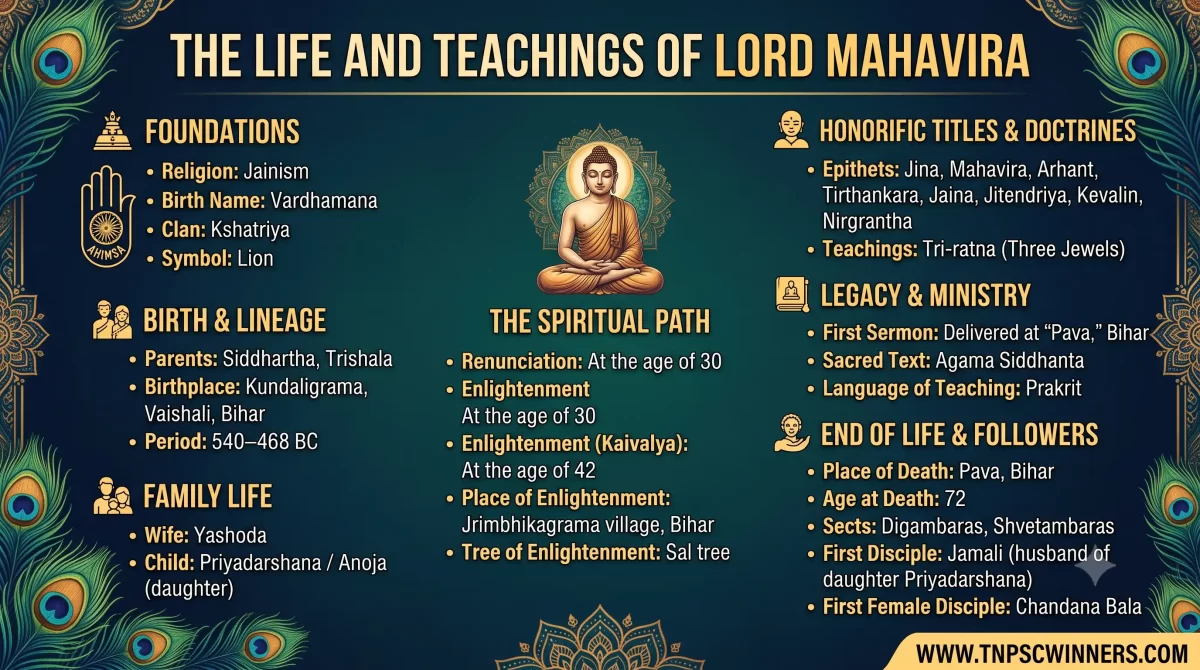
IMPORTANT FACTS ABOUT MAHAVIRA
- Religion: Jainism.
- Parents: Siddhartha, Trishala.
- Birth Name: Vardhamana.
- Period: 540–468 BC.
- Birthplace: Kundaligrama, Vaishali, Bihar.
- Wife: Yashoda.
- Clan: Kshatriya.
- Child: Priyadarshana / Anoja (daughter).
- Renunciation: At the age of 30.
- Enlightenment: At the age of 42 (attained *Kaivalya* or perfect knowledge).
- Place of Enlightenment: Jrimbhikagrama village, Bihar.
- Tree of Enlightenment: Sal tree.
- Epithets: Jina, Mahavira, Arhant, Tirthankara, Jaina, Jitendriya, Kevalin, Nirgrantha.
- Teachings: *Tri-ratna* (Three Jewels).
- First Sermon: Delivered at “Pava,” Bihar.
- Sacred Text: Agama Siddhanta.
- Language of Teaching: Prakrit.
- Place of Death: Pava, Bihar.
- Age at Death: 72.
- Sects: Digambaras, Shvetambaras.
- Symbol: Lion.
- First Disciple: Jamali (husband of his daughter Priyadarshana).
- First Female Disciple: Chandana Bala.
- He left home at the age of 30 and wandered for 12 years in search of the truth.
- At the age of 42, at a place called Jrimbhikagrama on the banks of the Riju-palika River, he attained enlightenment—known as *Kaivalya*—beneath a Sal tree.
JOIN OUR TELEGRAM CHANNEL – T.ME/TNPSC_WINNERS

- Mahavira delivered his first sermon at “Pava” to a group of 11 disciples known as *Gandharas*. He passed away at the age of 72 at Pavapuri, near Rajagriha.
- He was known as a Jaina or Jitendriya (one who has conquered his senses); he was also referred to as Kevalin (the enlightened one), Nirgrantha (one free from all bonds), Arihant (the blessed one), and Mahavira (the brave one).
- In Jain scriptures, he is addressed as Vira, Viraprabhu, Sanmati, Ativira, and Gnanaputra.
- After Mahavira’s death, the only one of his 11 disciples (Ganadharas) who remained alive was Sudharma.
- IMPORTANT FACTS ABOUT JAINISM
- வர்த்தமான மகாவீரர்
- சமணமதம்
- வேதங்கள்
- வேத காலம்
- Indus Valley Civilization
- சிந்து சமவெளி நாகரீகம்
- The Stone Age
- கற்காலம்
- Famous Indian Rulers and their Inscriptions
- இந்திய வரலாற்றில் முக்கிய கல்வெட்டுகள்