
World Iodine Deficiency Day 2026
Celebrate World Iodine Deficiency Day 2026. Discover the vital role of iodine in thyroid health and brain development, and learn how to prevent deficiency.
World Iodine Deficiency Day 2026
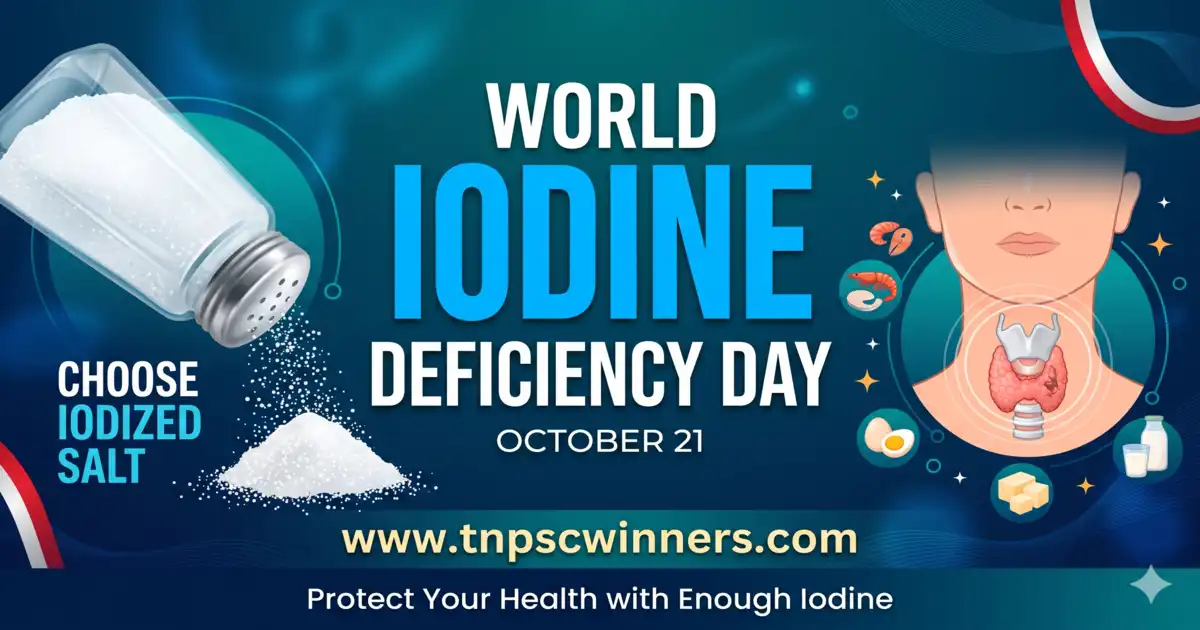
- World Iodine Deficiency Day, also known as Global Iodine Deficiency Disorders Prevention Day, is observed on 21 October every year to raise awareness about iodine deficiency and promote measures to prevent iodine deficiency disorders.
JOIN OUR TELEGRAM CHANNEL – T.ME/TNPSC_WINNERS

World Iodine Deficiency Day – Important Facts
- Observed on = 21 October every year
- Also known as = Global Iodine Deficiency Disorders Prevention Day
- Main objective = To create awareness about iodine deficiency and its prevention
- Essential nutrient = Iodine
- Main organ affected = Thyroid gland
- Important hormones = Thyroxine (T4) and Triiodothyronine (T3)
- Best preventive measure = Regular consumption of adequately iodized salt
What is iodine deficiency?
- Iodine deficiency occurs when the body does not receive enough iodine to produce adequate thyroid hormones.
- These hormones regulate metabolism and are essential for normal growth, brain development and nervous system function.
- Iodine is particularly important during pregnancy, infancy and childhood, when the brain and nervous system are developing.
- World Iodine Deficiency Day 2026
Biological Importance of Iodine
- Thyroid Hormone Synthesis = Essential micronutrient required for the synthesis of Thyroxine (T4) and Triiodothyronine (T3).
- Metabolism & Growth = Regulates basal metabolic rate (BMR), protein synthesis, and cellular enzyme activity.
- Neurodevelopment = Crucial during fetal life and early childhood for normal brain development, neural migration, and cognitive functioning.
Recommended Dietary Intake (WHO/UNICEF Guidelines)
- Infants (0–12 months) = 90–110 µg/day
- Children (1–8 years) = 90 µg/day
- Children (9–13 years) = 120–130 µg/day
- Adolescents & Adults = 150 µg/day
- Pregnant Women = 220–250 µg/day
- Lactating Mothers = 250–290 µg/day
Major iodine deficiency disorders (IDD)
- Goitre = Enlargement of the thyroid gland, often causing swelling in the neck.
- Hypothyroidism = Reduced production of thyroid hormones.
- Impaired brain development = Can lead to reduced cognitive ability and learning difficulties.
- Cretinism = An older medical term for severe congenital iodine deficiency syndrome, associated with profound developmental impairment.
- Growth and developmental problems = Particularly in children.
- Pregnancy complications = Severe deficiency can increase the risk of miscarriage, stillbirth and impaired fetal development.
- World Iodine Deficiency Day 2026
India’s National Iodine Deficiency Disorders Control Programme (NIDDCP)
- 1962 = National Goitre Control Programme (NGCP). Launched by the Government of India to control goitre and iodine deficiency.
- 1992 = Renamed NIDDCP. The programme was broadened to cover a wider range of iodine deficiency disorders.
Important statistics for examinations
- Adequately iodized salt at household level in India = 94.3%
- Survey source = National Family Health Survey (NFHS-5)
- Survey period = 2019–2021
- Adequate iodine level in salt at consumer level = At least 15 ppm, under Indian programme standards
- Recommended strategy = Universal salt iodization
Quick revision – One-liners
- World Iodine Deficiency Day = 21 October.
- Other name = Global Iodine Deficiency Disorders Prevention Day.
- Main gland affected by iodine deficiency = Thyroid gland.
- Thyroid hormones = Thyroxine (T4) and Triiodothyronine (T3).
- Common visible disorder = Goitre.
- National Goitre Control Programme launched = 1962.
- NGCP renamed NIDDCP = 1992.
- NIDDCP full form = National Iodine Deficiency Disorders Control Programme.
- Adequately iodized salt standard at consumer level in India = At least 15 ppm.
- Key preventive strategy = Universal salt iodization.
- World Iodine Deficiency Day 2026