
Indus Valley Civilization
Indus Valley Civilization
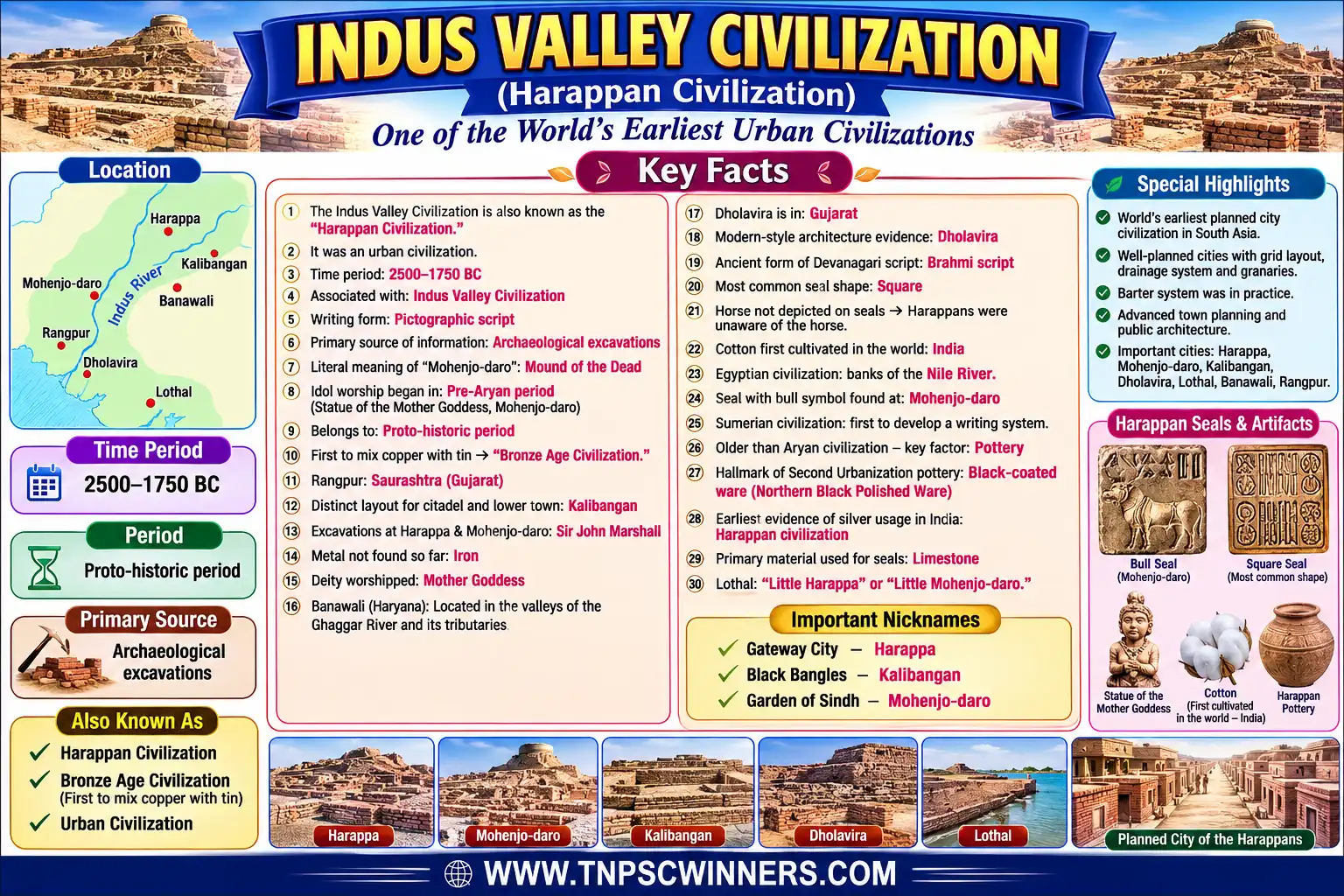
- The Indus Valley Civilization is also known as the “Harappan Civilization.”
- The Indus Valley Civilization was an urban civilization.
- What is the time period of the Harappan Civilization? = 2500–1750 BC
- With which civilization is the Harappan Civilization associated? = Indus Valley Civilization
- What form of writing was discovered in the Harappan Civilization? = Pictographic script
- What is the primary source of information regarding the Harappan Civilization? = Archaeological excavations
- What is the literal meaning of the word “Mohenjo-daro”? = Mound of the Dead
- When did idol worship begin? = Pre-Aryan period (Statue of the Mother Goddess, Mohenjo-daro)
- To which period does the Indus Valley Civilization belong? = Proto-historic period
- The people of the Indus Valley Civilization were the first to mix copper with tin; therefore, the Indus Valley Civilization is also known as the “Bronze Age Civilization.”
JOIN OUR TELEGRAM CHANNEL – T.ME/TNPSC_WINNERS

- Where is Rangpur, a city contemporary to the Harappan Civilization, located? = Saurashtra (Gujarat)
- Which Harappan city features a distinct layout for its citadel and lower town? = Kalibangan
- Who conducted the excavations at the Harappa and Mohenjo-daro sites? = Sir John Marshall
- Which metal has not been found at Harappan civilization sites so far? = Iron
- Which deity did the people of the Indus Valley Civilization worship? = Mother Goddess
- According to archaeological evidence, the Indus Valley city of ” Banawali ” (in present-day Haryana) is located in the valleys of the Ghaggar River and its tributaries.
- In which state is the Harappan city of ‘ Dholavira ‘ located? = Gujarat
- From which Harappan civilization site was evidence of modern-style architecture found? = Dholavira
- What is the ancient form of the Devanagari script? = Brahmi script
- What is the most common shape found among Harappan civilization seals? = Square
- The horse was not depicted on Harappan civilization seals; this implies that the people of Harappan cities were unaware of the horse.
- Where was cotton first cultivated in the world? = India
- The Egyptian civilization, a contemporary of the Indus Valley Civilization, was situated along the banks of the Nile River.
- Where was a seal bearing the symbol of a bull found in the Indus Valley Civilization? = Mohenjo-daro
- The Sumerian civilization was the first to develop a writing system.
- What is the key factor for considering the Indus Valley Civilization to be older than the Aryan civilization? = Pottery
- Which type of pottery in India was described as a hallmark of the Second Urbanization? = Black-coated ware (Northern Black Polished Ware)
- Where was the earliest evidence of silver usage in India found? = Harappan civilization
- What is the primary material used for Harappan seals? = Limestone
- The city of Lothal is referred to as “Little Harappa” or “Little Mohenjo-daro.”
- The “barter system” was in practice.
- The city known as the “Gateway City” = Harappa
- The city known as “Black Bangles” = Kalibangan
- The city known as the “Garden of Sindh” = Mohenjo-daro.
Indus Valley Civilization Archaeological Sites
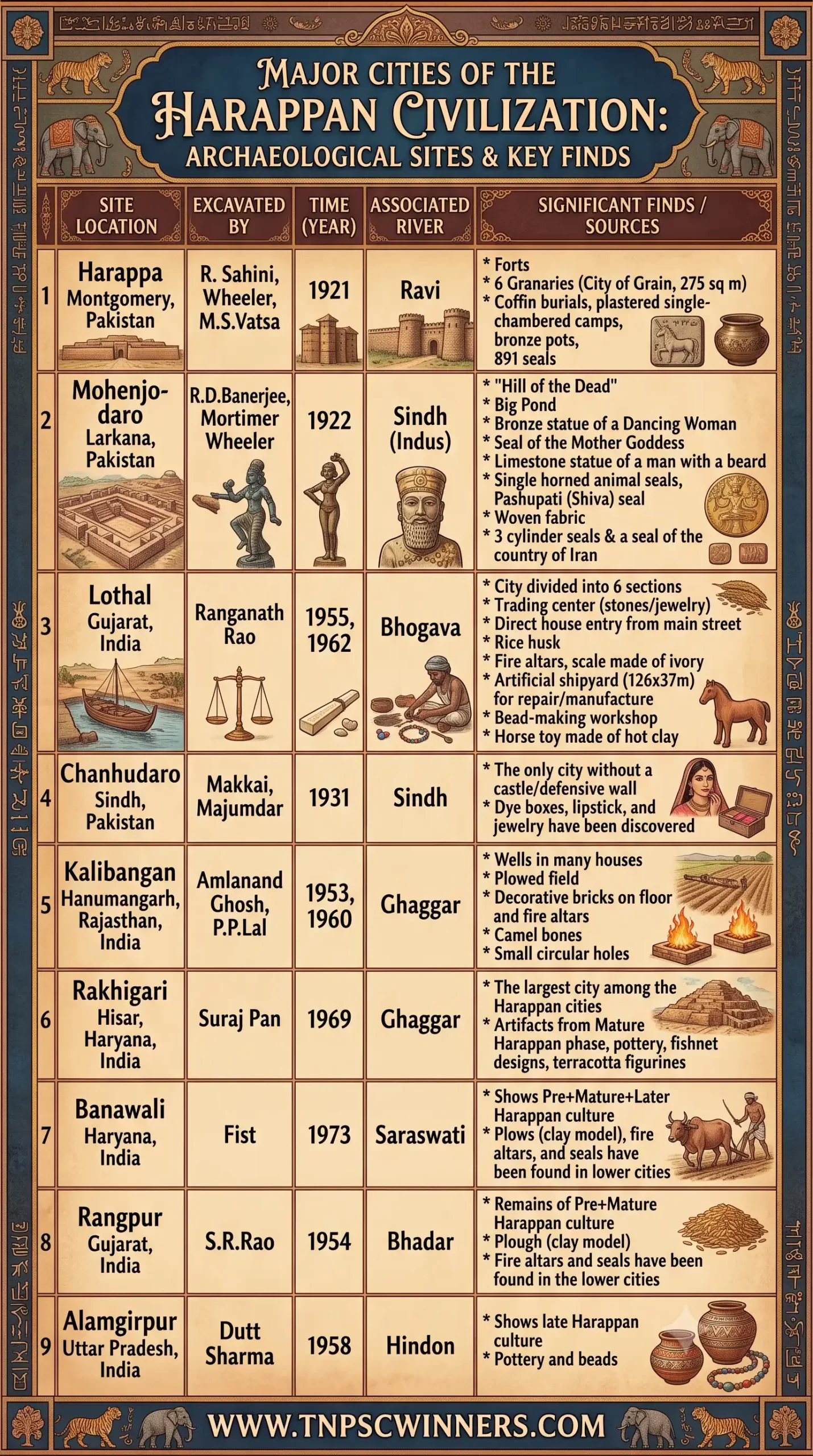
| Location | Excavated | Time | River | Sources |
| Harappa, Montgomery, present-day Pakistan | R.C.Sahini, Wheeler, M.S.Vatsa | 1921 | Ravi |
|
| Mohenjo-daro, Larkana, Pakistan | R.D.Banerjee, Mortimer Wheeler | 1922 | Sindh |
|
| Lothal, Gujarat | Ranganath Rao | 1955, 1962 | Bhogava |
|
| Chanhudaro, Sindh, Pakistan | Makkai, Majumdar | 1931 | Sindh |
|
| Kalibangan, Hanumangarh, Rajasthan | Amlanand Ghosh, P.P.Lal | 1953, 1960 | Ghaggar |
|
| Rakhigari, Hisar, Haryana | Suraj Pan | 1969 | Ghaggar |
|
| Banawali, Haryana | Fist | 1973 | Saraswati |
|
| Rangpur, Gujarat | S.R.Rao | 1954 | Bhadar |
|
| Alamgirpur, Uttar Pradesh | Dutt Sharma | 1958 | Hindon |
|
- சிந்து சமவெளி நாகரீகம்
- The Stone Age
- கற்காலம்
- Famous Indian Rulers and their Inscriptions
- இந்திய வரலாற்றில் முக்கிய கல்வெட்டுகள்
- Mahabharata
- மகாபாரதம்
- Historical Sources of Ancient India
- IMPORTANT DAYS IN NOVEMBER 2025