
Akbar the Great – Life, Reign, Administration, Battles and Achievements
Learn about Akbar the Great, the Mughal emperor: his early life, major battles, Rajput policy, religious policy, Din-i Ilahi, administration, Mansabdari system, revenue reforms, Navratnas and achievements for TNPSC exams.
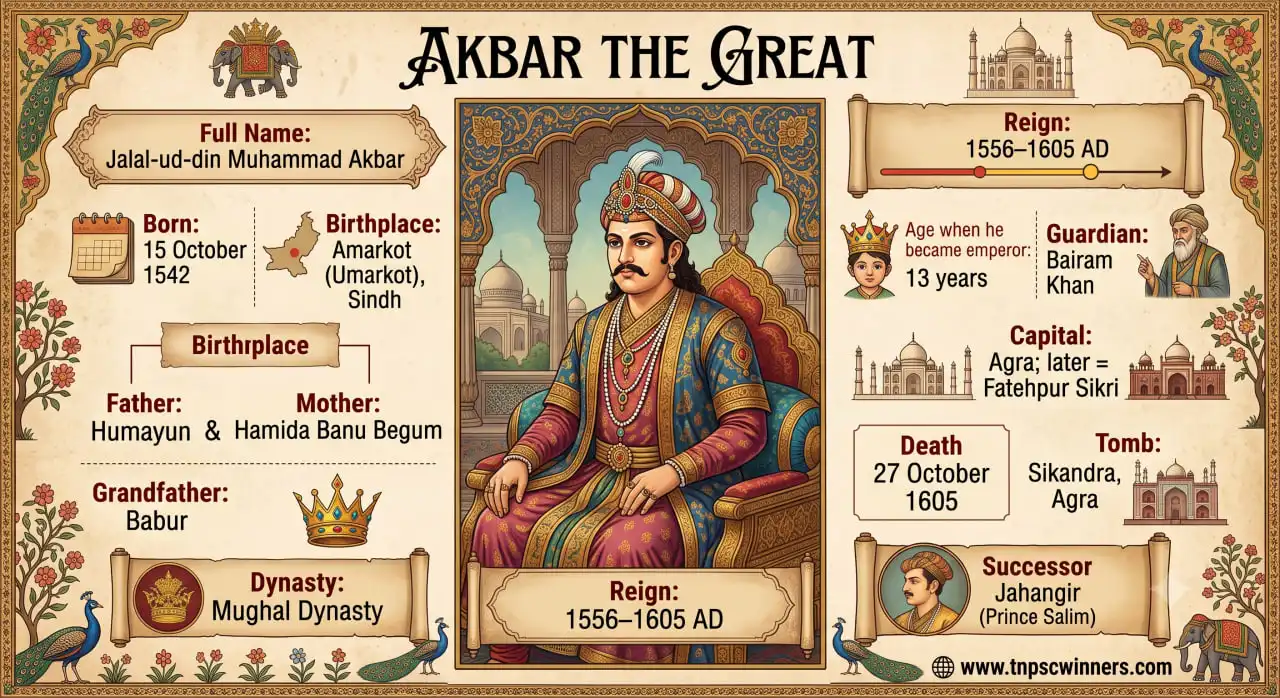
Akbar the Great – Life and Family
- Full Name = Jalal-ud-din Muhammad Akbar
- Born = 15 October 1542
- Birthplace = Amarkot (Umarkot), Sindh
- Father = Humayun
- Mother = Hamida Banu Begum
- Grandfather = Babur
- Dynasty = Mughal Dynasty
- Reign = 1556–1605 AD
- Age when he became emperor = 13 years
- Guardian = Bairam Khan
- Capital = Agra; later = Fatehpur Sikri
- Death = 27 October 1605
- Tomb = Sikandra, Agra
- Successor = Jahangir (Prince Salim)
Akbar’s Accession to the Mughal Throne
- Akbar became emperor in 1556, after the death of his father Humayun.
- He was crowned at Kalanaur in Punjab.
- Since Akbar was only 13, Bairam Khan acted as his regent.
- Akbar’s early reign was dominated by the challenge posed by Hemu.
- Akbar the Great – Life, Battles & Achievements
JOIN OUR TELEGRAM CHANNEL – T.ME/TNPSC_WINNERS

Akbar’s Major Battles and Conquests
- 1556 = Second Battle of Panipat
- 1561 = Conquest of Malwa
- 1562 = Establishment of matrimonial alliances with the Rajputs
- 1564 = Conquest of Gondwana
- 1567–68 = Siege and capture of Chittor
- 1569 = Capture of Ranthambore
- 1572–73 = Conquest of Gujarat
- 1574–76 = Bengal and Bihar brought under Mughal control
- 1581 = Invasion of Kabul
- 1586 = Conquest of Kashmir
- 1591–95 = Sindh and Kandahar brought under Mughal dominion
- 1595–1601 = Deccan campaigns; Ahmadnagar and Khandesh
- Akbar the Great – Life, Battles & Achievements
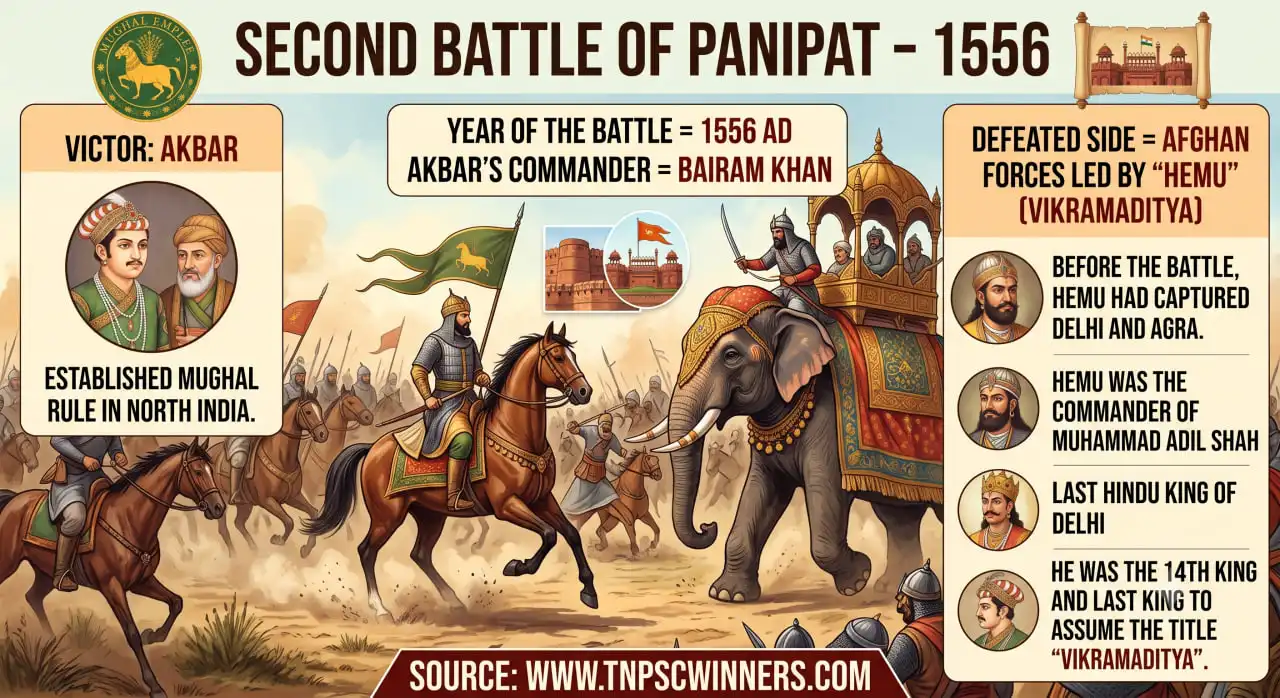
Second Battle of Panipat – 1556
- Hemu had captured Delhi and Agra prior to the battle.
- This battle helped establish Mughal rule in North India.
- Year of the battle: 1556 AD.
- Victor: Akbar.
- Akbar’s commander: Bairam Khan.
- Defeated side: Afghan forces led by the Hindu king Hemu (Vikramaditya). Hemu was the commander of Muhammad Adil Shah.
- Last Hindu king of Delhi: Hemu (Vikramaditya).
- He was the 14th king to assume the title “Vikramaditya.”
- He was the last king to assume the title “Vikramaditya.”
- Akbar the Great – Life, Battles & Achievements
Akbar’s Rajput Policy
- Akbar adopted a combination of military conquest, diplomacy and matrimonial alliances toward the Rajput states.
- Akbar married Harkha Bai, commonly known in later sources as Jodha Bai, daughter of the Rajput ruler of Amber, in 1562.
- Rajput rulers who accepted Mughal authority were generally allowed to retain considerable autonomy in their internal affairs.
- Rajput nobles were incorporated into the Mansabdari system.
- Important Rajput nobles included Raja Man Singh and Raja Bhagwan Das.
- Akbar the Great – Life, Battles & Achievements
Akbar’s Religious Policy
- Akbar is particularly important for his policy of religious tolerance and imperial integration.
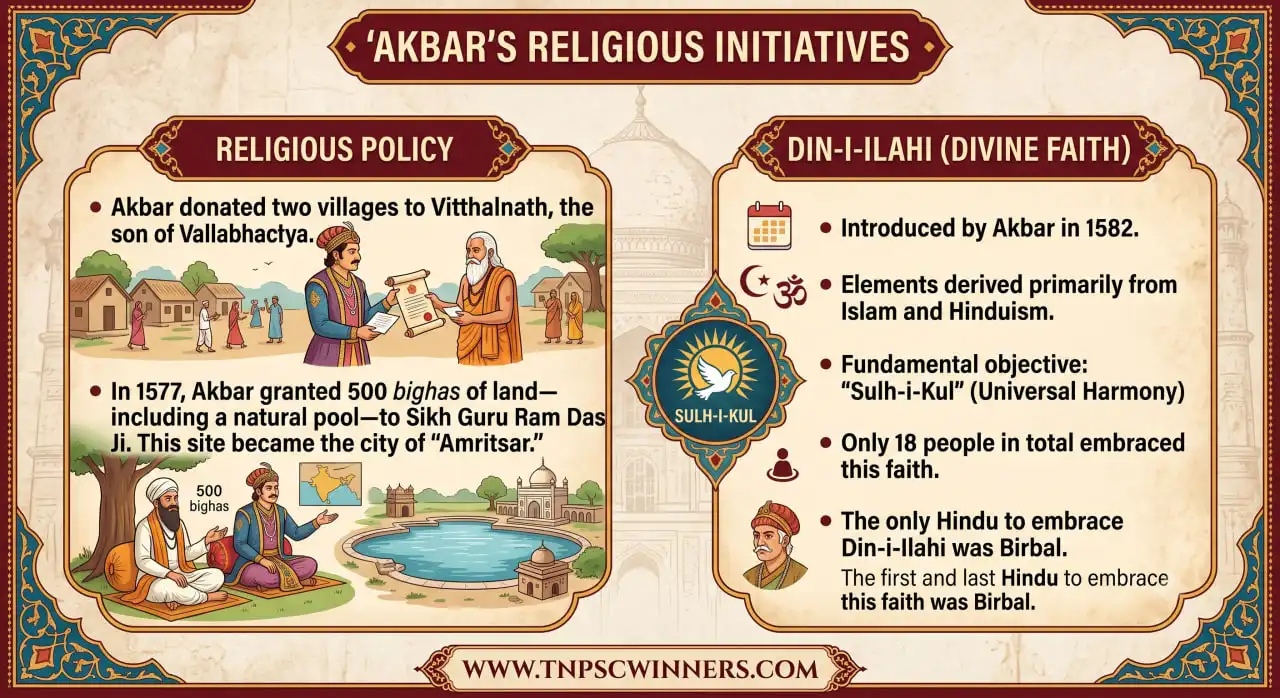
- 1562: Prohibition of the enslavement of prisoners of war and conversion of their families.
- 1563: Abolished the pilgrimage tax.
- 1564: Abolished the Jizya tax.
- Promoted the principle of Sulh-i-Kul — “Universal Peace.”
- Encouraged discussions among followers of different religions.
- Invited scholars of Islam, Hinduism, Jainism, Christianity and Zoroastrianism to religious discussions.
- Akbar gifted two villages to Vallabhacharya’s son, Vitthalnath.
- In 1577, Akbar granted 500 bighas of land—which included a natural pool—to the Sikh Guru Ram Das Ji; this site later emerged as the city of Amritsar.
- Akbar the Great – Life, Battles & Achievements
Ibadat Khana
- Established at Fatehpur Sikri in 1575.
- It was initially intended for discussions among Muslim scholars.
- Later, representatives of different religions were also invited.
Mahzar – 1579
- In 1579, Akbar issued the Mahzar.
- It gave the emperor a greater role in deciding religious questions when Islamic scholars disagreed.
- It is associated with the growing independence of Akbar’s religious policy.
- Akbar the Great – Life, Battles & Achievements
Akbar’s Din-i-Ilahi
- It was introduced by Akbar in 1582.
- It is more appropriate to describe it as an ethical or spiritual code of conduct rather than a religion for the masses.
- It emphasized loyalty to the Emperor, moral conduct, and elements drawn from various religious traditions.
- The elements of Din-i-Ilahi were primarily derived from Islam and Hinduism.
- The fundamental objective of Din-i-Ilahi was “Sulh-i-kul” (or “universal harmony”).
- A total of only 18 people embraced this faith.
- The only Hindu to embrace Din-i-Ilahi was Birbal.
- The first and last Hindu to embrace this faith was Birbal.
- Akbar the Great – Life, Battles & Achievements
Akbar’s Mansabdari System
- Akbar developed the Mansabdari system to organize military and civil administration.
- Mansab means rank/position.
- Every mansabdar was assigned a numerical rank.
- Two important terms:
- Zat → personal rank/status
- Sawar → number of cavalrymen the mansabdar was required to maintain
- The system helped Akbar control the nobility and organize the army.
- Akbar the Great – Life, Battles & Achievements
Akbar and the Navratnas
- Abul Fazl (Historian, authored Akbarnama & Ain-i-Akbari)
- Faizi (Poet laureate; oversaw translations into Persian)
- Tansen (Legendary musician, born Ramtanu Pandey)
- Birbal (Mahesh Das; courtier known for wit and counsel)
- Raja Todar Mal (Finance and revenue reformer)
- Raja Man Singh (Trusted military commander)
- Abdul Rahim Khan-i-Khana (Poet, son of Bairam Khan)
- Fakir Aziao-Din (Sufi mystic and advisor)
- Mullah Do-Piyaza (Chief advisor/counsel)
Akbar’s Important Buildings and Monuments
- Akbar developed Fatehpur Sikri as an imperial city.
- It became the Mughal capital for a period.
- Construction was closely associated with Akbar’s respect for the Sufi saint Sheikh Salim Chishti.
- Akbar’s son Salim, later Emperor Jahangir, was born after Akbar’s association with the saint.
- Buland Darwaza
- Jama Masjid
- Panch Mahal
- Diwan-i-Khas
- Tomb of Salim Chishti
- Buland Darwaza was constructed to commemorate Akbar’s Gujarat victory.
Historians’ Views and Quotes About Akbar
- Jawaharlal Nehru = “Akbar’s success is astonishing, for he created a sense of oneness among the diverse elements of north and central India.”
- Jawaharlal Nehru (The Discovery of India) = “In him the old dream of a united India took shape, not only in the political sense, but also in the realm of culture and faith… He was a dreamer and at the same time a man of action, a tremendous combination in a ruler.”
- Vincent A. Smith = He describes Akbar as the “third and greatest of the Mughal emperors of India”.
- Jadunath Sarkar = “Akbar was not only the architect of the Mughal Empire, but also the builder of the Mughal nation.”
- Akbar the Great – Life, Battles & Achievements
Important Facts About Akbar for TNPSC Exams
- After the death of Bairam Khan, Akbar’s foster mother, Maham Anga, effectively ruled from behind the scenes between 1560 and 1562 AD.
- This period of rule is known as the “Petticoat Government” (Pavadai Aatchi).
- In 1564 AD, Akbar annexed Gondwana after waging war against Queen Durgavati and her son, Bir Narayan.
- Akbar’s Rajput policy = Suppression and Conciliation.
- Akbar married Jodha, the daughter of the Rajput king Bharmal; Jahangir (Salim) was born to them.
- One of Akbar’s major humanitarian acts = Abolishing slavery in 1562 AD and banning the practice of forcibly converting prisoners of war to Islam.
- Akbar built the “Ibadat Khana” (House of Worship) in the city of Fatehpur Sikri in 1575 AD.
- The person who managed the land administration system during Akbar’s reign = Raja Todar Mal.
- The person who introduced the “Zabti” system of land measurement = Raja Todar Mal.
- Raja Todar Mal introduced the “Dah-sala” (ten-year settlement) system—a method of land revenue assessment—in Akbar’s court.
- The person who introduced the Mansabdari system (1575) in India = Akbar (with Raja Todar Mal).
- The first Englishman to visit Akbar’s court = Ralph Fitch.
- The author of the book “Akbarnama” = Abul Fazl.
- The first Mughal emperor to separate religion from politics = Akbar.
- The Sufi saint revered by Akbar = Salim Chishti.
- The Sikh Guru revered by Akbar = Guru Ram Das.
- Akbar the Great – Life, Battles & Achievements
20 Most Important TNPSC Exam Points
- Akbar’s reign → 1556–1605
- Father → Humayun
- Mother → Hamida Banu Begum
- Regent → Bairam Khan
- Coronation → Kalanaur, Punjab
- Second Battle of Panipat → 1556
- Opponent in Second Battle of Panipat → Hemu
- Battle of Haldighati → 1576
- Mewar ruler → Rana Pratap
- Pilgrimage tax abolished → 1563
- Jizya abolished → 1564
- Ibadat Khana → Fatehpur Sikri, 1575
- Mahzar → 1579
- Din-i-Ilahi → 1582
- Sulh-i-Kul → Universal Peace
- Dahsala revenue system → associated with Raja Todar Mal
- Mansabdari system → Akbar
- Akbarnama → Abul Fazl
- Ain-i-Akbari → Abul Fazl
- Tomb of Akbar → Sikandra, Agra
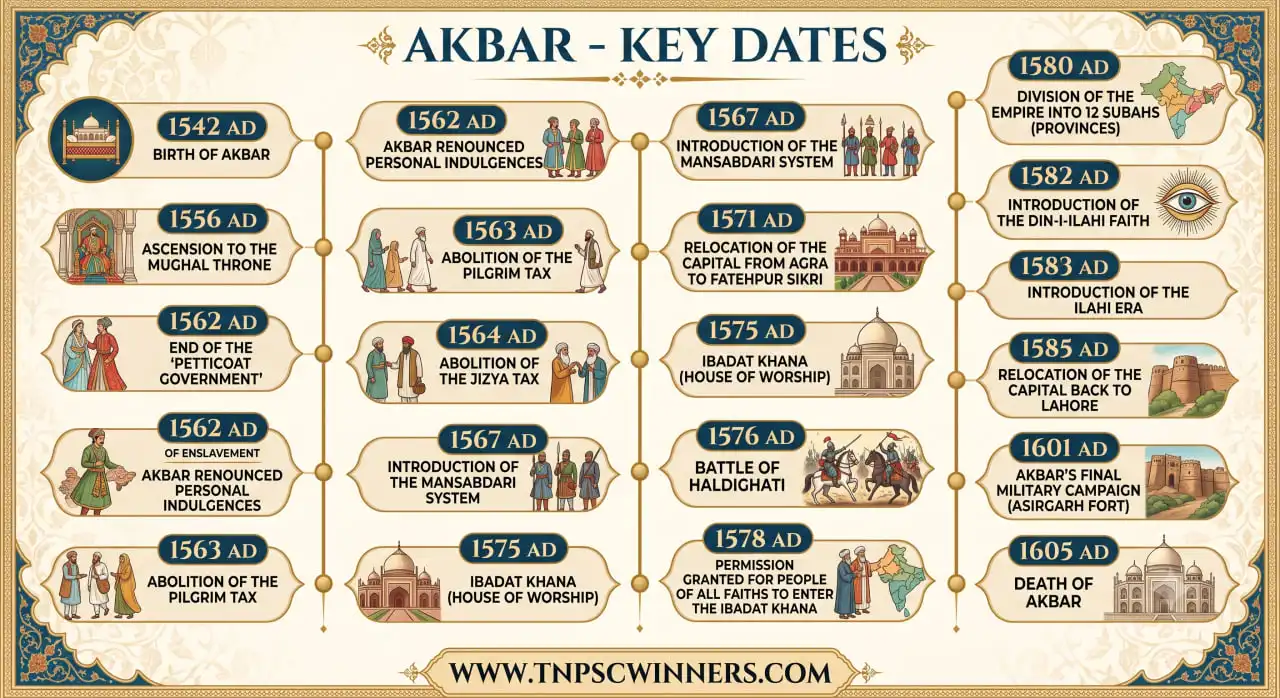
Akbar – Key Dates
- Birth of Akbar = 1542 AD
- Ascension to the Mughal throne = 1556 AD
- End of the ‘Petticoat Government’ = 1562 AD
- Abolition of the practice of enslavement = 1562 AD
- Akbar renounced personal indulgences = 1562 AD
- Abolition of the pilgrim tax = 1563 AD
- Abolition of the Jizya tax = 1564 AD
- Introduction of the Mansabdari system = 1567 AD
- Relocation of the capital from Agra to Fatehpur Sikri = 1571 AD
- Ibadat Khana (House of Worship) = 1575 AD
- Battle of Haldighati = 1576 AD
- Permission granted for people of all faiths to enter the Ibadat Khana = 1578 AD
- Division of the empire into 12 Subahs (provinces) = 1580 AD
- Introduction of the Din-i-Ilahi faith = 1582 AD
- Introduction of the Ilahi Era = 1583 AD
- Relocation of the capital back to Lahore = 1585 AD
- Akbar’s final military campaign (Asirgarh Fort) = 1601 AD
- Death of Akbar = 1605 AD