
Anglo French Wars in India
Study Anglo French Wars in India (1746–1763), including the three Carnatic Wars, major battles, key leaders, treaties, and outcomes for TNPSC exams.
Anglo French Wars in India
- The Anglo-French Wars were a series of conflicts between the English East India Company and the French East India Company during the 18th century for political supremacy and control over trade in India.
- These wars played a crucial role in establishing British dominance in India.
JOIN OUR TELEGRAM CHANNEL – T.ME/TNPSC_WINNERS

Anglo-French Wars in India – Background
- English East India Company = Established in 1600.
- French East India Company = Established in 1664 under the patronage of King Louis XIV.
- Main objective = Control of trade, territories and political influence in India.
- Major centre of French power = Pondicherry (Puducherry).
- Major centre of English power = Madras (Chennai).
- Key French governor = Joseph François Dupleix.
- Key British military leader = Robert Clive.
- Anglo French Wars in India
Three Carnatic Wars
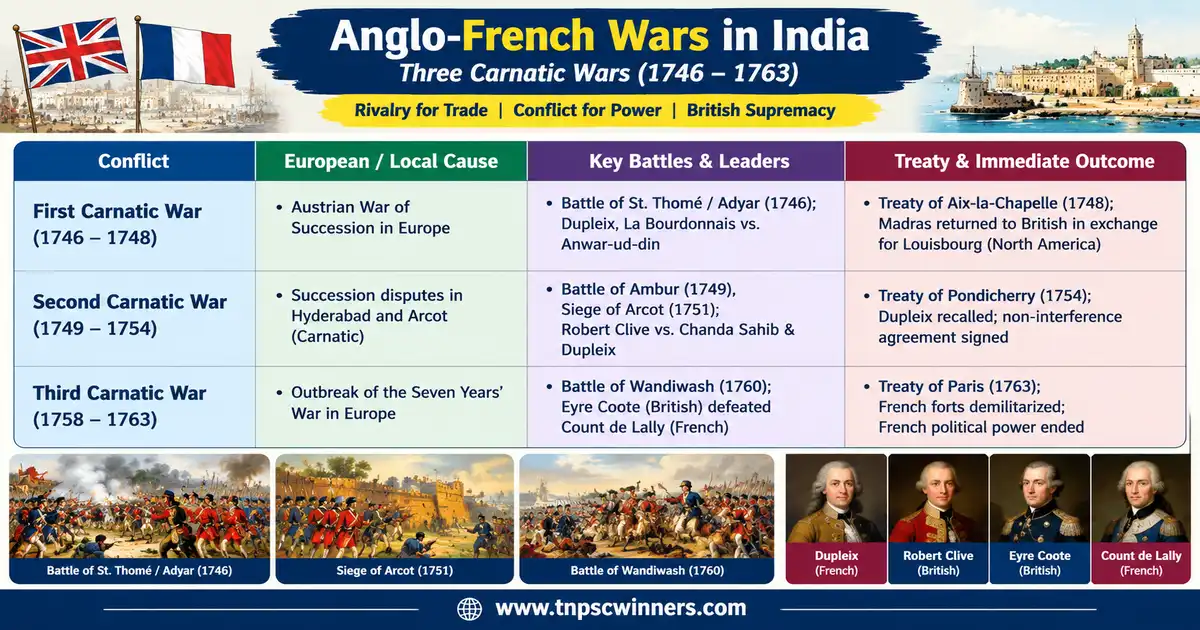
- The Anglo-French conflict in India is commonly studied through the three Carnatic Wars (1746–1763).
First Carnatic War (1746–1748)
- European connection = War of the Austrian Succession.
- French governor = Joseph François Dupleix.
- Major event = The French captured Madras in 1746.
- Battle of Adyar (1746) = French forces defeated the army of the Nawab of Carnatic.
- Treaty = Treaty of Aix-la-Chapelle (1748).
- Result = Madras was restored to the English.
Second Carnatic War (1749–1754)
- Background = Disputes over succession in Hyderabad and the Carnatic.
- French-supported candidates = Chanda Sahib and Muzaffar Jang.
- English-supported candidates = Muhammad Ali in the Carnatic and Nasir Jang in Hyderabad.
- Major event = Robert Clive captured Arcot in 1751.
- The person known as the “Hero of Arcot” is Robert Clive.
- French governor = Dupleix initially; Charles Godeheu later.
- For Dupleix, who had significantly expanded French influence in South India, this war ended in a major defeat. The French government recalled him to his home country.
- Godeheu took office as the new French governor in India.
- Treaty = Treaty of Pondicherry (1754).
- Result = Dupleix was recalled to France; the French political position weakened.
- Anglo French Wars in India
Third Carnatic War (1756–1763)
- European connection = Seven Years’ War.
- French commander = Count de Lally.
- British commander = Sir Eyre Coote.
- The person known as the “Hero of Wandiwash” is Sir Eyre Coote.
- Decisive battle = Battle of Wandiwash (Vandavasi), 1760.
- Result = The British defeated the French.
- Treaty = Treaty of Paris (1763).
- Outcome = French settlements were restored, but the French lost their ambition to establish a major territorial empire in India.
- Anglo French Wars in India
Important Battles and Events
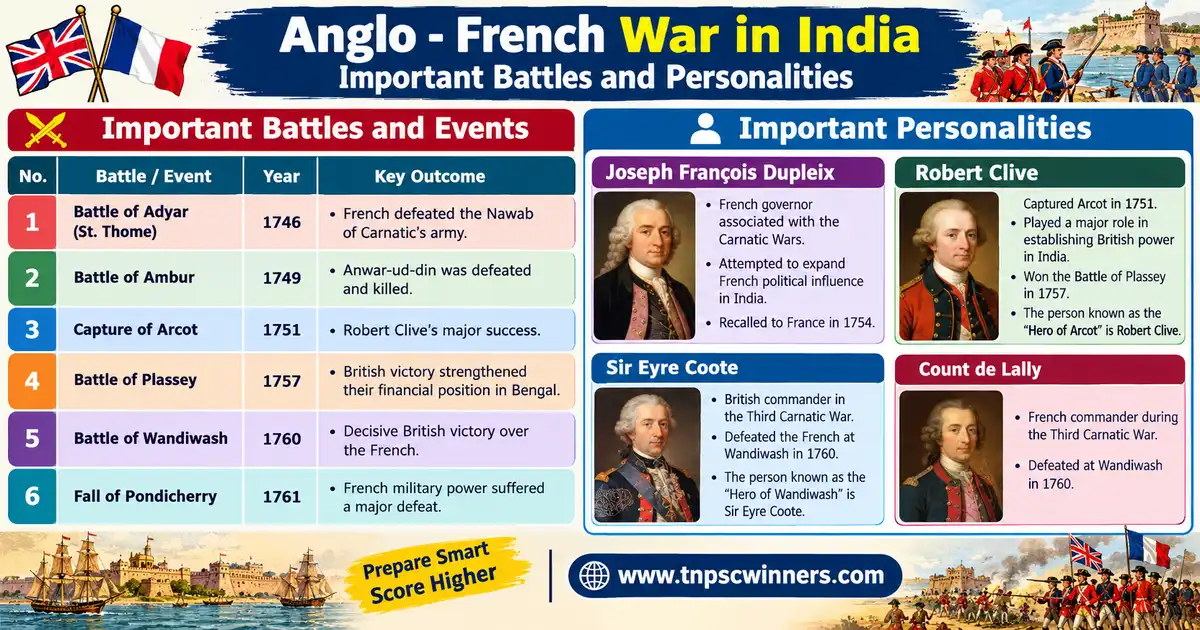
- Battle of Adyar (St. Thome) (1746) = French defeated the Nawab of Carnatic’s army
- Battle of Ambur (1749) = Anwar-ud-din was defeated and killed
- Capture of Arcot (1751) = Robert Clive’s major success
- Battle of Plassey (1757) = British victory strengthened their financial position in Bengal
- Battle of Wandiwash (1760) = Decisive British victory over the French
- Fall of Pondicherry (1761) = French military power suffered a major defeat.
- Anglo French Wars in India
Important Personalities
Joseph François Dupleix
- French governor associated with the Carnatic Wars.
- Attempted to expand French political influence in India.
- Recalled to France in 1754.
Robert Clive
- Captured Arcot in 1751.
- Played a major role in establishing British power in India.
- Won the Battle of Plassey in 1757.
- The person known as the “Hero of Arcot” is Robert Clive.
- Who is called as “Founder of the British Empire in India” = Robert Clive.
- Who is called as “Conqueror of Bengal” = Robert Clive
Sir Eyre Coote
- British commander in the Third Carnatic War.
- Defeated the French at Wandiwash in 1760.
- The person known as the “Hero of Wandiwash” is Sir Eyre Coote.
Count de Lally
- French commander during the Third Carnatic War.
- Defeated at Wandiwash in 1760.
- Anglo French Wars in India
Why did the French lose to the British?
- Naval superiority = The British had a stronger and more reliable naval presence.
- Financial resources = British control of Bengal after Plassey (1757) provided substantial resources.
- Political support = The French government did not provide consistent support to its Indian operations.
- Strategic limitations = French military resources were stretched across several regions.
- British leadership = Leaders such as Robert Clive and Sir Eyre Coote contributed to British victories.
Treaty comparison – important for TNPSC
- First Carnatic War = Treaty of Aix-la-Chapelle (1748)
- Second Carnatic War = Treaty of Pondicherry (1754)
- Third Carnatic War = Treaty of Paris (1763)
- Anglo French Wars in India
Quick revision – one-liners
- French East India Company = Established in 1664.
- French headquarters in India = Pondicherry.
- First Carnatic War = 1746–1748.
- Second Carnatic War = 1749–1754.
- Third Carnatic War = Commonly dated 1758–1763 in Indian history textbooks.
- Battle of Adyar = 1746.
- Battle of Ambur = 1749.
- Capture of Arcot = 1751, by Robert Clive.
- Battle of Wandiwash = 1760.
- British commander at Wandiwash = Sir Eyre Coote.
- French commander at Wandiwash = Count de Lally.
- Pondicherry captured by the British = 1761.
- Treaty of Paris = 1763.
- Final outcome = British political supremacy was strengthened; French influence was largely restricted to trading settlements.
- Anglo French Wars in India