
Anglo-Maratha Wars
Learn about the Anglo-Maratha Wars (1775–1818), including causes, major battles, Governor-Generals, important treaties, key events and results for TNPSC and other competitive exams.
Anglo-Maratha Wars
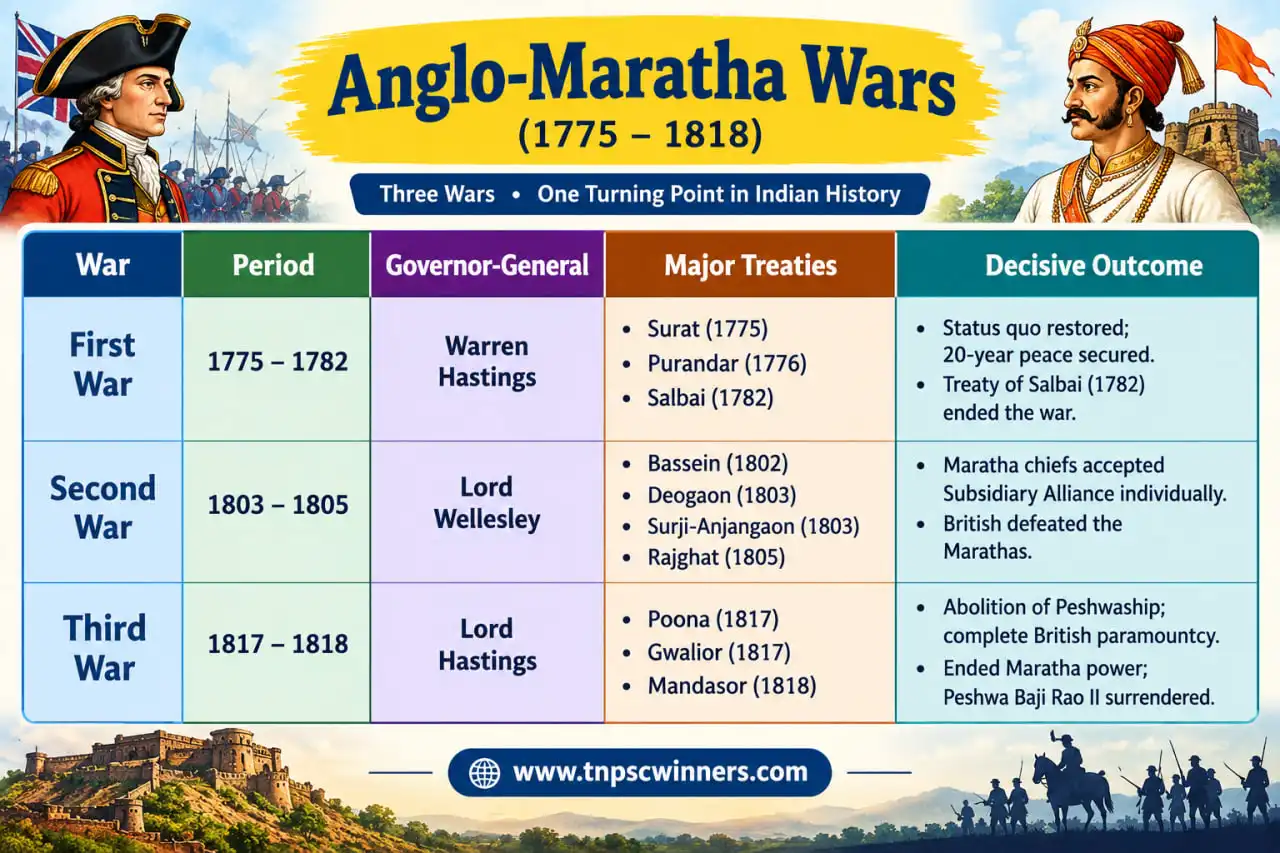
- The Anglo-Maratha Wars were a series of three wars fought between the English East India Company and the Maratha Confederacy.
- They played a major role in the expansion of British power in India.
JOIN OUR TELEGRAM CHANNEL – T.ME/TNPSC_WINNERS

First Anglo-Maratha War (1775–1782)
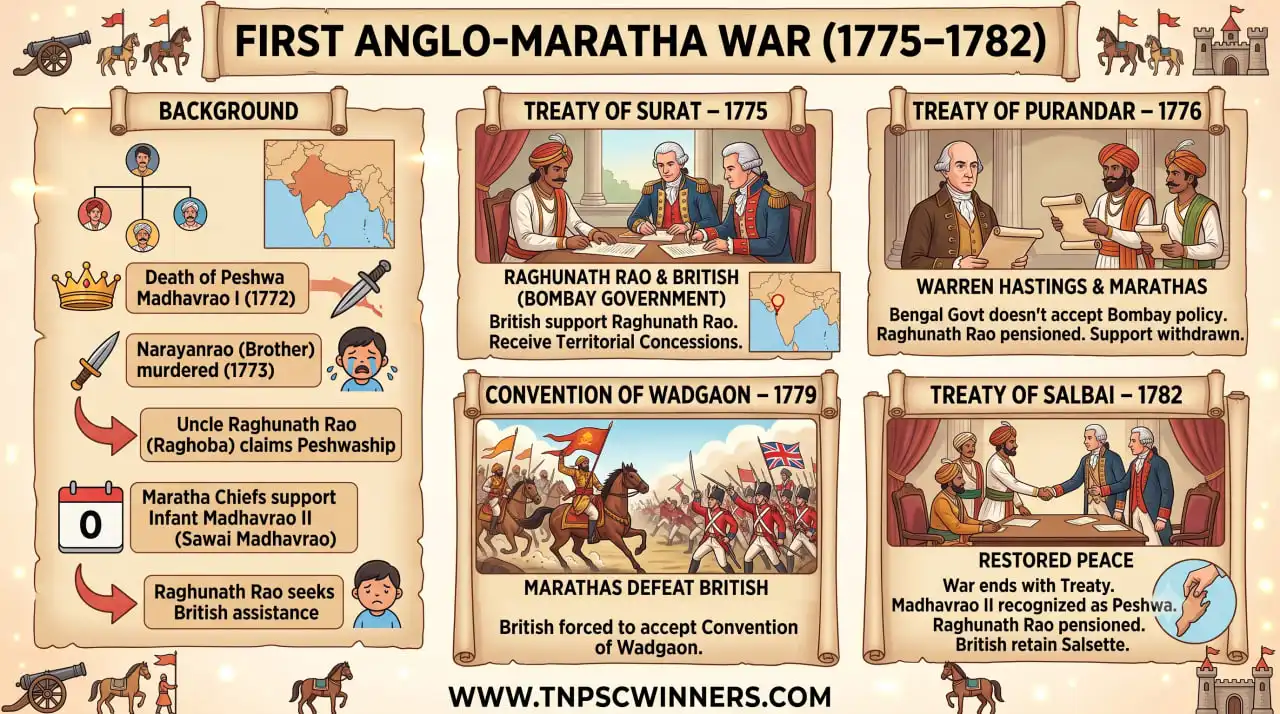
- FIrst Anglo Maratha War came after the death of Peshwa Madhavrao in 1772.
Background
- After the death of Peshwa Madhavrao I in 1772, his brother Narayanrao became Peshwa.
- Narayanrao was murdered in 1773.
- His uncle Raghunath Rao (Raghoba) claimed the Peshwaship.
- The Maratha chiefs supported the infant Madhavrao II (Sawai Madhavrao) instead.
- Raghunath Rao sought British assistance.
Treaty of Surat – 1775
- Raghunath Rao entered into the Treaty of Surat with the British.
- The British agreed to support Raghunath Rao’s claim to the Peshwaship.
- In return, the British received territorial concessions.
Treaty of Purandar – 1776
- The British government in Bengal, under Warren Hastings, did not fully accept the Bombay government’s policy.
- The Treaty of Purandar was concluded with the Marathas.
- Raghunath Rao was pensioned and the British withdrew their support temporarily.
Convention of Wadgaon – 1779
- Maratha forces defeated the British near Wadgaon.
- The British were forced to accept the Convention of Wadgaon.
Treaty of Salbai – 1782
- The war ended with the Treaty of Salbai.
- It restored peace between the British and the Marathas.
- Madhavrao II was recognized as Peshwa.
- Raghunath Rao was given a pension.
- The British retained Salsette.
Exam Point
- First Anglo-Maratha War → Treaty of Salbai (1782)
Second Anglo-Maratha War (1803–1805)
- Second Anglo-Marath War starts at 1803.
Background
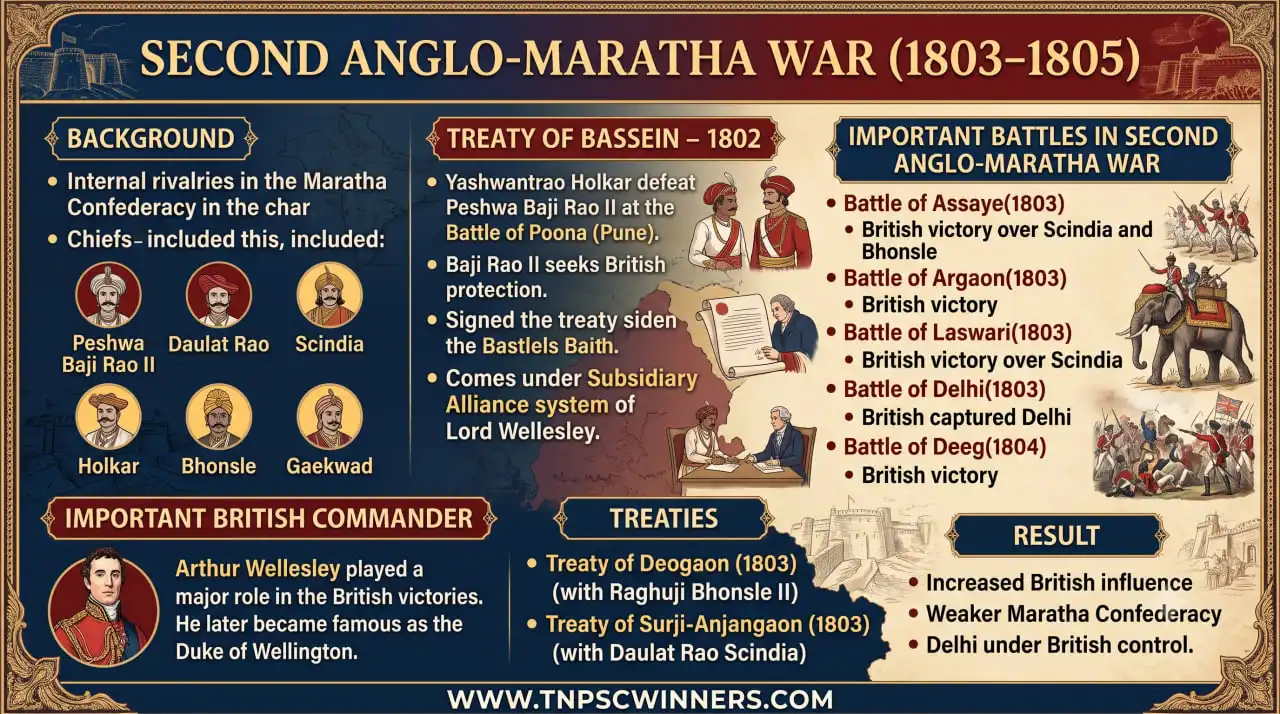
- The Maratha Confederacy was weakened by internal rivalries.
- Major Maratha chiefs included = Peshwa Baji Rao II, Daulat Rao, Scindia, Holkar, Bhonsle and Gaekwad.
Treaty of Bassein – 1802
- Yashwantrao Holkar defeated Peshwa Baji Rao II at the Battle of Poona (Pune) in 1802.
- Baji Rao II sought British protection.
- He signed the Treaty of Bassein (1802) with the British.
- This brought the Peshwa under the Subsidiary Alliance system of Lord Wellesley.
Important Battles in Second Anglo-Maratha war
- Battle of Assaye(1803) = British victory over Scindia and Bhonsle forces
- Battle of Argaon(1803) = British victory
- Battle of Laswari(1803) = British victory over Scindia
- Battle of Delhi(1803) = British captured Delhi
- Battle of Deeg(1804) = British victory
Important British Commander
- Arthur Wellesley played a major role in the British victories.
- He later became famous as the Duke of Wellington.
Treaties in 2nd Anglo-Maratha War
- Treaty of Deogaon (1803) – concluded with Raghuji Bhonsle II.
- Treaty of Surji-Anjangaon (1803) – concluded with Daulat Rao Scindia.
Result
- British influence over Maratha territories increased considerably.
- The Maratha Confederacy became weaker.
- Delhi came under British control.
Exam Point
- Second Anglo-Maratha War → Treaty of Bassein (1802) was the immediate background.
Third Anglo-Maratha War (1817–1818)
- Third Anglo-Maratha War starts at 1817.
Background
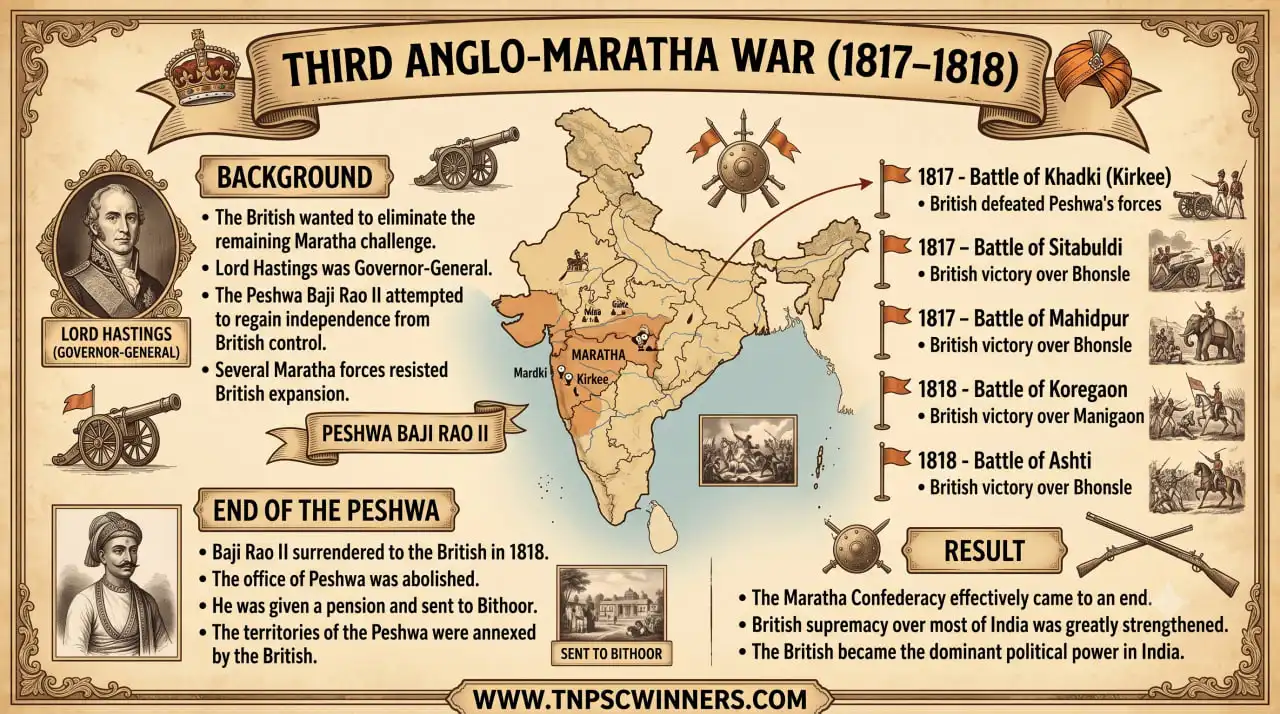
- The British wanted to eliminate the remaining Maratha challenge.
- Lord Hastings was Governor-General.
- The Peshwa Baji Rao II attempted to regain independence from British control.
- Several Maratha forces resisted British expansion.
Important Battles in Third Anglo-Maratha War
- Battle of Khadki (Kirkee) (1817) = British defeated Peshwa’s forces
- Battle of Sitabuldi (1817) = British victory over Bhonsle
- Battle of Mahidpur (1817) = British defeated Holkar
- Battle of Koregaon (1818) = Famous confrontation involving Peshwa’s forces
- Battle of Ashti (1818) = British victory over Peshwa’s forces
End of the Peshwa
- Baji Rao II surrendered to the British in 1818.
- The office of Peshwa was abolished.
- He was given a pension and sent to Bithoor.
- The territories of the Peshwa were annexed by the British.
Result
- The Maratha Confederacy effectively came to an end.
- British supremacy over most of India was greatly strengthened.
- The British became the dominant political power in India.
Anglo-Maratha Wars – Most Important One-Liners for TNPSC
- First Anglo-Maratha War = 1775–1782
- Second Anglo-Maratha War = 1803–1805
- Third Anglo-Maratha War = 1817–1818
- Governor-General during First Anglo-Maratha War = Warren Hastings
- Governor-General during Second Anglo-Maratha War = Lord Wellesley
- Governor-General during Third Anglo-Maratha War = Lord Hastings
- Treaty that ended First Anglo-Maratha War = Treaty of Salbai (1782)
- Treaty that brought Peshwa under Subsidiary Alliance = Treaty of Bassein (1802)
- Peshwa during Second and Third Wars = Baji Rao II
- Treaty with Scindia, 1803 = Treaty of Surji-Anjangaon
- Treaty with Bhonsle, 1803 = Treaty of Deogaon
- Major battle of Second War = Battle of Assaye (1803)
- Battle involving Holkar, 1817 = Battle of Mahidpur
- Treaty with Holkar, 1818 = Treaty of Mandasor
- Last Peshwa = Baji Rao II
- Office abolished after Third War = Peshwa
- Final result of Third War = End of Maratha political supremacy
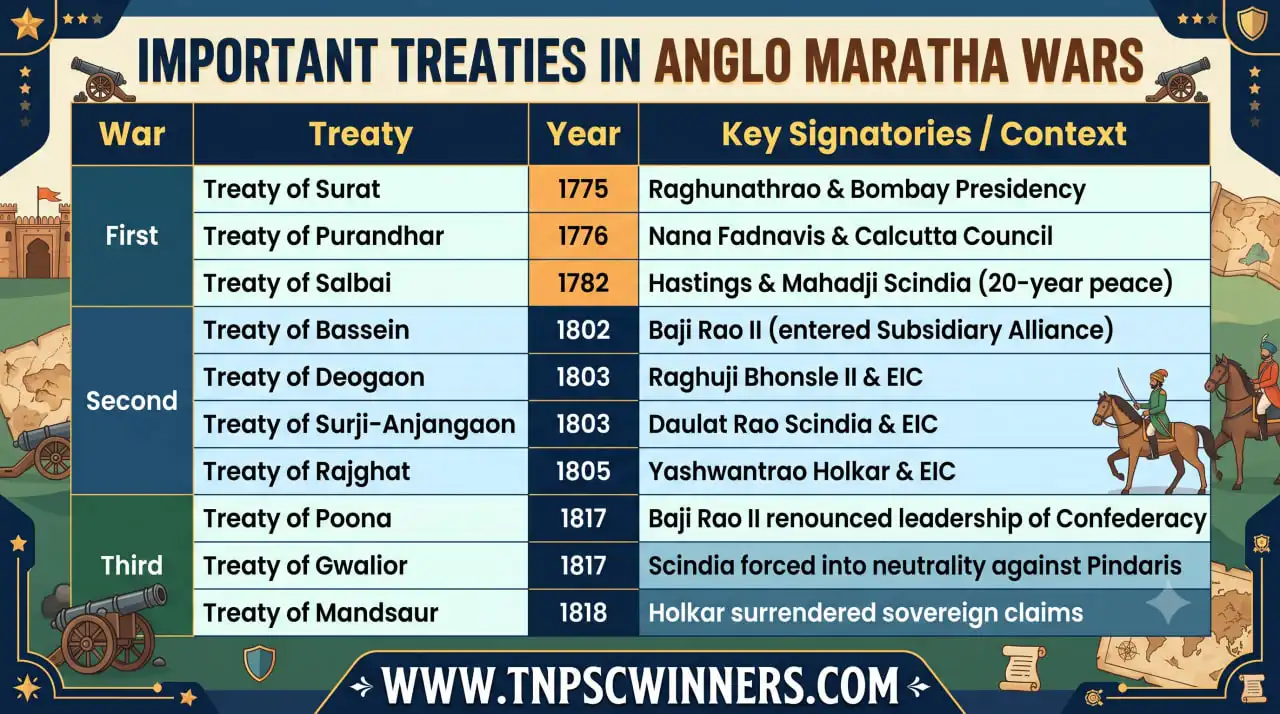
Important Treaties of the Anglo-Maratha Wars
- Treaty of Surat (1775) = Raghunath Rao sought British support
- Treaty of Purandar (1776) = First Anglo-Maratha War
- Treaty of Salbai (1782) = Ended First Anglo-Maratha War
- Treaty of Bassein (1802) = Peshwa accepted British protection
- Treaty of Deogaon (1803) = Raghuji Bhonsle II
- Treaty of Surji-Anjangaon (1803) = Daulat Rao Scindia
- Treaty of Mandasor (1818) = Holkar and British
Important Personalities in Anglo-Maratha Wars
- Raghunath Rao – claimant to the Peshwaship during the First War.
- Madhavrao II – Peshwa supported by the Maratha chiefs.
- Baji Rao II – Peshwa during the Second and Third Wars.
- Daulat Rao Scindia – major Maratha chief.
- Yashwantrao Holkar – defeated Baji Rao II at Pune in 1802.
- Raghuji Bhonsle II – Maratha ruler of Nagpur.
- Lord Wellesley – Governor-General during the Second Anglo-Maratha War.
- Arthur Wellesley – important British commander.
- Lord Hastings – Governor-General during the Third Anglo-Maratha War.
TNPSC Important One-Liners for Anglo-Maratha Wars
- Anglo-Maratha Wars = Three wars.
- First Anglo-Maratha War = 1775–1782.
- First Anglo-Maratha War ended with the Treaty of Salbai (1782).
- Treaty of Surat = 1775.
- Convention of Wadgaon = 1779.
- Second Anglo-Maratha War = 1803–1805.
- Treaty of Bassein = 1802.
- Treaty of Bassein was signed between Baji Rao II and the British.
- Treaty of Bassein brought the Peshwa under the Subsidiary Alliance system.
- Battle of Assaye = 1803.
- Arthur Wellesley played an important role in the Battle of Assaye.
- Third Anglo-Maratha War = 1817–1818.
- Lord Hastings was Governor-General during the Third Anglo-Maratha War.
- Battle of Khadki (Kirkee) = 1817.
- Battle of Mahidpur = 1817.
- Battle of Koregaon = 1818.
- Peshwa Baji Rao II surrendered in 1818.
- The office of Peshwa was abolished after the Third Anglo-Maratha War.
- The Third Anglo-Maratha War ended effective Maratha political supremacy.
- After 1818, British supremacy over India was greatly strengthened.
Most important TNPSC sequence to remember
- Surat (1775) → Purandar (1776) → Wadgaon (1779) → Salbai (1782) → Bassein (1802) → Assaye (1803) → Khadki (1817) → Mahidpur (1817) → Koregaon (1818).