
Aurangzeb – Biography, Reign, Policies, Wars and Important Facts
Learn about Aurangzeb, the last of the great Mughal emperors, including his early life, accession, reign (1658–1707), religious and administrative policies, Deccan campaigns, Maratha conflict, wars, and important exam-oriented facts.
Aurangzeb – Biography, Policies & Important Facts
- Aurangzeb was the sixth Mughal emperor and ruled for nearly half a century. His reign is important for the study of Mughal administration, Deccan expansion, Marathas, Sikh history, and Mughal decline.
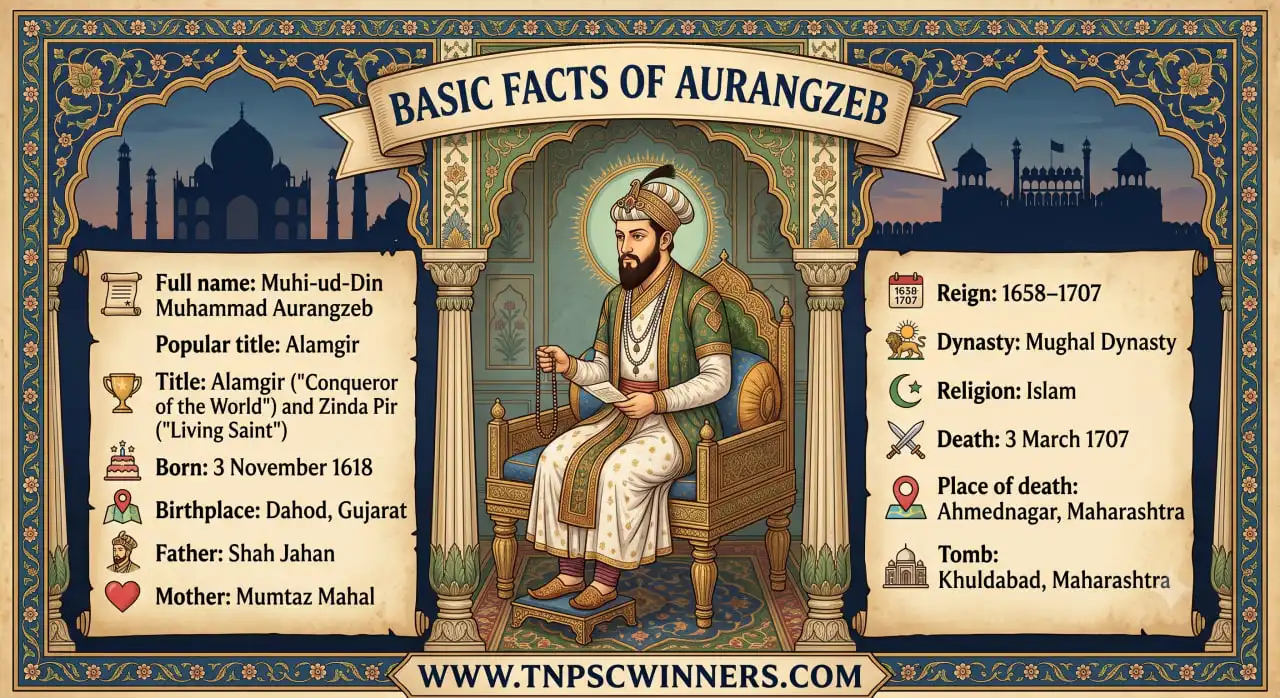
Basic Facts of Aurangzeb
- Full name = Muhi-ud-Din Muhammad Aurangzeb
- Popular title = Alamgir
- Title = Alamgir (“Conqueror of the World”) and Zinda Pir (“Living Saint”)
- Born = 3 November 1618
- Birthplace = Dahod, Gujarat
- Father = Shah Jahan
- Mother = Mumtaz Mahal
- Reign = 1658–1707
- Dynasty = Mughal Dynasty
- Religion = Islam
- Death = 3 March 1707
- Place of death = Ahmednagar, Maharashtra
- Tomb = Khuldabad, Maharashtra
- Aurangzeb – Biography, Policies & Important Facts
JOIN OUR TELEGRAM CHANNEL – T.ME/TNPSC_WINNERS

Aurangzeb’s War of Succession
- Battle of Dharmat – 1658: Aurangzeb defeated the forces of Dara Shikoh.
- Battle of Samugarh – 1658: Aurangzeb defeated Dara Shikoh.
- Battle of Khajwa – 1659: Aurangzeb defeated Shah Shuja.
- Battle of Deorai – 1659: Aurangzeb defeated Dara Shikoh.
Religious Policies of Aurangzeb
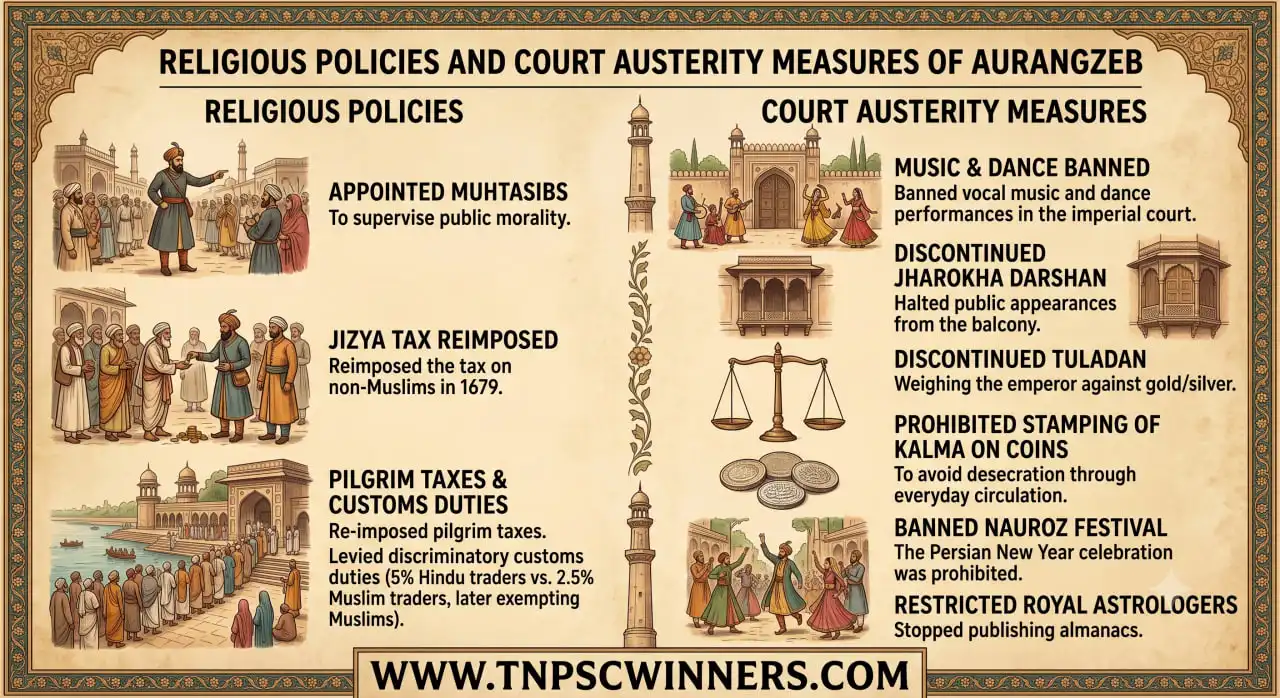
- He appointed Muhtasibs to supervise public morality.
- He abolished some practices considered un-Islamic.
- The jizya tax on non-Muslims was reimposed in 1679.
- Re-imposed pilgrim taxes and levied discriminatory customs duties (5% on Hindu traders vs. 5% on Muslim traders, later fully exempting Muslims).
- He ordered the compilation of the Fatawa-i-Alamgiri, an important collection of Islamic law.
- Music at the imperial court was discouraged, although music did not disappear from Mughal society.
- His religious policies remain an important subject of historical debate.
- Aurangzeb – Biography, Policies & Important Facts
Aurangzeb’s Court Austerity Measures
- Banned vocal music and dance performances in the imperial court
- Discontinued Jharokha Darshan (balcony appearances)
- Discontinued Tuladan (weighing the emperor against gold/silver)
- Prohibited the stamping of the Kalma on coins to avoid desecration through everyday circulation.
- Banned the Persian festival of Nauroz
- Restricted royal astrologers from publishing almanacs.
- Aurangzeb – Biography, Policies & Important Facts
Aurangzeb’s Military Campaign against Marathas
- Shivaji challenged Mughal authority in the Deccan.
- Chhatrapati Shivaji sacked Surat twice (1664, 1670).
- Raja Jai Singh forced the Treaty of Purandar (1665).
- Shivaji visited Aurangzeb’s court at Agra in
- After Shivaji’s death in 1680, the struggle continued under Sambhaji and later Maratha leaders.
- Aurangzeb captured and executed Sambhaji in
- Despite prolonged Mughal campaigns, Maratha resistance continued.
- Marathas switched to decentralized guerrilla warfare (Bargir-giri) under Rajaram and Tarabai.
Aurangzeb’s Military Campaign against Deccan
- Personally moved to the Deccan in
- Annexed Bijapur (Adil Shahi, 1686) and Golconda (Qutb Shahi, 1687).
- Instead of pacifying the region, the annexation removed buffer states, draining imperial finances and manpower (“The Deccan Ulcer”).
Aurangzeb’s Relations with the Sikhs
- Guru Tegh Bahadur, the ninth Sikh Guru, was executed in Delhi in 1675.
- His execution had a major impact on the subsequent development of Sikh resistance.
- Guru Gobind Singh, the tenth Sikh Guru, founded the Khalsa in 1699.
- Aurangzeb – Biography, Policies & Important Facts
Architecture in Aurangzeb Period
- Badshahi Mosque – Lahore
- Bibi Ka Maqbara – Aurangabad. Built by Azam Shah, Aurangzeb’s son, in memory of Dilras Banu Begum.
- Called as “Taj of the Deccan”
Aurangzeb’s Death
- Aurangzeb died on 3 March 1707 at Ahmednagar.
- He was buried at Khuldabad near Aurangabad, in a relatively simple open-air grave.
Important Battles of Aurangazeb – Quick Revision
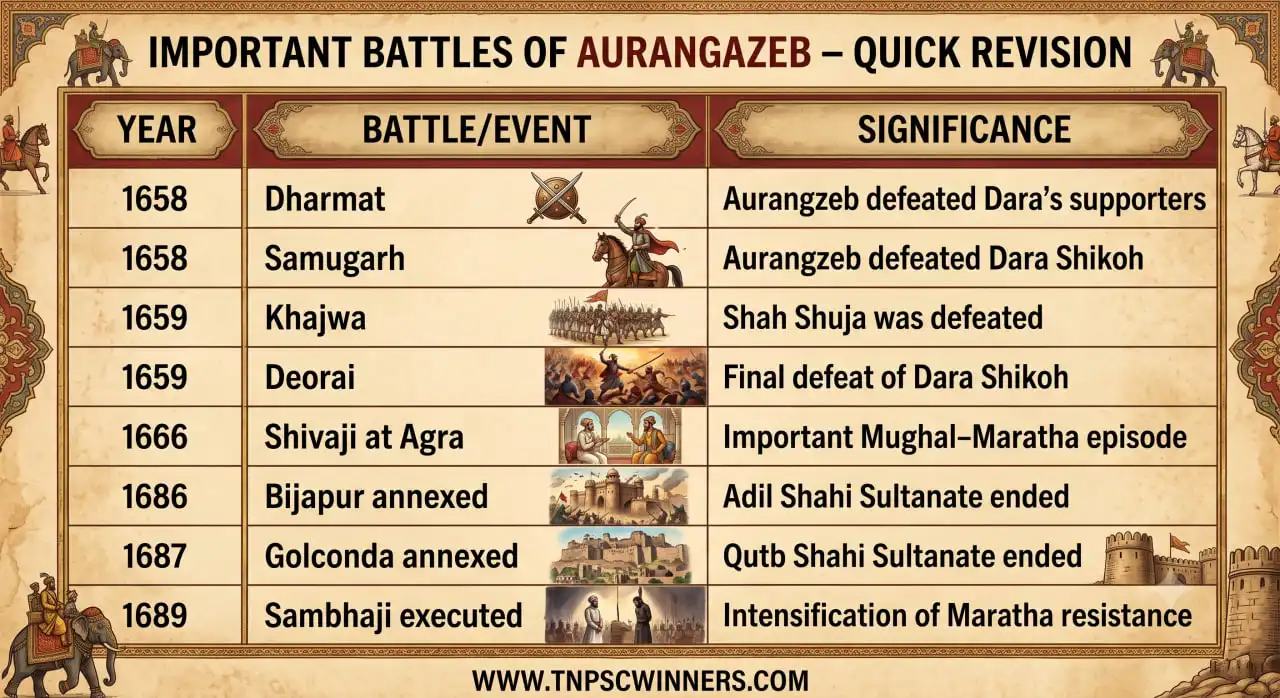
| Year | Battle/Event | Significance |
| 1658 | Dharmat | Aurangzeb defeated Dara’s supporters |
| 1658 | Samugarh | Aurangzeb defeated Dara Shikoh |
| 1659 | Khajwa | Shah Shuja was defeated |
| 1659 | Deorai | Final defeat of Dara Shikoh |
| 1666 | Shivaji at Agra | Important Mughal–Maratha episode |
| 1686 | Bijapur annexed | Adil Shahi Sultanate ended |
| 1687 | Golconda annexed | Qutb Shahi Sultanate ended |
| 1689 | Sambhaji executed | Intensification of Maratha resistance |
Aurangzeb – General Notes
- He ruled for approximately 50
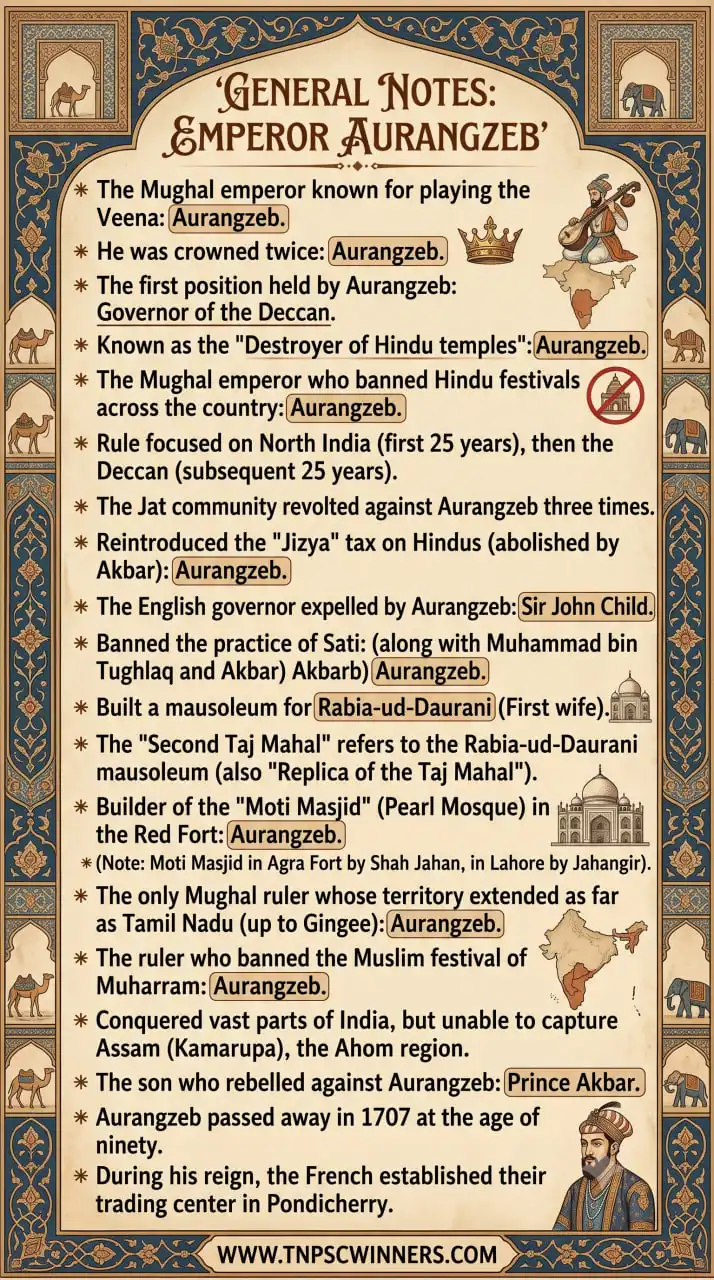
- The Mughal emperor known for playing the Veena = Aurangzeb.
- He was crowned twice = Aurangzeb.
- The first position held by Aurangzeb = Governor of the Deccan.
- He adopted the title “Alamgir” (Conqueror of the World) = Aurangzeb.
- He was known as “Darvesh” or “Zinda Pir” (Living Saint) = Aurangzeb.
- Aurangzeb’s wife = Persian Princess Dilras Banu Begum.
- Who was known as the “Destroyer of Hindu temples” = Aurangzeb.
- The Mughal emperor who banned Hindu festivals across the country = Aurangzeb.
- Historians divide his reign into two 25-year periods.
- Aurangzeb’s first 25 years of rule were focused on North India, while the subsequent 25 years were focused on the Deccan.
- The Jat community revolted against Aurangzeb three times.
- He reintroduced the “Jizya” tax on Hindus, which had been abolished by Akbar = Aurangzeb.
- The English governor expelled by Aurangzeb = Sir John Child.
- Practices banned by Aurangzeb = Rahdari tax, the festival of Navroz, Jharokha Darshan, Sati (widow burning), Dussehra, and Muharram.
- He banned Sati (widow burning) across the country in 1663
- Muslim rulers who banned Sati (the practice of a widow immolating herself on her husband’s funeral pyre) = Muhammad bin Tughlaq, Akbar, and Aurangzeb.
- Aurangzeb built a mausoleum for Rabia-ud-Daurani.
- The “Second Taj Mahal” refers to the Rabia-ud-Daurani mausoleum.
- The structure known as the “Replica of the Taj Mahal” is the Rabia-ud-Daurani mausoleum.
- The builder of the “Moti Masjid” (Pearl Mosque) in Agra Fort: Shah Jahan.
- The builder of the “Moti Masjid” (Pearl Mosque) in the Red Fort: Aurangzeb.
- The builder of the “Moti Masjid” (Pearl Mosque) in Lahore: Jahangir.
- The ruler who ascended the Mughal throne after Aurangzeb’s death: Bahadur Shah I.
- The only Mughal ruler whose territory extended as far as Tamil Nadu (up to Gingee): Aurangzeb.
- The ruler who banned the Muslim festival of Muharram: Aurangzeb.
- Aurangzeb’s empire was divided into 21
- The ruler who governed the largest territory during the Mughal era: Aurangzeb.
- The thirty-year conflict between Marwar and the Mughals unfolded in three phases: 1681–1687, 1687–1701, and 1701–1707. During the third phase (1701–1707), the Rajputs effectively secured independence for Marwar. Who is considered the hero of this thirty-year war? = Durgadas Rathore.
- During Aurangzeb’s reign, the Jats revolted under Gokula (1669), and a second rebellion took place in 1685 under the leadership of Rajaram. Who among them looted Akbar’s tomb, and took away and burned Akbar’s bones? = Rajaram.
- The last of the Great Mughal emperors = Aurangzeb.
- He refrained from appointing Hindus to government positions.
- Although Aurangzeb conquered a vast part of India, he was unable to capture the region of the Ahom people—Assam (Kamarupa).
- The son who rebelled against Aurangzeb = Prince Akbar.
- Prince Akbar entered into a pact with Sambhaji, the son of Shivaji.
- Aurangzeb passed away in 1707 at the age of ninety.
- During Aurangzeb’s reign, the French established their trading center in Pondicherry.
- Aurangzeb – Biography, Policies & Important Facts
Aurangzeb’s Important TNPSC One-Liners
- Sixth Mughal Emperor → Aurangzeb
- Title of Aurangzeb → Alamgir
- Father → Shah Jahan
- Mother → Mumtaz Mahal
- Reign → 1658–1707
- Jizya reimposed → 1679
- Bijapur annexed → 1686
- Golconda annexed → 1687
- Sambhaji executed → 1689
- Khalsa founded → 1699, by Guru Gobind Singh
- Guru Tegh Bahadur executed → 1675
- Fatawa-i-Alamgiri → Islamic law compilation under Aurangzeb
- Aurangzeb died → 1707
- Death place → Ahmednagar
- Burial place → Khuldabad
- Aurangzeb – Biography, Policies & Important Facts