
Ayurveda Day 2026 – Date, Theme, History and Significance
Ayurveda Day 2026: Learn the date, theme, history, significance and important facts about Ayurveda Day for TNPSC, UPSC and competitive exams.
Ayurveda Day 2026
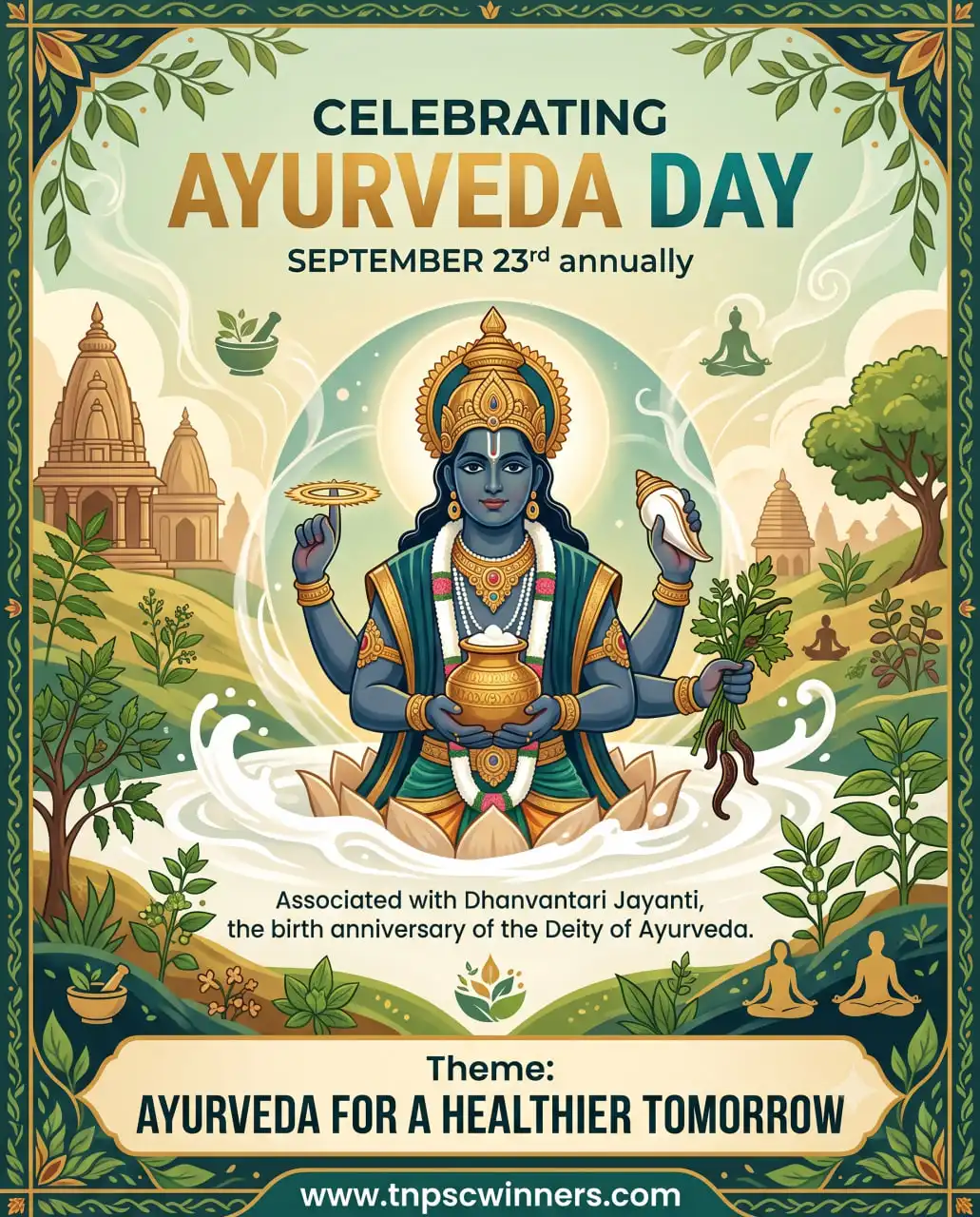
- The Ayurveda Day is celebrated on September 23rd annually.
- Ayurveda Day is observed annually in India to promote awareness of Ayurveda, the traditional system of Indian medicine.
JOIN OUR TELEGRAM CHANNEL – T.ME/TNPSC_WINNERS

Why Ayurveda Day is celebrated?
- The day is associated with Dhanvantari Jayanti, the birth anniversary of Lord Dhanvantari, regarded in the Ayurvedic tradition as the deity associated with medicine and Ayurveda.
Ayurveda Day – Important Facts
- Ayurveda Day = Observed annually in India on September 23rd
- Associated with = Dhanvantari Jayanti
- Lord Dhanvantari = Associated with Ayurveda and medicine
- Meaning of Ayurveda = Science/Knowledge of Life
- Ayus = Life
- Veda = Knowledge/Science
- System of medicine = Traditional Indian system of medicine
- Ministry associated with Ayurveda = Ministry of Ayush, Government of India
- Ayurveda Day observance = Dhanteras / Dhanvantari Jayanti
- Website = https://ayurvedaday.org.in/
Key Details for Ayurveda Day 2026
- Date = September 23, 2026
- Theme = “Ayurveda for a Healthier Tomorrow”
- Core Message = One Health, One Future
- Main Celebration Venue = Nagpur, Maharashtra (with additional state and national events across institutions like NIA Panchkula and Kerala)
- Focus Areas = Preventive healthcare, evidence-based research, innovation, and sustainable community well-being.
- Ayurveda Day 2026
Objectives of the Ayurveda Day
- Promote and position Ayurveda to the global forefront of healthcare.
- Explore the potential of Ayurveda to contribute towards national health policy and shaping national health programs.
- Reduce the disease burden and associated morbidity and mortality by harnessing the untapped potential of Ayurveda.
- Ayurveda Day 2026
What are the Three Doshas?
- A fundamental concept in Ayurveda is the Tridosha theory:
-
- Vata – associated mainly with movement and bodily functions such as circulation and nervous activity.
- Pitta – associated mainly with metabolism and digestion.
- Kapha – associated mainly with structure, stability and lubrication.
-
- Vata + Pitta + Kapha = Tridosha
What are the Eight Branches of Ayurveda?
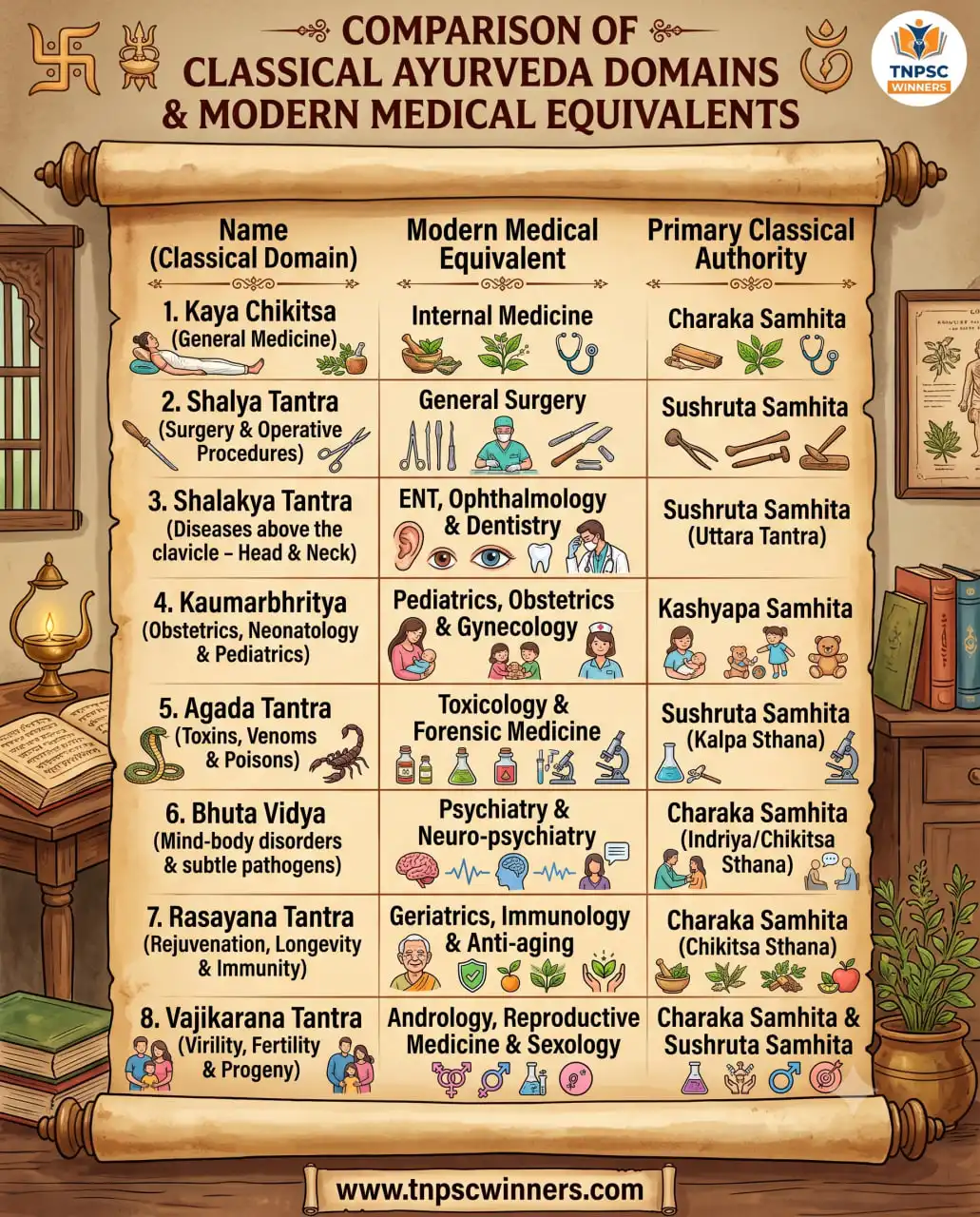
- Eight Branches of Ayurveda = Ashtanga Ayurveda
- The classical Ayurvedic system is traditionally divided into eight branches:
-
-
- Kaya Chikitsa – Internal medicine
- Shalya Tantra – Surgery
- Shalakya Tantra – Diseases of the eyes, ears, nose, throat and head
- Kaumarabhritya – Paediatrics and child care
- Rasayana – Rejuvenation and healthy ageing
- Vajikarana – Reproductive health
- Agada Tantra – Toxicology
- Bhuta Vidya – Traditionally concerned with mental disorders and related conditions
-
Important Ayurvedic Texts
- Charaka Samhita – Mainly deals with medicine (Kaya Chikitsa).
- Sushruta Samhita – Mainly deals with surgery (Shalya Tantra).
- Ashtanga Hridaya – Associated with Vagbhata and provides a systematic presentation of Ayurvedic knowledge.
- Ayurveda Day 2026
Important Personalities on Ayurveda
- Charaka – Traditionally associated with internal medicine.
- Sushruta – Traditionally known as the Father of Surgery in the Ayurvedic tradition.
- Vagbhata – Author associated with Ashtanga Hridaya.
- Dhanvantari – Traditionally regarded as the deity of Ayurveda and medicine.
Ayurveda and Ministry of Ayush
- Ministry of AYUSH is the Union ministry responsible for promoting and developing traditional systems of medicine in India.
- AYUSH stands for:
-
-
- A – Ayurveda
- Y – Yoga & Naturopathy
- U – Unani
- S – Siddha
- H – Homoeopathy
-
TNPSC One-Liner Questions on Ayurveda Day
- Ayurveda means → Science/Knowledge of Life.
- Ayurveda Day is associated with → Dhanvantari Jayanti.
- Dhanvantari is associated with → Ayurveda and medicine.
- Three Doshas → Vata, Pitta and Kapha.
- Charaka Samhita → Internal medicine.
- Sushruta Samhita → Surgery.
- Ashtanga Hridaya → Vagbhata.
- Father of Surgery in the Ayurvedic tradition → Sushruta.
- Eight branches of Ayurveda → Ashtanga Ayurveda.
- Ministry responsible for Ayurveda in India → Ministry of AYUSH.
- Ayurveda Day 2026