
British capture of Bengal
Learn about the British capture of Bengal, the Battle of Plassey (1757), the Battle of Buxar (1764), and the establishment of British rule in India.
British capture of Bengal
- The British East India Company’s capture of Bengal occurred primarily across two decisive military and political turning points—the Battle of Plassey (1757) and the Battle of Buxar (1764)—which transformed a trading corporation into the dominant territorial ruler of India’s wealthiest province.
Introduction
- Bengal was one of the richest provinces of the Mughal Empire during the 18th century.
- It was famous for its textiles, silk, muslin, agriculture, and trade.
- The British East India Company gradually established political control over Bengal through military victories, diplomatic manoeuvres, and interference in the succession of the Nawabs.
- The Battle of Plassey (1757) and the Battle of Buxar (1764) were the major turning points in the British conquest of Bengal.
Important Nawabs of Bengal
- Murshid Quli Khan = Established the effective autonomy of Bengal from Mughal central control
- Alivardi Khan = 1740–1756; predecessor of Siraj-ud-Daulah
- Siraj-ud-Daulah = 1756–1757; defeated at the Battle of Plassey
- Mir Jafar = 1757–1760; became Nawab with British support
- Mir Qasim = 1760–1763; attempted to resist British interference
- Mir Jafar = Restored as Nawab in 1763
- Najm-ud-Daulah = Became Nawab in 1765 under British influence
Causes of the British Capture of Bengal
- Economic interests = The East India Company wanted to control Bengal’s rich resources and profitable trade.
- Misuse of trade privileges = Company officials misused dastaks (passes exempting authorised goods from certain duties), causing disputes with the Nawab.
- Fortification of Calcutta = Siraj-ud-Daulah opposed the unauthorised strengthening of British fortifications.
- Interference in Bengal’s administration = The Company interfered in the Nawab’s political affairs.
- Conflict with Siraj-ud-Daulah = The Nawab attempted to restrict the Company’s privileges and assert his authority.
- Conspiracy against the Nawab = The British secured the support of Mir Jafar and other influential figures against Siraj-ud-Daulah.
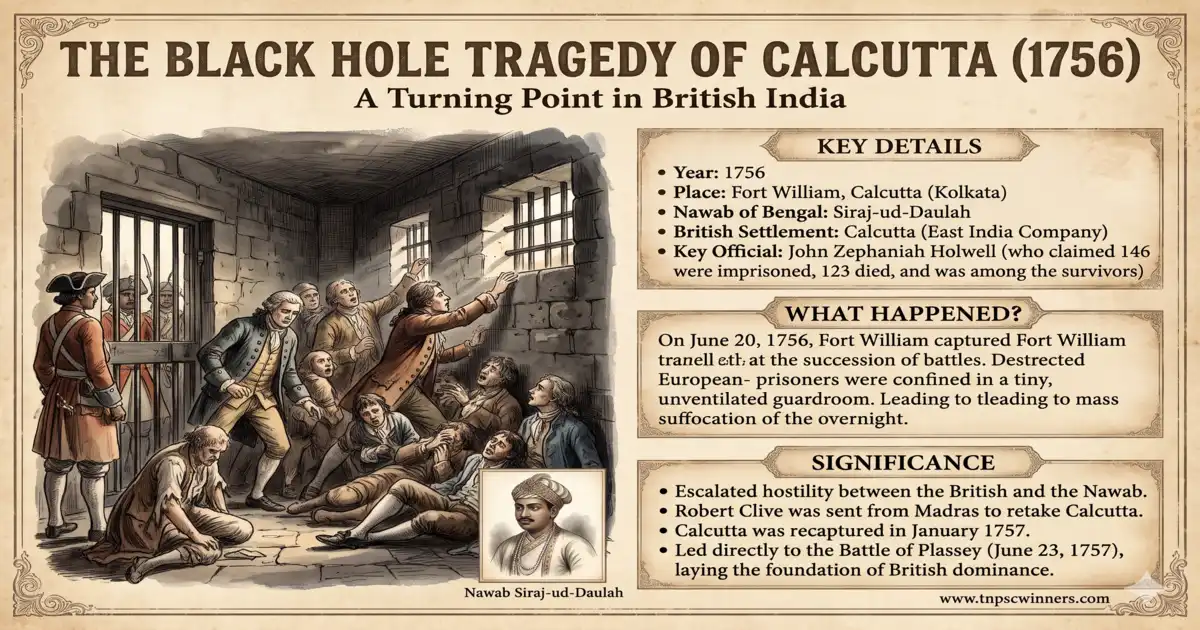
Black Hole Tragedy of Calcutta (1756)
- Year = 1756
- Place = Fort William, Calcutta (present-day Kolkata)
- Nawab of Bengal = Siraj-ud-Daulah
- British settlement = Calcutta, controlled by the English East India Company
- British official associated with the account = John Zephaniah Holwell
- Historical context = The conflict between Siraj-ud-Daulah and the East India Company.
- British capture of Bengal
JOIN OUR TELEGRAM CHANNEL – T.ME/TNPSC_WINNERS

What happened in the Black Hole Tragedy?
- After Siraj-ud-Daulah captured Fort William on 20 June 1756, a group of European prisoners was confined overnight in a small room.
- The room was described as overcrowded and poorly ventilated.
- Holwell claimed that 146 people were imprisoned and 123 died from suffocation.
- Holwell was among the reported survivors.
Significance
- The incident intensified hostility between the British East India Company and Siraj-ud-Daulah.
- Robert Clive led the British campaign to recover Calcutta.
- The British recaptured Calcutta in January 1757.
- The conflict culminated in the Battle of Plassey on 23 June 1757, which established the foundation of British political dominance in Bengal.
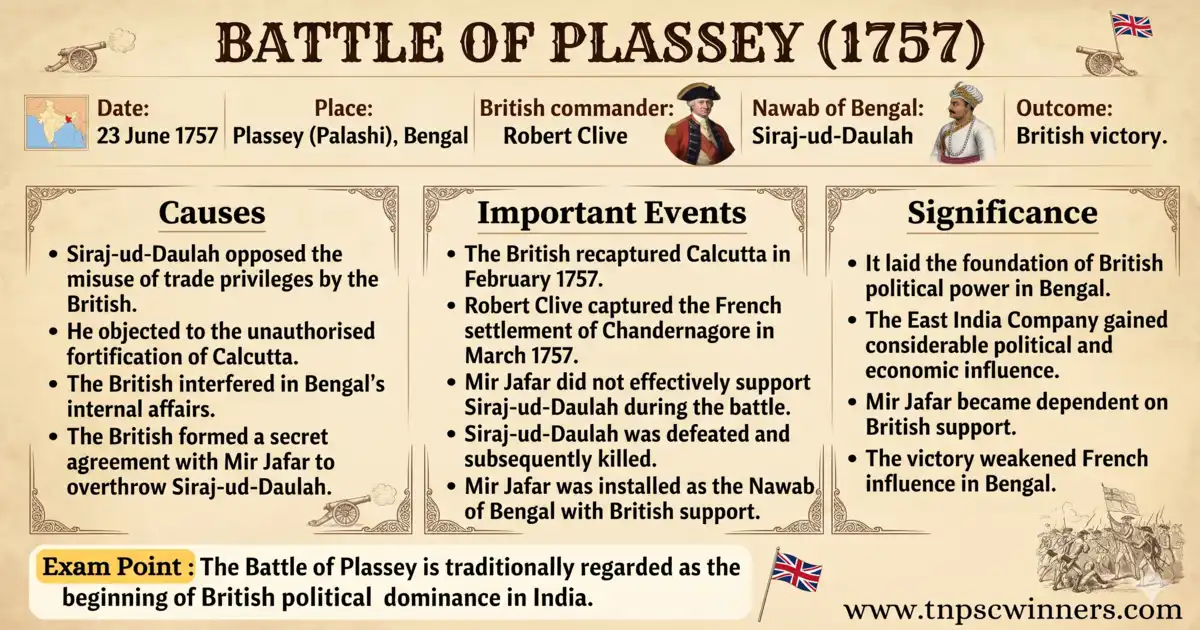
Battle of Plassey (1757)
- Date = 23 June 1757
- Place = Plassey (Palashi), Bengal
- British commander = Robert Clive
- Nawab of Bengal = Siraj-ud-Daulah
- Outcome = British victory.
Causes
- Siraj-ud-Daulah opposed the misuse of trade privileges by the British.
- He objected to the unauthorised fortification of Calcutta.
- The British interfered in Bengal’s internal affairs.
- The British formed a secret agreement with Mir Jafar to overthrow Siraj-ud-Daulah.
- British capture of Bengal
Important events
- The British recaptured Calcutta in February 1757.
- Robert Clive captured the French settlement of Chandernagore in March 1757.
- Mir Jafar did not effectively support Siraj-ud-Daulah during the battle.
- Siraj-ud-Daulah was defeated and subsequently killed.
- Mir Jafar was installed as the Nawab of Bengal with British support.
Significance
- It laid the foundation of British political power in Bengal.
- The East India Company gained considerable political and economic influence.
- Mir Jafar became dependent on British support.
- The victory weakened French influence in Bengal.
Exam point
- The Battle of Plassey is traditionally regarded as the beginning of British political dominance in India.
Important facts about Mir Qasim
- Mir Qasim became Nawab in 1760, replacing Mir Jafar.
- He transferred his capital from Murshidabad to Munger (Monghyr).
- He attempted to strengthen his administration and military.
- To remove the unfair advantage enjoyed by the Company’s traders, he abolished internal duties on trade.
- His conflict with the Company led to war in 1763.
- After his defeat, he allied with Shuja-ud-Daulah, Nawab of Awadh, and Mughal Emperor Shah Alam II.
- British capture of Bengal
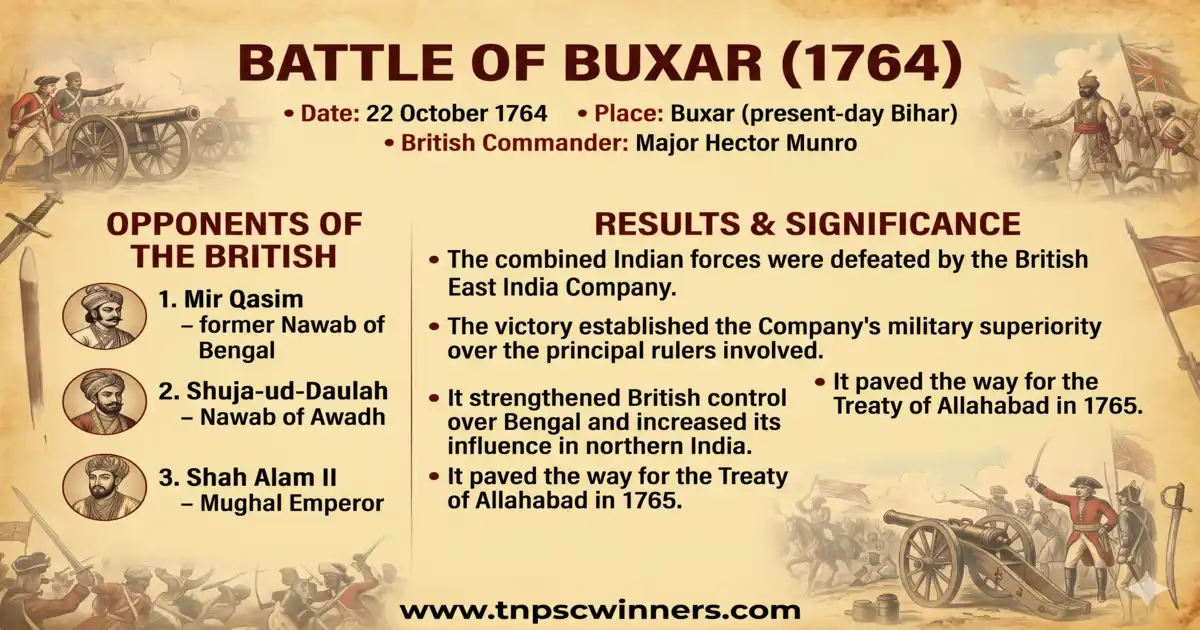
Battle of Buxar (1764)
- Date = 22 October 1764
- Place = Buxar, present-day Bihar
- British commander = Major Hector Munro
Opponents of the British
- Mir Qasim – former Nawab of Bengal
- Shuja-ud-Daulah – Nawab of Awadh
- Shah Alam II – Mughal Emperor
Result
- The combined Indian forces were defeated by the British East India Company.
- The victory established the Company’s military superiority over the principal rulers involved.
- It strengthened British control over Bengal and increased its influence in northern India.
- It paved the way for the Treaty of Allahabad in 1765.
- British capture of Bengal
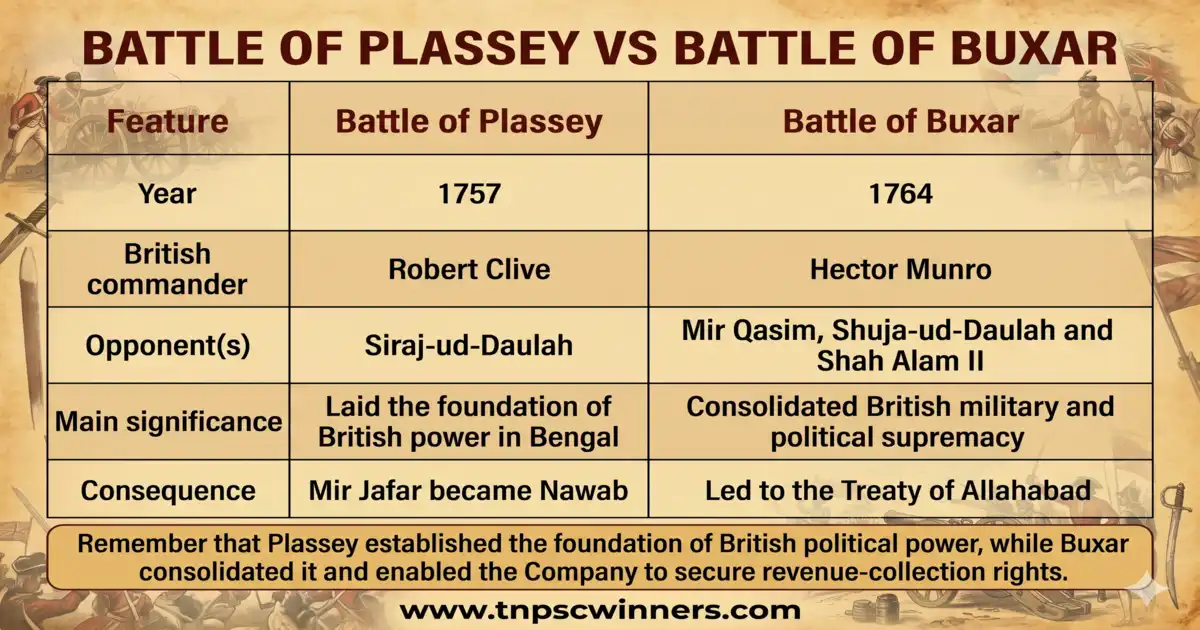
Battle of Plassey vs Battle of Buxar
- Remember that Plassey established the foundation of British political power, while Buxar consolidated it and enabled the Company to secure revenue-collection rights.
Treaty of Allahabad (1765)
- Year = 1765
- British representative = Robert Clive
- Mughal Emperor = Shah Alam II
- Following the British victory at Buxar, Robert Clive concluded agreements at Allahabad.
- British capture of Bengal
Major provisions
- Shah Alam II granted the East India Company the Diwani rights of Bengal, Bihar and Orissa.
- Diwani rights allowed the Company to collect revenue and exercise civil financial authority in these provinces.
- The Company agreed to make an annual payment of ₹26 lakh to the Mughal Emperor under the settlement.
- Shuja-ud-Daulah entered into a settlement with the Company and recovered Awadh subject to its terms.
What is Diwani?
- Diwani refers primarily to the right to collect revenue and administer civil financial affairs.
- The grant of Diwani in 1765 gave the Company a major source of income.
- It reduced the Company’s dependence on funds brought from Britain to purchase Indian goods.
- Bengal’s revenue helped finance the Company’s army and further territorial expansion.
- British capture of Bengal
Dual Government in Bengal (1765–1772)
- Introduced by = Robert Clive
- Period = 1765–1772
- Ended by = Warren Hastings in 1772
- Under the Dual Government system, the Company exercised revenue authority while the Nawab’s administration retained formal responsibility for much of the ordinary administration (Power without responsibility for the British; Responsibility without power for the Nawab.)
- British capture of Bengal
Chronology of the British Capture of Bengal
- 1756 = Siraj-ud-Daulah captures Calcutta. Conflict with the East India Company intensifies.
- 1757 = Battle of Plassey. Robert Clive defeats Siraj-ud-Daulah; Mir Jafar becomes Nawab.
- 1760 = Mir Qasim becomes Nawab. He attempts to reduce British interference.
- 1764 = Battle of Buxar. The Company defeats the combined forces of Mir Qasim, Shuja-ud-Daulah and Shah Alam II.
- 1765 = Treaty of Allahabad and grant of Diwani. The Company gains revenue-collection rights in Bengal, Bihar and Orissa.
- 1772 = End of Dual Government. Warren Hastings assumes more direct control over Bengal’s administration.
Important one-line facts for TNPSC
- Battle of Plassey was fought in 1757.
- Battle of Buxar was fought in 1764.
- The British commander at Plassey was Robert Clive.
- The British commander at Buxar was Hector Munro.
- The Nawab defeated at Plassey was Siraj-ud-Daulah.
- The Nawab installed after Plassey was Mir Jafar.
- The Nawab who resisted British interference and fought at Buxar was Mir Qasim.
- The Mughal Emperor at the time of Buxar was Shah Alam II.
- The Treaty of Allahabad was concluded in 1765.
- The Company received Diwani rights from Shah Alam II.
- Diwani covered Bengal, Bihar and Orissa.
- The Dual Government system was introduced by Robert Clive.
- The Dual Government system ended in 1772 under Warren Hastings.
- British capture of Bengal