
Day to Protect Education from Attack
Day to Protect Education from Attack
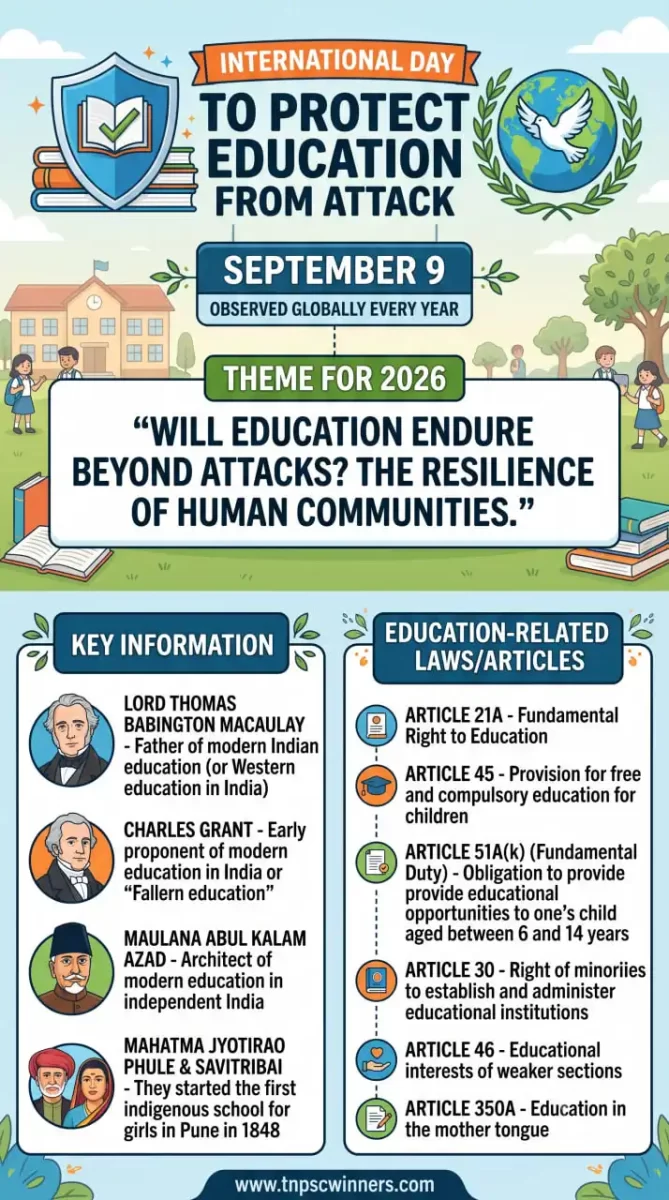
- The International Day to Protect Education from Attack is observed annually on September 9.
- Established by the United Nations General Assembly, it calls for safeguarding schools, universities, students, and educators from violence and armed conflict.
- Date = September 9 (observed annually worldwide).
- Origin = Proclaimed on May 28, 2020, via UN General Assembly Resolution 74/275.
- Theme for 2026 = “Can Education Survive Attack? The Resilience of Human Communities”.
JOIN OUR TELEGRAM CHANNEL – T.ME/TNPSC_WINNERS

Objectives & Call to Action
- Enforce International Humanitarian Law (IHL): Hold parties to armed conflict accountable for war crimes and violations against protected civilian infrastructure.
- Prioritize Psychosocial Support: Provide mental health services, trauma-informed teaching, and rapid remediation for displaced youth.
- Fund Education in Emergencies: Direct sustained humanitarian aid to emergency educational response funds rather than treating education as a secondary relief priority.
- Day to Protect Education from Attack
Key Facts
- Lord Thomas Babington Macaulay is widely regarded as the Father of Modern Indian Education (or Western education in India).
- Charles Grant = Often cited by historians as the earliest proponent or “father of modern education in India”.
- Maulana Abul Kalam Azad = Known as the Architect of Modern Education in Independent India. As India’s first Minister of Education, he established institutions including the IITs, IISc, UGC, and Sahitya Akademi. His birth anniversary (November 11) is celebrated nationally as National Education Day.
- Mahatma Jyotirao Phule & Savitribai Phule = Regarded as the pioneers of mass, inclusive, and women’s education in India, opening the first indigenous school for girls in Pune in 1848.
- Sarvepalli Radhakrishnan = Chaired the University Education Commission (1948–1949) to reform higher education in independent India; his birthday (September 5) is celebrated as National Teachers’ Day.
- Day to Protect Education from Attack
Constitutional Articles Governing Education in India
- Article 21A (Right to Education): Enacted via the 86th Constitutional Amendment Act (2002), it guarantees free and compulsory education for all children aged 6 to 14 years as a Fundamental Right.
- Article 45 (Early Childhood Care): A Directive Principle of State Policy instructing the State to endeavor to provide early childhood care and education for all children until they complete the age of 6 years.
- Article 51A(k) (Fundamental Duty): Imposes a duty on every citizen who is a parent or guardian to provide educational opportunities to their child or ward between 6 and 14 years.
- Article 30 (Rights of Minorities): Protects the right of linguistic and religious minorities to establish and administer educational institutions of their choice.
- Article 46 (Educational Interests of Weaker Sections): Directs the State to promote the educational and economic interests of Scheduled Castes, Scheduled Tribes, and other vulnerable sections.
- Article 350A (Instruction in Mother Tongue): Mandates facilities for instruction in the mother tongue at the primary stage of education to children belonging to linguistic minority groups.