
Development of education in India under British
Explore the development of education in India under British rule, including major educational policies, acts, commissions, reforms and their contributions.
Development of education in India under British
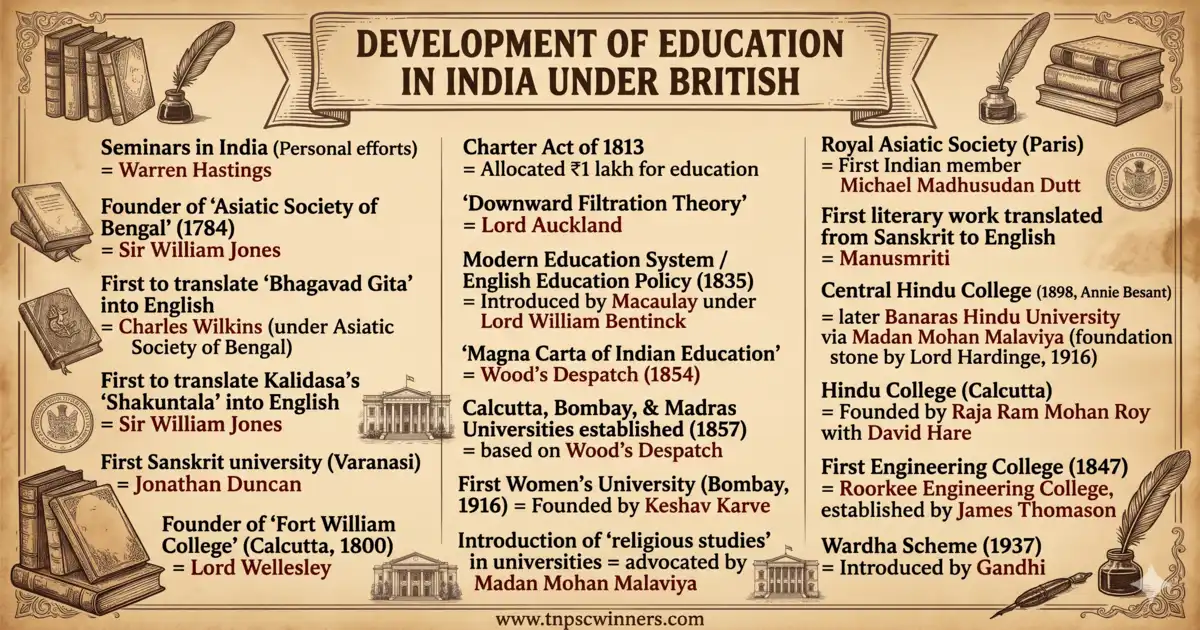
- The person who initiated seminars in India for the first time through his own personal efforts = Warren Hastings.
- The founder of the “Asiatic Society of Bengal” in 1784 = Sir William Jones.
- The first person to translate the “Bhagavad Gita” into English = Charles Wilkins.
- The organization under which the Bhagavad Gita was first translated into English = The Asiatic Society of Bengal.
- The first person to translate Kalidasa’s play “Shakuntala” into English = Sir William Jones.
- The founder of the “first Sanskrit university” (Sanskrit College) in Varanasi = Jonathan Duncan (who later became the Governor of Bombay).
JOIN OUR TELEGRAM CHANNEL – T.ME/TNPSC_WINNERS

- The founder of “Fort William College” in Calcutta in 1800 = Lord Wellesley.
- The Act under which a fund of “one lakh rupees” was allocated to improve the quality of education in India = The Charter Act of
- The person who proposed the famous “Downward Filtration Theory” in Indian education = Lord Auckland.
- The educational policy associated with Lord Macaulay = The English Education Policy.
- When was the “modern education system” introduced in India? = 1835 (Macaulay).
- Who was the Governor-General (often referred to as Viceroy in general historical context) of India when the English education system was introduced? = Lord William Bentinck (1835).
- What is known as the “Magna Carta of Indian Education”? = Wood’s Despatch (1854).
- Where was the “first women’s university” in India established? = Bombay (1916).
- The founder of India’s “first women’s university” in Bombay in 1916 = Keshav Karve.
“EDUCATIONAL DEVELOPMENT IN BRITISH INDIA”
- The person who advocated for the introduction of “religious studies” in Indian universities = Madan Mohan Malaviya.
- The location of the “Royal Asiatic Society” = Paris.
- The first Indian to become a member of the renowned “Royal Asiatic Society” in Paris = Michael Madhusudan Dutt.
- The year in which the universities of Calcutta, Bombay, and Madras (Chennai) were established, based on the Wood’s Despatch = 1857.
- The first literary work to be translated from Sanskrit into English = Manusmriti.
- The founder of the “Central Hindu College” = Annie Besant (1898).
- The person who laid the foundation stone for the “Banaras Hindu University” = Lord Hardinge (February 4, 1916).
- The Central Hindu College, established by Annie Besant, later evolved into the “Banaras Hindu University” through the efforts of “Madan Mohan Malaviya.”
- The Englishman who assisted in the establishment of the “Hindu College” in Calcutta = David Hare.
- The person who established the “Hindu College” in Calcutta with the help of the Englishman David Hare = Raja Ram Mohan Roy.
- The year in which the first engineering college was established in India = 1847.
- The person who established the first engineering college in India in 1847 = James Thomason.
- India’s first engineering college = Roorkee Engineering College (1847).
- The year in which Gandhi’s “Wardha Scheme” was introduced = 1937.
- First official step towards educational development in British India = Charter Act of 1813.
- Annual educational grant under Charter Act of 1813 = ₹1 lakh.
- General Committee of Public Instruction established in = 1823.
- Macaulay’s Minute was presented in = 1835.
- Who introduced English education policy in India? = Lord William Bentinck accepted Macaulay’s recommendations.
- Downward Filtration Theory is associated with = Macaulay.
- Magna Carta of English Education in India = Wood’s Despatch (1854).
- Who introduced Wood’s Despatch? = Sir Charles Wood.
- First three modern universities in India = Calcutta, Bombay and Madras (1857).
- Hunter Commission was appointed by = Lord Ripon.
- Chairman of Hunter Commission = William Wilson Hunter.
- Raleigh Commission was appointed in = 1902.
- Indian Universities Act was passed in = 1904.
- Who introduced the Compulsory Primary Education Bill in 1911? = Gopal Krishna Gokhale.
- Sadler Commission was appointed in = 1917.
- Chairman of Sadler Commission = Michael Sadler.
- Development of education in India under British
- Hartog Committee was appointed in = 1929.
- Nai Talim was introduced by = Mahatma Gandhi.
- Wardha Scheme was introduced in = 1937.
- Chairman of Zakir Hussain Committee = Dr. Zakir Hussain.
- Sargent Plan was introduced in = 1944.
- Sargent Plan recommended free and compulsory education for = Children aged 6–14 years.
- Savitribai Phule and Jyotirao Phule started a girls’ school in = Pune, 1848.
- SNDT Women’s University was established in = 1916.
- Development of education in India under British
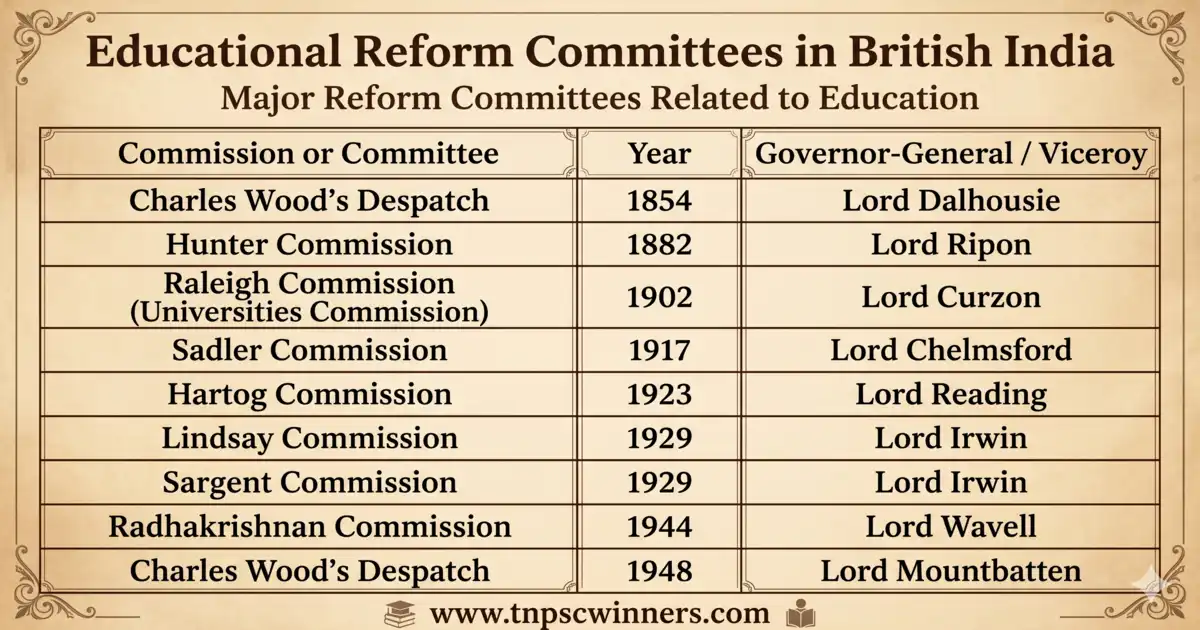
Educational Reform Committees in British India
|
Major Reform Committees Related to Education |
||
| Commission or Committee | Year | Governor-General / Viceroy |
| Charles Wood’s Despatch | 1854 | Lord Dalhousie |
| Hunter Commission | 1882 | Lord Ripon |
| Raleigh Commission (Universities Commission) | 1902 | Lord Curzon |
| Sadler Commission | 1917 | Lord Chelmsford |
| Hartog Commission | 1923 | Lord Reading |
| Lindsay Commission | 1929 | Lord Irwin |
| Sargent Commission | 1929 | Lord Irwin |
| Radhakrishnan Commission | 1944 | Lord Wavell |
| Charles Wood’s Despatch | 1948 | Lord Mountbatten |
Development of education in India under British