
Educational Development in British India
Explore the educational development in British India, including major acts, commissions, policies, and contributions to modern education.
Educational Development in British India
During British rule, the education system gradually changed from traditional education to a modern Western system. The British introduced English education, modern sciences, universities and a formal educational administration.
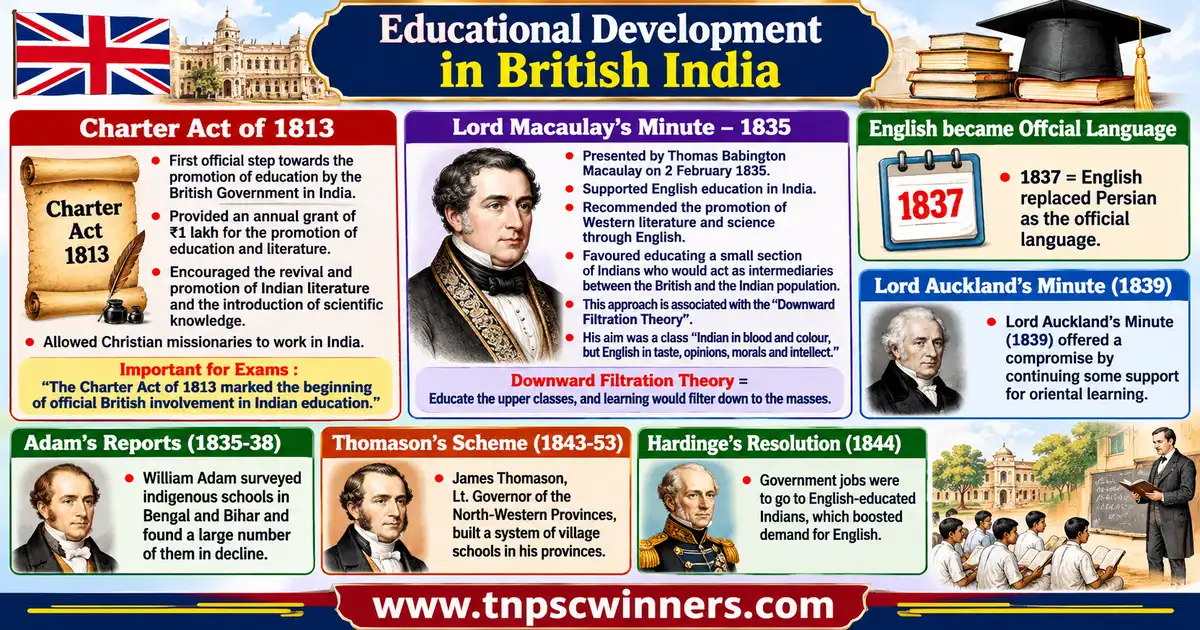
Charter Act of 1813
First official step towards the promotion of education by the British Government in India. Provided an annual grant of ₹1 lakh for the promotion of education and literature. Encouraged the revival and promotion of Indian literature and the introduction of scientific knowledge. Allowed Christian missionaries to work in India.
Important for Exams = “The Charter Act of 1813 marked the beginning of official British involvement in Indian education.”
JOIN OUR TELEGRAM CHANNEL – T.ME/TNPSC_WINNERS

General Committee of Public Instruction – 1823
Established in 1823. Responsible for promoting education in India. Initially supported Oriental education, including Sanskrit, Arabic and Persian. It became the centre of the debate between Orientalists and Anglicists.
Lord Macaulay’s Minute – 1835
Presented by Thomas Babington Macaulay on 2 February 1835. Supported English education in India. Recommended the promotion of Western literature and science through English. Favoured educating a small section of Indians who would act as intermediaries between the British and the Indian population. This approach is associated with the “Downward Filtration Theory”. His aim was a class “Indian in blood and colour, but English in taste, opinions, morals and intellect.”
Downward Filtration Theory = Educate the upper classes, and learning would filter down to the masses.
“COMMITTEES AND COMMISSIONS IN BRITISH INDIA”
Lord William Bentinck’s Resolution – 1835
Accepted Macaulay’s recommendations. English became the principal medium for higher education.
English became Offcial Language
1837 = English replaced Persian as the official language.
Lord Auckland’s Minute (1839)
Lord Auckland’s Minute (1839) offered a compromise by continuing some support for oriental learning.
Adam’s Reports (1835-38)
Adam’s Reports (1835-38) = William Adam surveyed indigenous schools in Bengal and Bihar and found a large number of them in decline.
Thomason’s Scheme (1843-53)
Thomason’s Scheme (1843-53) = James Thomason, Lt. Governor of the North-Western Provinces, built a system of village schools in his provinces.
Educational Development in British India
Hardinge’s Resolution (1844)
Hardinge’s Resolution (1844) = Government jobs were to go to English-educated Indians, which boosted demand for English.
Wood’s Despatch – 1854
Issued in 1854 by Sir Charles Wood. Known as the Magna Carta of English Education in India. Considered one of the most important milestones in the development of modern education in India.
Major Recommendations of Wood’s Despatch – 1854
- Establishment of a Department of Public Instruction (DPI) in every province.
- Establishment of universities in major cities.
- Promotion of primary education through vernacular languages.
- English as the medium of higher education.
- Establishment of teacher-training institutions.
- Encouragement of women’s education.
- Introduction of a grant-in-aid system for private educational institutions.
- Establishment of a graded educational system from primary to university level.
- Promotion of vocational and technical education.
- Important for exams = Following Wood’s Despatch, universities were established in Calcutta, Bombay and Madras in 1857.
- Educational Development in British India
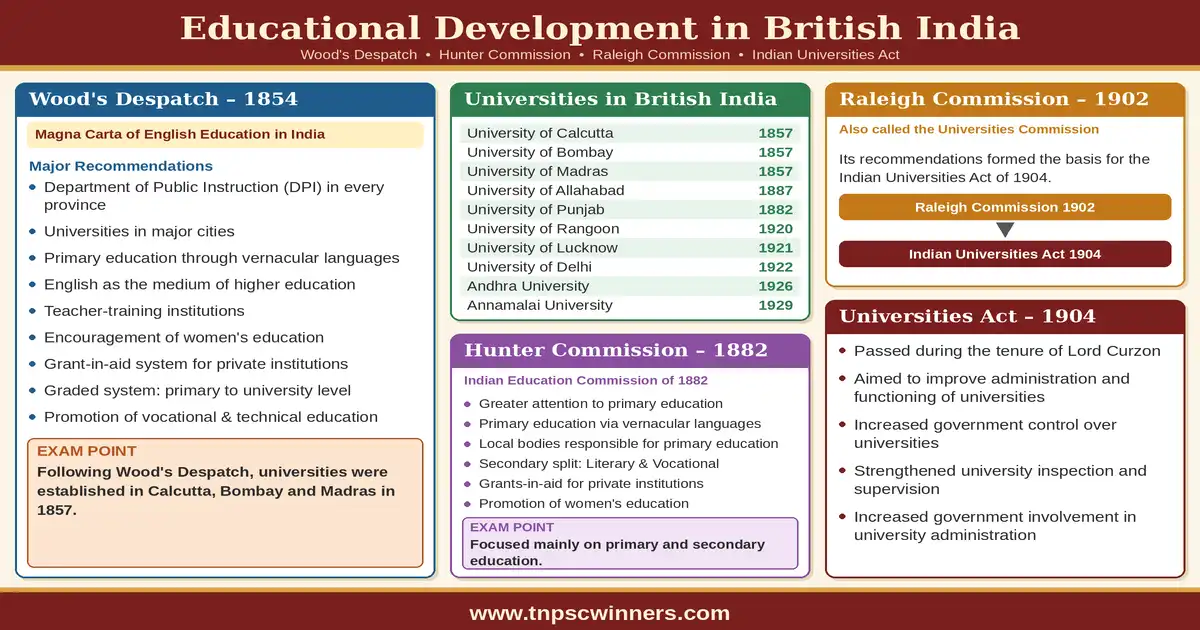
Establishment of Universities in British India
- University of Calcutta = 1857
- University of Bombay = 1857
- University of Madras = 1857
- University of Allahabad = 1887
- University of Punjab = 1882
- University of Rangoon = 1920
- University of Lucknow = 1921
- University of Delhi = 1922
- Andhra University = 1926
- Annamalai University = 1929
- The first three modern universities in India were established in 1857.
- They were established on the model of the University of London.
- The University of Calcutta was established on 24 January 1857.
- The University of Madras was established on 5 September 1857.
Hunter Education Commission – 1882
Appointed by Lord Ripon in 1882. Chairman: Sir William Wilson Hunter. Also known as the Indian Education Commission of 1882.
Major Recommendations Hunter Education Commission – 1882
- Primary education should receive greater attention.
- Primary education should be imparted through vernacular languages.
- Local bodies should be given responsibility for primary education.
- Secondary education should be divided into = Literary education and Vocational education.
- Encouraged private institutions through grants-in-aid.
- Recommended the promotion of women’s education.
- Important for exams = The Hunter Commission mainly focused on primary and secondary education.
- Educational Development in British India
Raleigh Commission – 1902
Appointed by Lord Curzon in 1902. Chairman = Sir Thomas Raleigh. Examined the condition and administration of Indian universities. Its recommendations formed the basis for the Indian Universities Act of 1904. Also called as Universities Commission.
Indian Universities Act – 1904
- Passed during the tenure of Lord Curzon.
- Aimed to improve the administration and functioning of universities.
- Increased government control over universities.
- Strengthened university inspection and supervision.
- Increased government involvement in university administration.
- Educational Development in British India
Gokhale’s Efforts for Compulsory Primary Education – 1911
- Gopal Krishna Gokhale introduced a bill for compulsory primary education in the Imperial Legislative Council in 1911.
- Proposed free and compulsory primary education for children.
- The bill was not accepted by the British Government.
- He is remembered for his efforts to make primary education compulsory in India.
- Important for exams = Gokhale is associated with the early movement for compulsory primary education in India.
- Educational Development in British India
Sadler Commission – 1917–1919
Appointed in 1917. Chairman = Dr. Michael Ernest Sadler. Also known as the Calcutta University Commission. Examined the condition of Calcutta University and the Indian university education system.
Major Recommendations of Sadler Commission
- Intermediate education should be separated from university education.
- A 12-year school education system was recommended before university admission.
- A three-year degree course was recommended.
- Women’s education should be encouraged.
- Vocational and technical education should be promoted.
- Improvement of teacher training was recommended.
- Educational Development in British India
Hartog Committee – 1929
Appointed under the chairmanship of Sir Philip Hartog. Examined the development of education in India.
Major Recommendations of Hartog Committee
- Focus on improving the quality of primary education.
- Reduce wastage and stagnation in primary education.
- Improve the quality of teachers.
- Strengthen vocational education.
- Improve the standard of university education.
- Important for exams:
- Wastage = Students leaving school before completing the course.
- Stagnation = Students remaining in the same class for more than one year.
Wardha Scheme of Basic Education – 1937
- Introduced by Mahatma Gandhi in 1937.
- Also known as Nai Talim or Basic Education.
- Proposed education through productive handicrafts.
- Emphasised learning by doing.
- Recommended free and compulsory education for children aged 7–14 years.
- Mother tongue was recommended as the medium of instruction.
- Focused on the physical, intellectual and moral development of children.
- Educational Development in British India
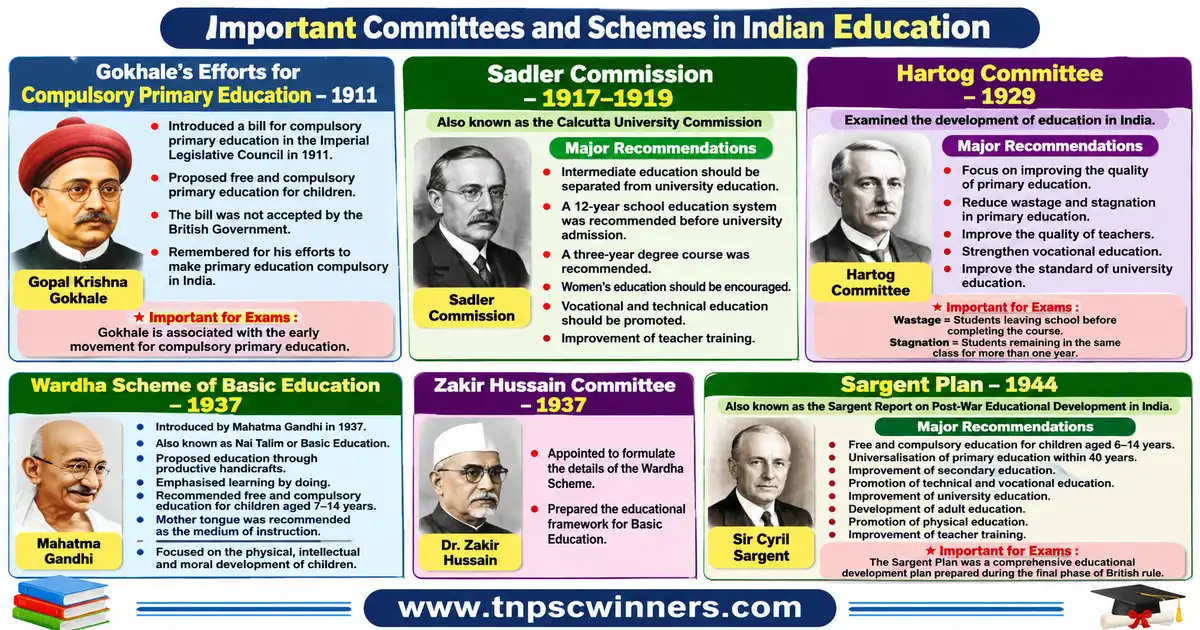
Zakir Hussain Committee – 1937
- Appointed to formulate the details of the Wardha Scheme.
- Chairman: Dr. Zakir Hussain.
- Prepared the educational framework for Basic Education.
- Educational Development in British India
Sargent Plan – 1944
- Prepared under the chairmanship of Sir John Sargent.
- Also known as the Sargent Report on Post-War Educational Development in India.
- Presented in 1944.
Major Recommendations of Sargent Plan
- Free and compulsory education for children aged 6–14 years.
- Universalisation of primary education within 40 years.
- Improvement of secondary education.
- Promotion of technical and vocational education.
- Improvement of university education.
- Development of adult education.
- Promotion of physical education.
- Improvement of teacher training.
- Important for exams = The Sargent Plan was a comprehensive educational development plan prepared during the final phase of British rule.
- Educational Development in British India
Important Educational Institutions Established During British Rule
| Institution | Year | Founder / Associated Person |
| Calcutta Madrasa | 1781 | Warren Hastings |
| Asiatic Society of Bengal | 1784 | Sir William Jones |
| Sanskrit College, Banaras | 1791 | Jonathan Duncan |
| Fort William College | 1800 | Lord Wellesley |
| Serampore Mission | 1800 | William Carey and others |
| Hindu College, Calcutta | 1817 | David Hare and Indian reformers |
| Sanskrit College, Calcutta | 1824 | British Government |
| Elphinstone Institution | 1834 | Bombay |
| Thomason College of Civil Engineering | 1847 | Roorkee |
| Bethune School | 1849 | John Elliot Drinkwater Bethune |
| University of Calcutta | 1857 | British Government |
| University of Bombay | 1857 | British Government |
| University of Madras | 1857 | British Government |
| Deccan Education Society | 1884 | Indian nationalists |
| Punjab University | 1882 | British Government |
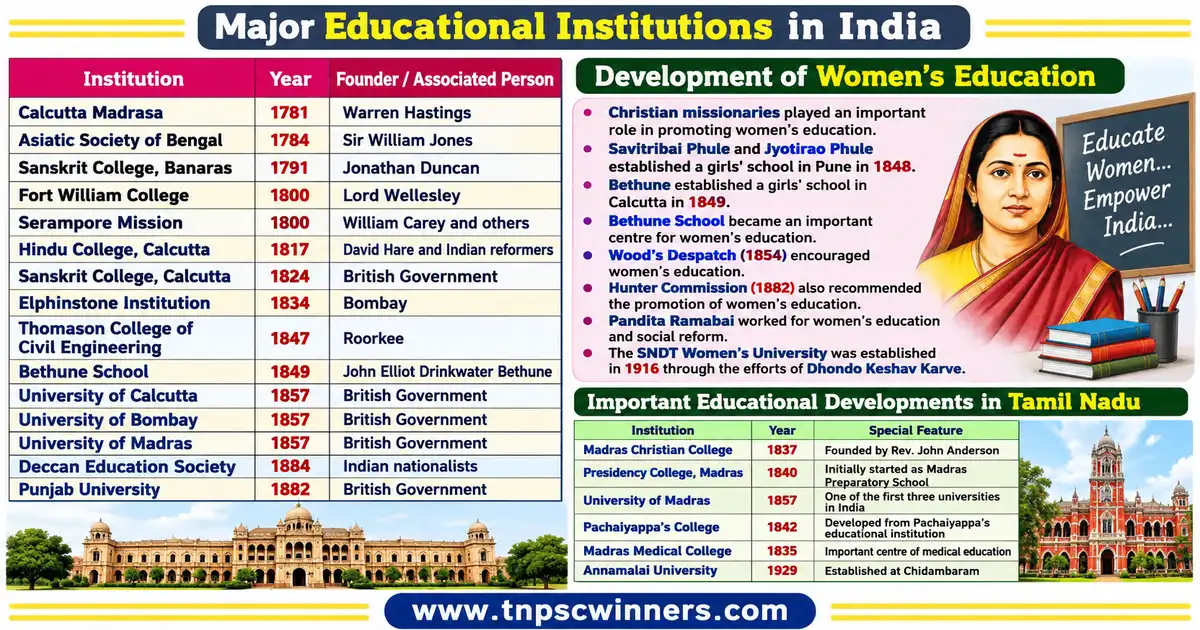
Development of Women’s Education
- Christian missionaries played an important role in promoting women’s education.
- Savitribai Phule and Jyotirao Phule established a girls’ school in Pune in 1848.
- Bethune established a girls’ school in Calcutta in 1849.
- Bethune School became an important centre for women’s education.
- Wood’s Despatch (1854) encouraged women’s education.
- Hunter Commission (1882) also recommended the promotion of women’s education.
- Pandita Ramabai worked for women’s education and social reform.
- The SNDT Women’s University was established in 1916 through the efforts of Dhondo Keshav Karve.
- Educational Development in British India
Important Educational Developments in Tamil Nadu
| Madras Christian College | 1837 | Founded by Rev. John Anderson |
| Presidency College, Madras | 1840 | Initially started as Madras Preparatory School |
| University of Madras | 1857 | One of the first three universities in India |
| Pachaiyappa’s College | 1842 | Developed from Pachaiyappa’s educational institution |
| Madras Medical College | 1835 | Important centre of medical education |
| Annamalai University | 1929 | Established at Chidambaram |
Important Facts for TNPSC
- University of Madras was established in 1857.
- Madras Christian College was founded by Rev. John Anderson.
- Pachaiyappa’s educational institutions developed through the philanthropy of Pachaiyappa Mudaliar.
- Annamalai University was established in 1929 by Raja Sir Annamalai Chettiar.
- Educational Development in British India
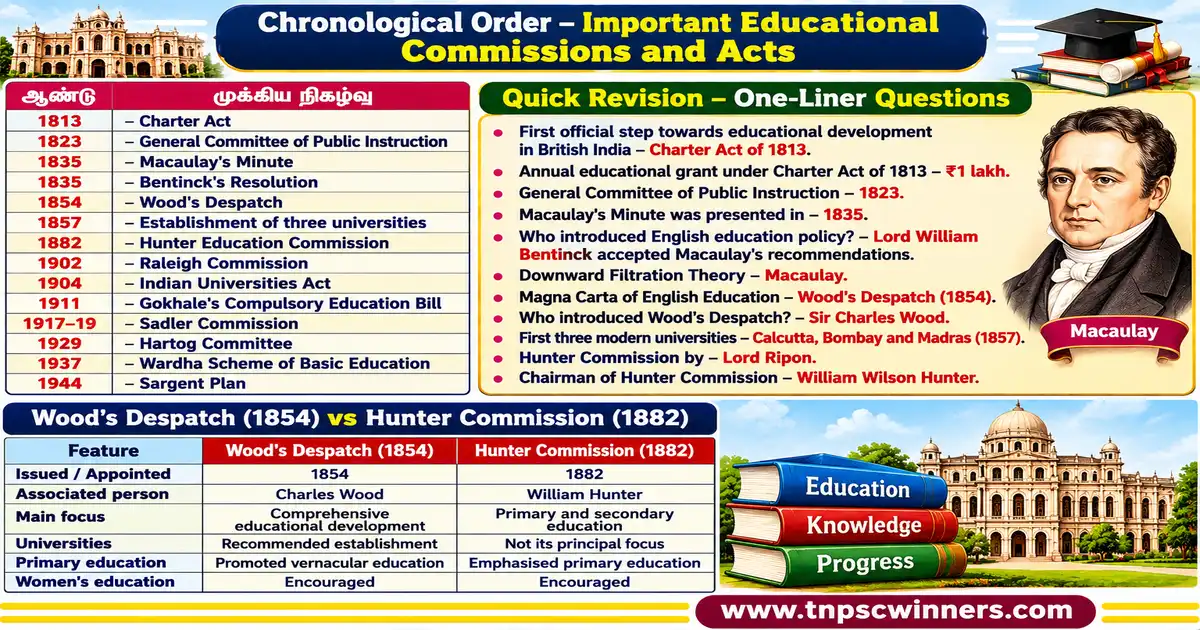
Chronological Order – Important Educational Commissions and Acts
- 1813 = Charter Act
- 1823 = General Committee of Public Instruction
- 1835 = Macaulay’s Minute
- 1835 = Bentinck’s Resolution
- 1854 = Wood’s Despatch
- 1857 = Establishment of three universities
- 1882 = Hunter Education Commission
- 1902 = Raleigh Commission
- 1904 = Indian Universities Act
- 1911 = Gokhale’s Compulsory Education Bill
- 1917–19 = Sadler Commission
- 1929 = Hartog Committee
- 1937 = Wardha Scheme of Basic Education
- 1944 = Sargent Plan
Important Personalities and Their Contributions
- Warren Hastings = Established Calcutta Madrasa (1781)
- William Jones = Founded Asiatic Society of Bengal (1784)
- Lord Wellesley = Established Fort William College (1800)
- Thomas Babington Macaulay = Macaulay’s Minute (1835)
- Lord William Bentinck = Accepted English education policy (1835)
- Charles Wood = Wood’s Despatch (1854)
- Lord Ripon = Hunter Commission (1882)
- William Wilson Hunter = Chairman of Hunter Commission
- Lord Curzon = Indian Universities Act (1904)
- Gopal Krishna Gokhale = Compulsory Primary Education Bill (1911)
- Michael Sadler = Sadler Commission (1917–19)
- Philip Hartog = Hartog Committee (1929)
- Mahatma Gandhi = Wardha Scheme (1937)
- Zakir Hussain = Chairman of Wardha Scheme Committee
- John Sargent = Sargent Plan (1944)
- Educational Development in British India
Quick Revision – One-Liner Questions
- First official step towards educational development in British India – Charter Act of 1813.
- Annual educational grant under Charter Act of 1813 – ₹1 lakh.
- General Committee of Public Instruction established in – 1823.
- Macaulay’s Minute was presented in – 1835.
- Who introduced English education policy in India? – Lord William Bentinck accepted Macaulay’s recommendations.
- Downward Filtration Theory is associated with – Macaulay.
- Magna Carta of English Education in India – Wood’s Despatch (1854).
- Who introduced Wood’s Despatch? – Sir Charles Wood.
- First three modern universities in India – Calcutta, Bombay and Madras (1857).
- Hunter Commission was appointed by – Lord Ripon.
- Chairman of Hunter Commission – William Wilson Hunter.
- Raleigh Commission was appointed in – 1902.
- Indian Universities Act was passed in – 1904.
- Who introduced the Compulsory Primary Education Bill in 1911? – Gopal Krishna Gokhale.
- Sadler Commission was appointed in – 1917.
- Chairman of Sadler Commission – Michael Sadler.
- Hartog Committee was appointed in – 1929.
- Nai Talim was introduced by – Mahatma Gandhi.
- Wardha Scheme was introduced in – 1937.
- Chairman of Zakir Hussain Committee – Dr. Zakir Hussain.
- Sargent Plan was introduced in – 1944.
- Sargent Plan recommended free and compulsory education for – Children aged 6–14 years.
- Savitribai Phule and Jyotirao Phule started a girls’ school in – Pune, 1848.
- SNDT Women’s University was established in – 1916.
- Educational Development in British India
Wood’s Despatch (1854) vs Hunter Commission (1882)
| Feature | Wood’s Despatch (1854) | Hunter Commission (1882) |
| Issued / Appointed | 1854 | 1882 |
| Associated person | Charles Wood | William Hunter |
| Main focus | Comprehensive educational development | Primary and secondary education |
| Universities | Recommended establishment | Not its principal focus |
| Primary education | Promoted vernacular education | Emphasised primary education |
| Women’s education | Encouraged | Encouraged |
Educational Development in British India