
Important Facts about Shaivism and Vaishnavism
Important Facts about Shaivism and Vaishnavism
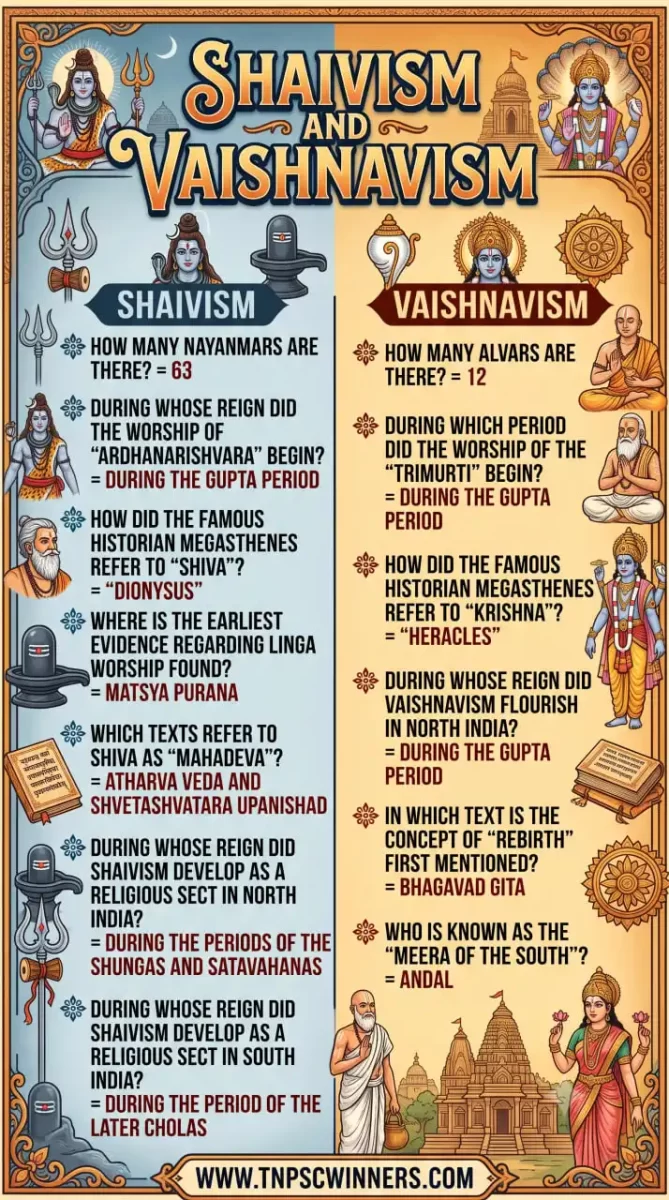
- How many Nayanmars are there? = 63
- How many Alvars are there? = 12
- During which period did the worship of the “Trimurti” begin? = During the Gupta period
- During whose reign did the worship of “Ardhanarishvara” begin? = During the Gupta period
- How did the famous historian Megasthenes refer to “Shiva”? = “Dionysus”
- How did the famous historian Megasthenes refer to “Krishna”? = “Heracles”
- Where is the earliest evidence regarding Linga worship found? = Matsya Purana
- Which Jain Tirthankara is said to be an incarnation of Krishna? = The 22nd Tirthankara, “Arishtanemi” (Neminatha)
- Which Jain text states that Neminatha is an incarnation of Krishna? = Uttaradhyayana Sutra
- Important Facts about Shaivism and Vaishnavism
JOIN OUR TELEGRAM CHANNEL – T.ME/TNPSC_WINNERS

- Which texts refer to Shiva as “Mahadeva”? = Atharva Veda and Shvetashvatara Upanishad
- During whose reign did Shaivism develop as a religious sect in North India? = During the periods of the Shungas and Satavahanas
- During whose reign did Shaivism develop as a religious sect in South India? = During the period of the Later Cholas
- Which text contains the earliest reference to Krishna as the son of Devaki? = Chandogya Upanishad
- During whose reign did Vaishnavism flourish in North India? = During the Gupta period
- In which text is the concept of “rebirth” first mentioned? = Bhagavad Gita
- Where did the sage Suta narrate the story of the Mahabharata to Shaunaka and 88,000 other ascetics and sages? = Naimisharanya (Uttar Pradesh)
- Who is known as the “Meera of the South”? = Andal
- Important Facts about Shaivism and Vaishnavism
The Panniru Thirumurai (The Twelve Holy Volumes)
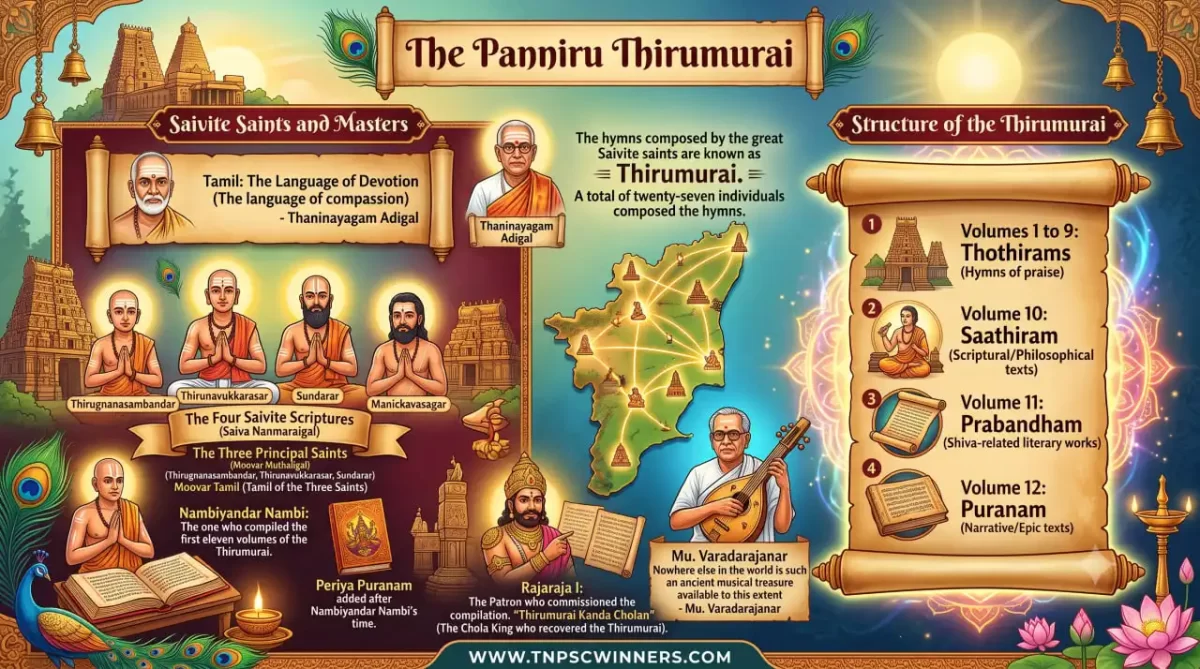
- Thaninayagam Adigal described Tamil as the “language of devotion” (the language of compassion).
- The era of religious renaissance and the Bhakti movement corresponds to the Pallava period.
- The hymns composed by the great Saivite saints are known as = Thirumurai.
- Nambiyandar Nambi was the one who compiled the *Thirumurai*.
- Nambiyandar Nambi compiled only the first eleven volumes of the *Thirumurai*.
- Important Facts about Shaivism and Vaishnavism
- The *Periya Puranam* was added after Nambiyandar Nambi’s time.
- Rajaraja I was the patron who commissioned the compilation of the *Thirumurai*; he is known as “Thirumurai Kanda Cholan” (The Chola King who discovered/recovered the *Thirumurai*).
- The first seven volumes of the *Thirumurai* are collectively known as *Tevaram*.
- The *Tevaram* hymns are described as a “repository of ancient traditional music.”
- The term *Tevaram* is interpreted in two ways: as “De + Varam” (songs dedicated to God) or as “De + Aaram” (a garland of verses offered to God).
- The first seven volumes are also known as “Moovar Tamil” (Tamil of the Three Saints).
- The “Moovar Muthaligal” (The Three Principal Saints) are Thirugnanasambandar, Thirunavukkarasar, and Sundarar.
- The “Saiva Samaya Kuravargal” (Saivite Religious Preceptors) are Thirugnanasambandar, Thirunavukkarasar, Sundarar, and Manickavasagar.
- The hymns composed by these four Saivite preceptors are celebrated as the “Saiva Nanmaraigal” (The Four Saivite Scriptures).
- A total of twenty-seven individuals composed the hymns found in the *Thirumurai*.
- Varadarajanar remarked, “Nowhere else in the world is such an ancient musical treasure available to this extent.”
- How are Thirumurais 1 to 9 referred to? = Thothirams (Hymns of praise)
- How is the 10th Thirumurai referred to? = Saathiram (Scriptural/Philosophical texts)
- How is the 11th Thirumurai referred to? = Prabandham (Shiva-related literary works)
- How is the 12th Thirumurai referred to? = Puranam (Narrative/Epic texts)
- Among the twelve Thirumurais, how many consist of musical verses (Isai Tamil)? = The first nine Thirumurais (Note: The 8th Thirumurai belongs to the *Iyarpa* category)
- Among the twelve Thirumurais, what type of verses constitute the 10th, 11th, and 12th? = Iyarpa (Literary Tamil/Non-musical verse)
- Important Facts about Shaivism and Vaishnavism
Nalayira Divya Prabandham
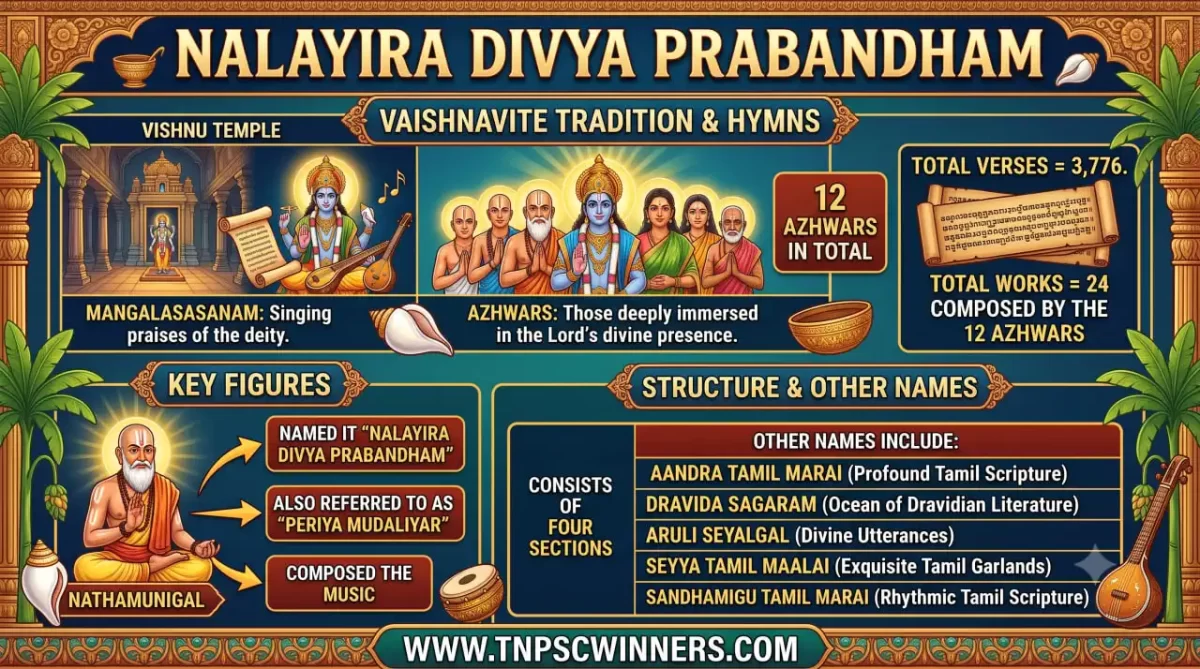
- In the Vaishnavite tradition, singing praises of the deity in the temple is known as “Mangalasasanam.”
- Those who were deeply immersed in the divine feet or the auspicious attributes of the Lord were known as “Azhwars.”
- There are 12 Azhwars in total.
- Total number of verses = 3,776.
- The person who named it “Nalayira Divya Prabandham” was Nathamunigal.
- It is also known by other names such as “Aandra Tamil Marai” (Profound Tamil Scripture), “Dravida Sagaram” (Ocean of Dravidian Literature), “Aruli Seyalgal” (Divine Utterances), “Seyya Tamil Maalai” (Exquisite Tamil Garlands), and “Sandhamigu Tamil Marai” (Rhythmic Tamil Scripture).
- The Nalayira Divya Prabandham consists of four sections.
- The total number of works composed by the 12 Azhwars = 24.
- Those who came after Nathamunigal were known as “Acharyas.”
- Nathamunigal is also referred to as “Periya Mudaliyar.”
- The person who composed the music for the Nalayira Divya Prabandham was Nathamunigal.
- Important Facts about Shaivism and Vaishnavism