
International Day for the Eradication of Poverty
Learn about the International Day for the Eradication of Poverty, its 2026 theme, significance, history, and key facts for competitive exams like TNPSC.
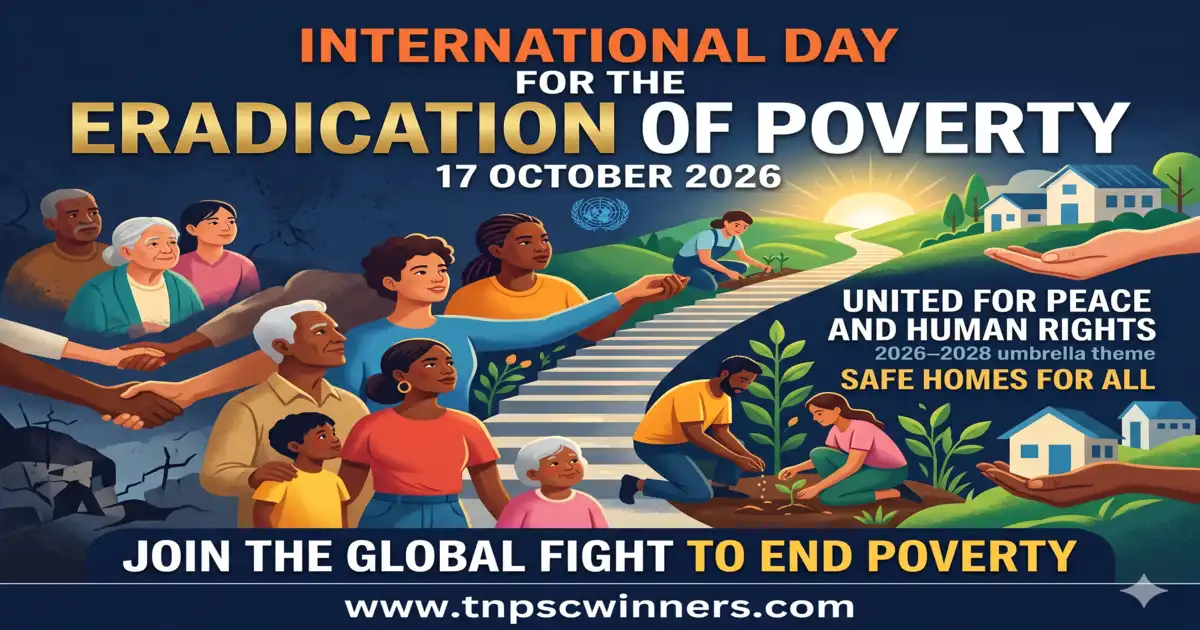
International Day for the Eradication of Poverty
- The International Day for the Eradication of Poverty is observed annually on 17 October to raise awareness about poverty, promote human dignity and human rights, and encourage global efforts to eliminate poverty in all its forms.
JOIN OUR TELEGRAM CHANNEL – T.ME/TNPSC_WINNERS

International Day for the Eradication of Poverty – Important Facts
- Date = 17 October
- First observed = 17 October 1987
- Declared by = United Nations General Assembly (UNGA)
- UN resolution = A/RES/47/196
- Resolution adopted on = 22 December 1992
- 2026–2028 theme = “United for Peace and Human Rights”
- 2026 focus = “Safe Homes for All”
What is the International Day for the Eradication of Poverty?
- The International Day for the Eradication of Poverty is observed annually on 17 October to raise awareness about poverty, promote human dignity and human rights, and encourage global efforts to eliminate poverty in all its forms.
- It emphasizes that poverty is not merely a lack of income; it also involves deprivation of food, housing, education, healthcare, social protection and opportunities.
History and background
- 17 October 1987 = More than 100,000 people gathered at the Trocadéro in Paris, France, to honour victims of extreme poverty, violence and hunger.
- The gathering affirmed that poverty is a violation of human rights and that collective action is necessary to eradicate it.
- 22 December 1992 = The UN General Assembly adopted Resolution A/RES/47/196, officially proclaiming 17 October as the International Day for the Eradication of Poverty.
- The observance encourages governments, international organizations and civil society to take practical steps towards poverty eradication.
Theme for 2026
- 2026–2028 overarching theme = United for Peace and Human Rights
- 2026 focus = Safe Homes for All
Poverty and global facts
- Extreme poverty = Approximately 826 million people were estimated to live in extreme poverty in 2026, according to the UN’s 2026 figures.
- Housing inadequacy = More than 2.8 billion people worldwide face some form of inadequate housing.
- Social protection = Approximately 3.8 billion people lack any form of social protection.
- Sustainable Development Goal = SDG 1 aims to end poverty in all its forms everywhere by 2030.
Sustainable Development Goals (SDGs)
- SDG 1 = No Poverty – Eradicate povertyin all its forms
- SDG 2 = Zero Hunger – Ensure food security and nutrition
- SDG 4 = Quality Education – Improve access to education
- SDG 8 = Decent Work and Economic Growth – Promote productive employment
- SDG 10 = Reduced Inequalities – Reduce inequality within and among countries
- SDG 11 = Sustainable Cities and Communities – Promote safe and adequate housing
Major causes of poverty
- Unemployment and underemployment.
- Low wages and unequal distribution of income.
- Lack of quality education and skill development.
- Poor access to healthcare and social security.
- Social discrimination and gender inequality.
- Natural disasters, climate change and displacement.
- Armed conflicts and economic instability.
- Lack of adequate housing and basic services.
Poverty alleviation in India
- Mahatma Gandhi National Rural Employment Guarantee Act (MGNREGA) = Provides a statutory framework for guaranteed wage employment to rural households.
- Pradhan Mantri Awas Yojana (PMAY) = Supports affordable housing
- National Food Security Act, 2013 = Provides a legal framework for subsidised food grains to eligible beneficiaries
- National Rural Livelihoods Mission (DAY-NRLM) = Promotes rural livelihoods and self-help groups
- Pradhan Mantri Jan Dhan Yojana (PMJDY) = Expands access to basic banking and financial inclusion
- Deendayal Antyodaya Yojana–National Urban Livelihoods Mission (DAY-NULM) = Supports urban livelihoods and poverty reduction
- International Day for the Eradication of Poverty
Poverty Estimation Committees in India
- K. Alagh Committee (1979) = First to define poverty line based on nutritional requirements (2,400 kcal/day in rural areas, 2,100 kcal/day in urban areas).
- T. Lakdawala Committee (1993) = Retained calorie norms; used state-specific CPI-AL (Agricultural Labourers) for rural and CPI-IW (Industrial Workers) for urban areas.
- Suresh Tendulkar Committee (2009) = Moved away from calorie intake to uniform Mixed Reference Period (MRP) consumption expenditure covering health and education.
- Rangarajan Committee (2014) = Recommended monthly per capita consumption expenditure of ₹972 (rural) and ₹1,407 (urban) using Modified Mixed Reference Period (MMRP).
- NITI Aayog National MPI = Based on the Alkire-Foster methodology with 12 indicators (adding maternal health and bank accounts to the 10 global indicators).
Important one-liners for TNPSC / UPSC
- International Day for the Eradication of Poverty: 17 October.
- First observed: 17 October 1987.
- Officially proclaimed by: UN General Assembly.
- Resolution number: A/RES/47/196.
- Date of adoption of the resolution: 22 December 1992.
- 2026–2028 theme: United for Peace and Human Rights.
- 2026 focus: Safe Homes for All.
- Relevant SDG: SDG 1 – No Poverty.
- 2030 Agenda adopted in: 2015.
- Third UN Decade for the Eradication of Poverty: 2018–2027.
- International Day for the Eradication of Poverty