
International Sloth Day 2026
Discover International Sloth Day 2026, celebrated on October 20, to learn about sloths, their unique adaptations, habitat conservation, and wildlife protection.
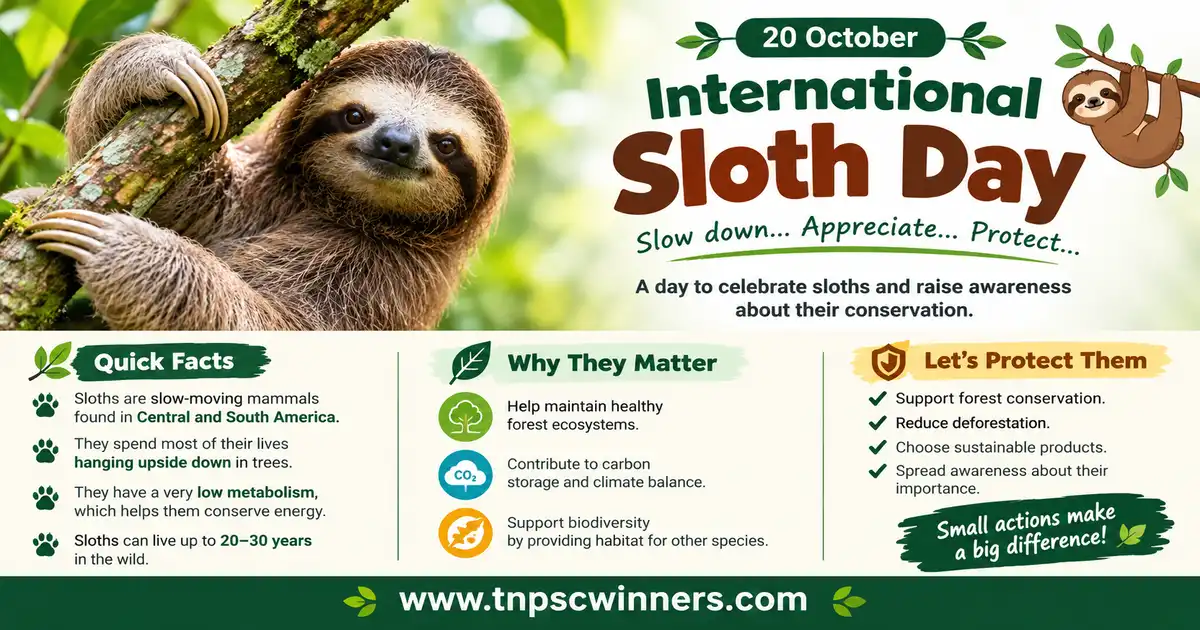
International Sloth Day 2026
- International Sloth Day is observed annually on October 20 to raise global awareness about the conservation, biology, and ecological importance of sloths.
JOIN OUR TELEGRAM CHANNEL – T.ME/TNPSC_WINNERS

International Sloth Day – Overview
- International Sloth Day is observed annually on 20 October.
- It aims to raise awareness about sloths, their unique characteristics, their natural habitats, and the need for their conservation.
- Sloths are slow-moving mammals that spend most of their lives in trees.
- The observance highlights the importance of protecting tropical forests and the biodiversity they support.
Important Facts About Sloths
- Scientific classification = Class Mammalia; order Pilosa.
- Habitat = Tropical forests of Central and South America.
- Diet = Mainly leaves, shoots and other plant material; some species have a more varied diet.
- Lifestyle = Arboreal, meaning they live predominantly in trees.
- Movement = Sloths are known for their exceptionally slow movements and low metabolic rates.
- Adaptation = Their long, curved claws help them hang from tree branches.
- Swimming = Sloths are capable swimmers despite their slow movement on land.
- International Sloth Day 2026
Biological & Taxonomic Profile
- Order & Suborder = Order Pilosa; Suborder Folivora (closest living relatives are anteaters and armadillos)
- Geographic Distribution = Tropical rainforest canopies of Central and South America
- Living Families = Bradypodidae (Three-toed sloths) and Choloepodidae (Two-toed sloths)
- Diet = Primarily folivorous (leaves, buds, tender shoots)
- Metabolic Rate = Lowest metabolic rate among non-hibernating mammals; digestion of a single leaf can take up to 30 days
- Thermoregulation = Poor metabolic temperature control; they use sun-basking to regulate body heat
Types of Sloths
- Two-toed sloths = Have two digits on their forelimbs.
- Three-toed sloths = Have three digits on their forelimbs.
Importance of International Sloth Day
- Creates awareness about wildlife conservation.
- Promotes the protection of tropical rainforests.
- Highlights the threats posed by deforestation and habitat fragmentation.
- Discourages illegal wildlife trade and the exploitation of sloths for tourist photographs.
- Encourages scientific research and responsible ecotourism.
- International Sloth Day 2026
Threats to Sloths
- Deforestation and destruction of natural habitats.
- Fragmentation of forests due to roads and urban development.
- Illegal wildlife trafficking and the exotic pet trade.
- Road accidents and electrocution from power lines.
- Stress and injury caused by irresponsible wildlife tourism.
International Sloth Day 2026
- Date = 20 October 2026.
- Day = Tuesday.
- Main objective = To promote sloth conservation and protect their natural habitats.
- The Sloth Conservation Foundation’s 2026 campaign, Slothtober, uses the theme “Sloths Wild and Free”, emphasizing connected forests and freedom from wildlife trade and exploitation.
- International Sloth Day 2026
Important One-Liners for TNPSC Exams
- When is International Sloth Day observed? = 20 October
- Sloths belong to which class? = Mammalia
- Sloths belong to which order? = Pilosa
- Where are sloths naturally found? = Central and South America
- What type of animals are sloths? = Arboreal mammals
- What is the main food of sloths? = Leaves and other plant material
- What is a major threat to sloths? = Habitat destruction
- Which organization works specifically for sloth conservation? = Sloth Conservation Foundation (SloCo)
- What is the annual October campaign of SloCo called? = Slothtober
- Are sloths good swimmers? = Yes
- International Sloth Day 2026