
Jahangir – Reign, Administration & Important Facts
Learn about Jahangir, the Mughal emperor who ruled from 1605 to 1627, including his reign, administration, Nur Jahan, Chain of Justice, wars, art, literature and important exam facts.
Jahangir – Reign, Administration & Important Facts
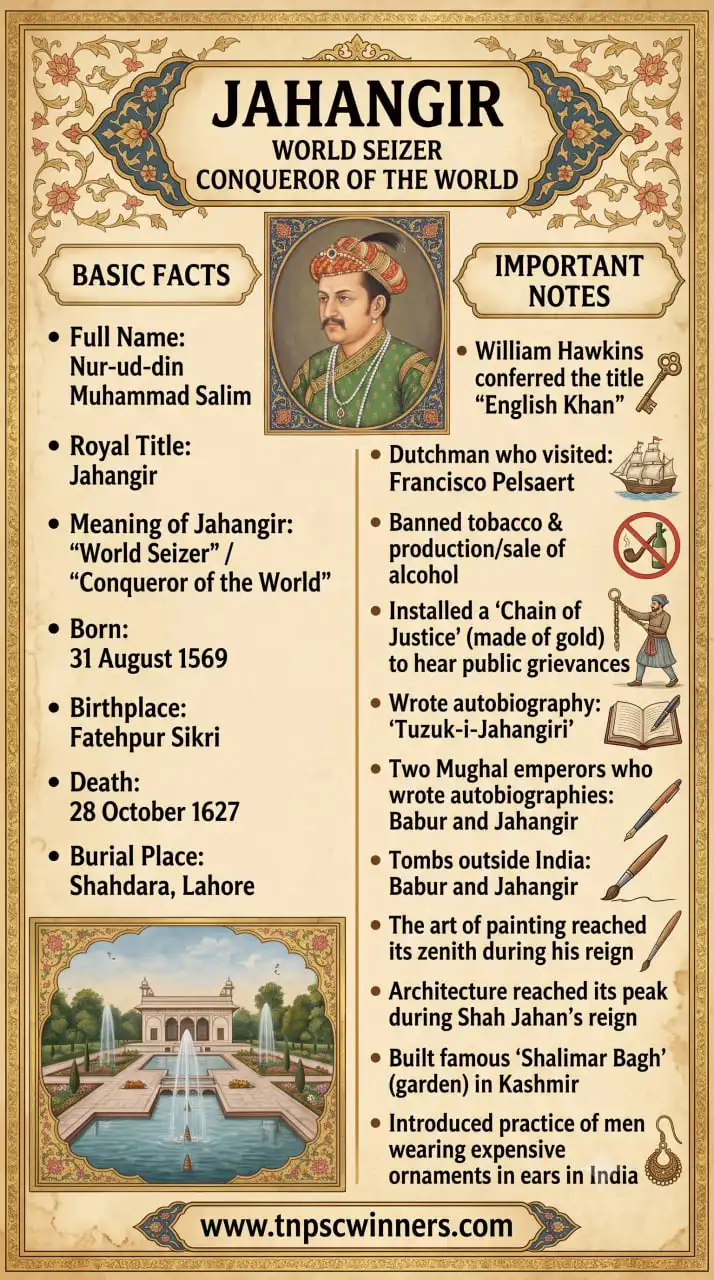
- Full Name = Nur-ud-din Muhammad Salim
- Royal Title = Jahangir
- Meaning of Jahangir = “World Seizer” / “Conqueror of the World”
- Born = 31 August 1569
- Birthplace = Fatehpur Sikri
- Father = Akbar
- Mother = Mariam-uz-Zamani (Jodha Bai)
- Reign = 1605–1627 CE
- Dynasty = Mughal Dynasty
- Predecessor = Akbar
- Successor = Shah Jahan
- Death = 28 October 1627
- Burial Place = Shahdara, Lahore
JOIN OUR TELEGRAM CHANNEL – T.ME/TNPSC_WINNERS

Jahangir – Important Notes
- Jahangir acted against Akbar’s religious policies.
- William Hawkins conferred the title “English Khan” upon Jahangir.
- The Dutchman who visited Jahangir’s court was Francisco Pelsaert.
- Jahangir was the Mughal emperor who banned tobacco.
- He prohibited the production and sale of alcohol.
- Jahangir installed a “Chain of Justice” (made of gold) to hear the grievances of the public.
- Jahangir wrote his autobiography, “Tuzuk-i-Jahangiri”.
- The Mughal emperors who wrote autobiographies were Babur and Jahangir.
- The two Mughal emperors whose tombs are located outside India were Babur and Jahangir.
- The art of painting reached its zenith during the reign of Jahangir.
- Architecture reached its peak during the reign of Shah Jahan.
- Jahangir built the famous “Shalimar Bagh” (garden) in Kashmir.
- Jahangir appointed a Hindu named “Srikanth” to administer justice.
- Jahangir introduced the practice of men wearing expensive ornaments in their ears in India.
- Jahangir – Reign, Administration & Important Facts
Rebellion of Prince Khusrau
- Prince Khusrau, Jahangir’s eldest son, rebelled against his father in 1606.
- Khusrau was defeated and captured.
- He sought the blessings of Guru Arjan Dev, the fifth Sikh Guru.
- Jahangir ordered the execution of Guru Arjan Dev in 1606.
- Khusrau was later imprisoned and eventually blinded.
Treaty of Chittor / Treaty of Mewar
- The Treaty of Chittor was concluded between the king of Mewar, Rana Amar Singh (son of Rana Pratap), and Jahangir in 1615 AD.
- Jahangir – Reign, Administration & Important Facts
Jahangir and the English
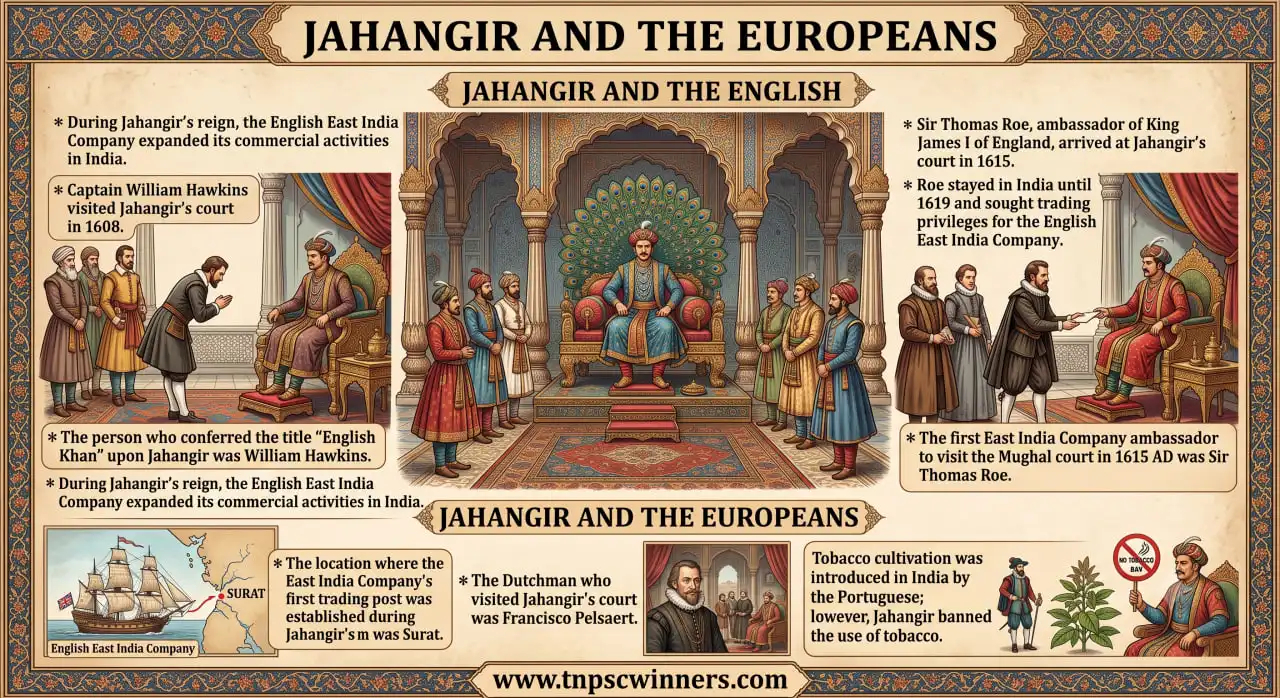
- During Jahangir’s reign, the English East India Company expanded its commercial activities in India.
- Captain William Hawkins visited Jahangir’s court in 1608.
- The person who conferred the title “English Khan” upon Jahangir was William Hawkins.
- Sir Thomas Roe, ambassador of King James I of England, arrived at Jahangir’s court in 1615.
- Roe stayed in India until 1619 and sought trading privileges for the English East India Company.
- The first East India Company ambassador to visit the Mughal court in 1615 AD was Sir Thomas Roe.
- The location where the East India Company’s first trading post was established during Jahangir’s reign was Surat.
Jahangir and the Europeans
- The Dutchman who visited Jahangir’s court was Francisco Pelsaert.
- Tobacco cultivation was introduced in India by the Portuguese; however, Jahangir banned the use of tobacco.
- Jahangir – Reign, Administration & Important Facts
Nur Jahan
- Nur Jahan was the most influential woman in Jahangir’s court.
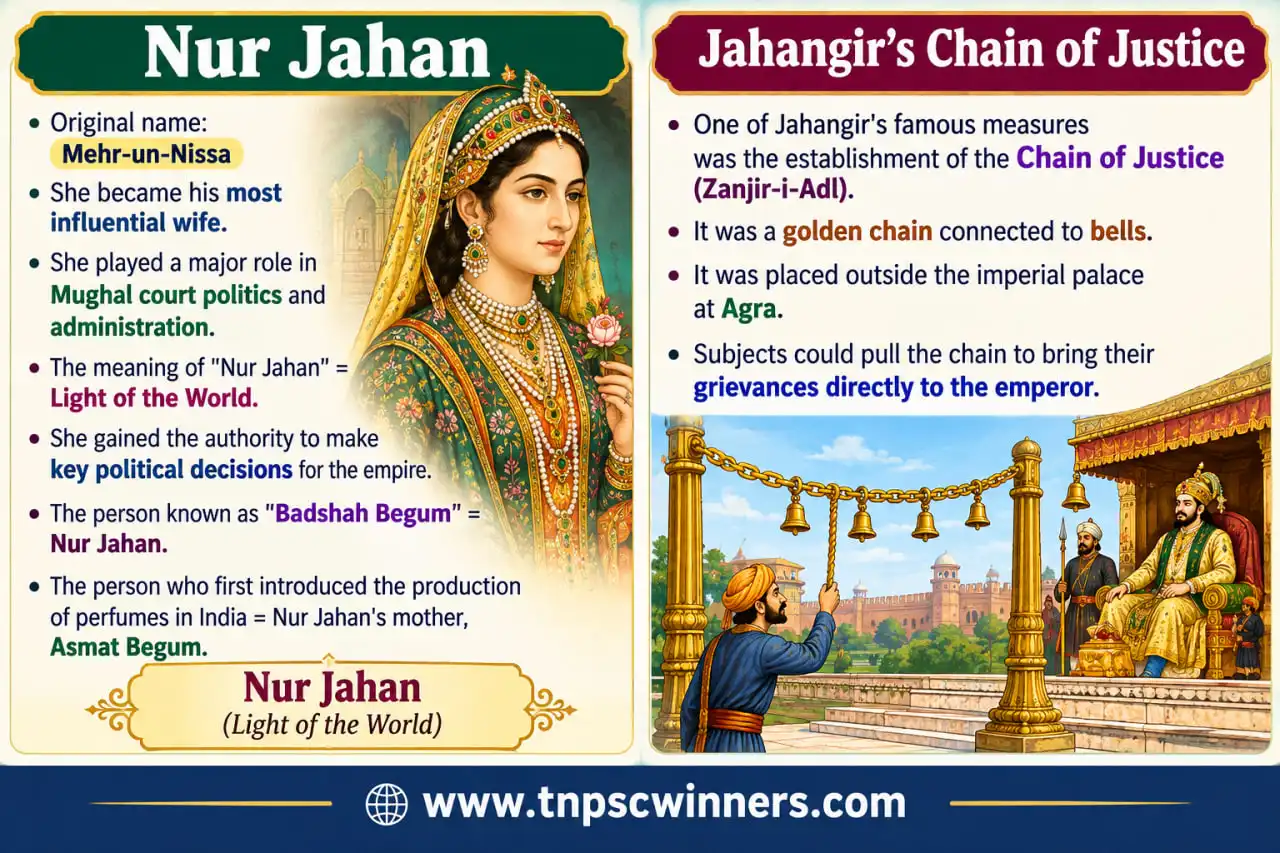
- Original name: Mehr-un-Nissa
- Born: 1577
- Married Jahangir in 1611.
- She became his most influential wife.
- She played a major role in Mughal court politics and administration.
- A political group known as the Nur Jahan Junta emerged around her influence.
- Jahangir married Nur Jahan (Jahangir was the one who killed Nur Jahan’s husband, Ali Quli).
- The meaning of “Nur Jahan” = Light of the World.
- She gained the authority to make key political decisions for the empire.
- Her image was also inscribed on the state’s coins.
- The person known as “Badshah Begum” = Nur Jahan.
- The person who first introduced the production of perfumes in India = Nur Jahan’s mother, Asmat Begum.
- Jahangir – Reign, Administration & Important Facts
Jahangir’s Chain of Justice
- One of Jahangir’s famous measures was the establishment of the Chain of Justice (Zanjir-i-Adl).
- It was a golden chain connected to bells.
- It was placed outside the imperial palace at Agra.
- Subjects could pull the chain to bring their grievances directly to the emperor.
- It symbolized the emperor’s commitment to justice.
Death of Jahangir
- Jahangir died in 1627.
- He died while returning from Kashmir.
- He was buried at Shahdara, Lahore.
- His son Prince Khurram succeeded him as Shah Jahan in 1628 after a succession struggle.
Important One-Liners for TNPSC/UPSC
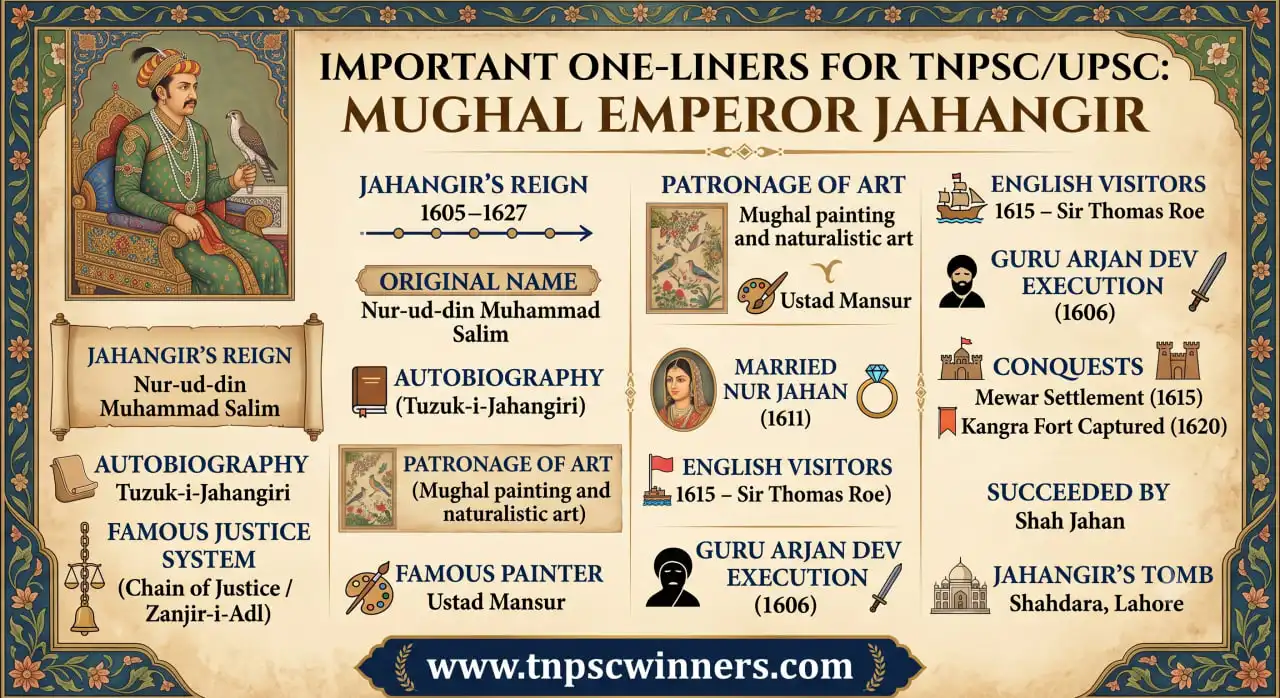
- Jahangir’s original name – Nur-ud-din Muhammad Salim.
- Jahangir was the son of – Akbar.
- Jahangir succeeded Akbar in – 1605.
- Jahangir’s reign – 1605–1627.
- Jahangir’s autobiography – Tuzuk-i-Jahangiri.
- Jahangir’s famous justice system – Chain of Justice (Zanjir-i-Adl).
- Nur Jahan married Jahangir in – 1611.
- Nur Jahan’s original name – Mehr-un-Nissa.
- Nur Jahan’s father – Mirza Ghiyas Beg.
- Mirza Ghiyas Beg’s title – Itimad-ud-Daulah.
- Famous Mughal painter under Jahangir – Ustad Mansur.
- English visitor to Jahangir’s court in 1608 – William Hawkins.
- English ambassador who visited Jahangir’s court in 1615 – Sir Thomas Roe.
- Guru Arjan Dev was executed during – Jahangir’s reign.
- Year of Guru Arjan Dev’s execution – 1606.
- Mewar settlement during Jahangir’s reign – 1615.
- Kangra Fort was captured during – Jahangir’s reign, 1620.
- Jahangir was succeeded by – Shah Jahan.
- Jahangir’s tomb – Shahdara, Lahore.
- Jahangir was particularly known for patronage of – Mughal painting and naturalistic art.
- Jahangir – Reign, Administration & Important Facts