
Post Mauryan Indian History Major Dynasties
Post Mauryan Indian History Major Dynasties
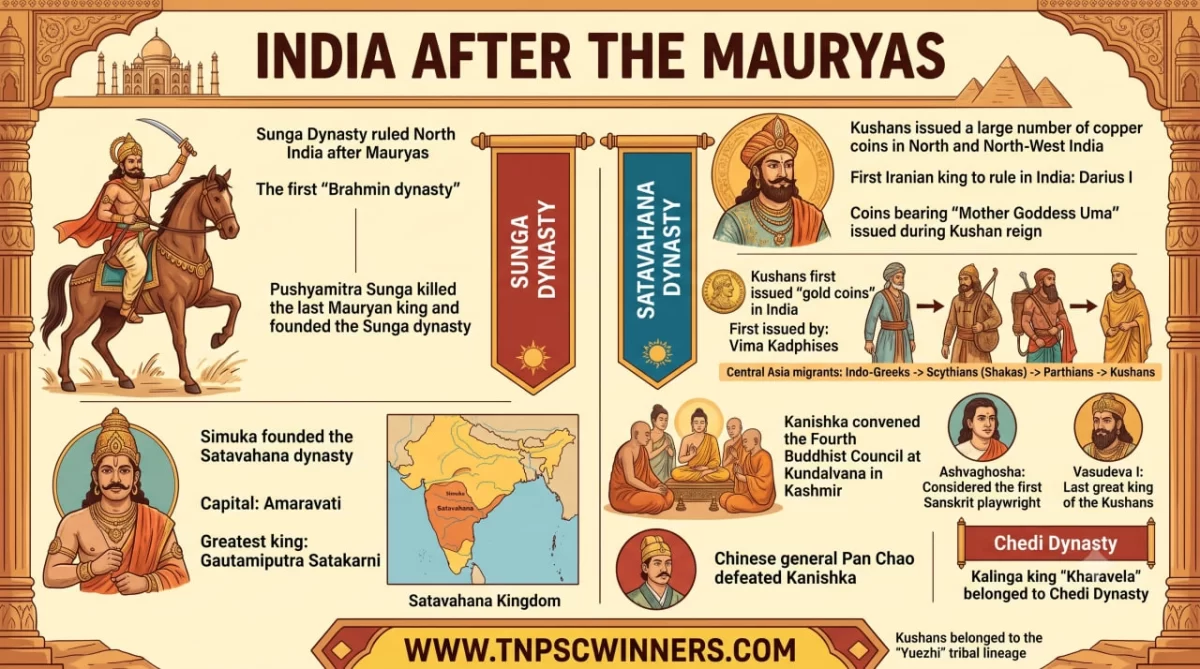
- Who ruled India after the Mauryan rule? = Sunga dynasty
- The first “Brahmin dynasty”? =Sunga dynasty
- The last Mauryan king? = Brihadatta.
- Who killed the last Mauryan king and founded the Sunga dynasty? = Pushyamitra Sunga
- The capital of the Sunga dynasty rulers? = Pataliputra (later they ruled with Vidisha as their capital)
- Which king founded the Satavahana dynasty? = Simuka
- The capital of the Satavahanas? = Amaravati
- The best Satavahana king? = Gautamiputra Satakarni
- In which year did the Kushana king Kanishka ascend to power? = 78 AD
- Who issued the largest quantity of copper coins in North and Northwestern India? = Kushans.
JOIN OUR TELEGRAM CHANNEL – T.ME/TNPSC_WINNERS

- Which Chinese commander defeated Kanishka? = Ben Chao
- When did the Vikrama Era begin? = 56 AD
- The famous Kalinga king, “Karavela”, belonged to which dynasty? = Chedi dynasty
- The first Iranian king to rule in India? = Darius 1
- During whose reign were coins named after “Mother God Uma” issued? = During the reign of the Kushans
- Who engraved Buddha’s image on coins? = Kushans
- Who was the first to issue “gold coin” in India? = Kushans.
- Which Kushana king issued the first gold coin in India? = Vima Gadbisas.
- Gandhara art = Indian art + Greek art.
- The physician in Kanishka’s court? = Sarakar.
- What religion did Kanishka follow? = Mahayana Buddhism
- Who came to India from Central Asia? = In order (Indo-Greeks -> Scythians (Sagars) -> Parthians -> Kushans)
- The Kushans belonged to a tribal dynasty called “Yuchi”.
- Kanishka’s main capital was Peshawar , then called Purushpura.
- After the capture of Pataliputra , he is said to have taken the Buddhist monk Ashvagosha with him to Peshawar.
- Kanishka convened the Fourth Buddhist Council at Kundalvana in Kashmir.
- He was very tolerant in his religious views, but supported Buddhism. His coins feature a mix of Indian , Greek, and Zoroastrian deities.
- Asvokhosha is considered the first Sanskrit playwright.
- Vasudeva I was the last great king of the Kushans.
- Post Mauryan Indian History Major Dynasties
Sungas
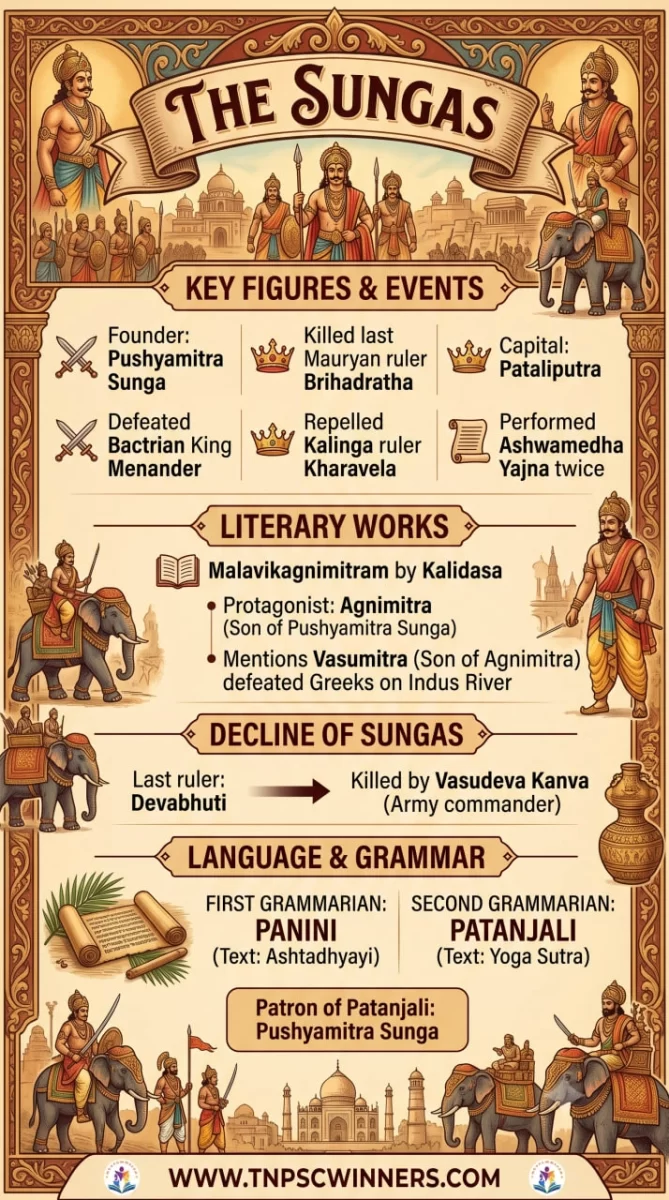
- The last king of the Mauryan Empire = Brihadratha.
- Brihadratha’s commander = Pushyamitra Sunga.
- The last king of the Mauryan Empire, who killed Brihadratha = Pushyamitra Sunga.
- The founder of the Sunga dynasty was Pushyamitra Sunga.
- The capital of Pushyamitra Sunga = Pataliputra.
- The Sungai king who defeated the king of Bactria, Menander = Pushyamitra Sunga.
- The Sunga king who defeated the invasion of the Kalinga king Karavela = Pushyamitra Sunga.
- The religion followed by Pushyamitra = Vedic religion.
- The Sunga king who performed the Aswamedha sacrifice twice = Pushyamitra Sunga.
- Pushyamitra, the son of Sunga, was Agnimitra.
- The author of the play “Malavikagnimitram” is Kalidasa.
- The protagonist of the play “Malavikagnimitram” written by Kalidasa is Agnimitra, the son of Pushyamitra Sunga.
- Agnimitra’s son = Vasumitra.
- The book that mentions that Vasumitra, the son of Agnimitra, defeated the Greeks on the banks of the Indus River = Kalidasa’s Malavikagnimitra.
- The period of rule of the Sunga dynasty = one hundred years.
- The last king of the Sunga dynasty = Devabhuti.
- The commander of the Sunga king Devabhuti = Vasudeva Kanvar.
- The last king of the Sunga dynasty was the one who killed Devabhuti = Devabhuti’s general Vasudeva Kanvar.
- The founder of the Kanvar dynasty is Vasudeva Kanvar.
- Post Mauryan Indian History Major Dynasties
The second grammarian of Sanskrit
- The second grammarian of Sanskrit language = Patanjali.
- The second grammar book of the Sanskrit language = Yoga Sutra
- Additional information:
- The first grammarian of Sanskrit language = Panini.
- The first grammar book of the Sanskrit language = Ashtadhyayi.
- The king who supported Patanjali, the second grammarian of Sanskrit, was Pushyamitra Sunga.
- Post Mauryan Indian History Major Dynasties
Post Mauryan Indian History Major Dynasties
- Number of kings in the Kanva dynasty = four.
- Total years of rule of Kanva dynasty = 45 years.
- The four Kanva kings were Vasudeva, Bhumiputra, Narayana, and Susarman.
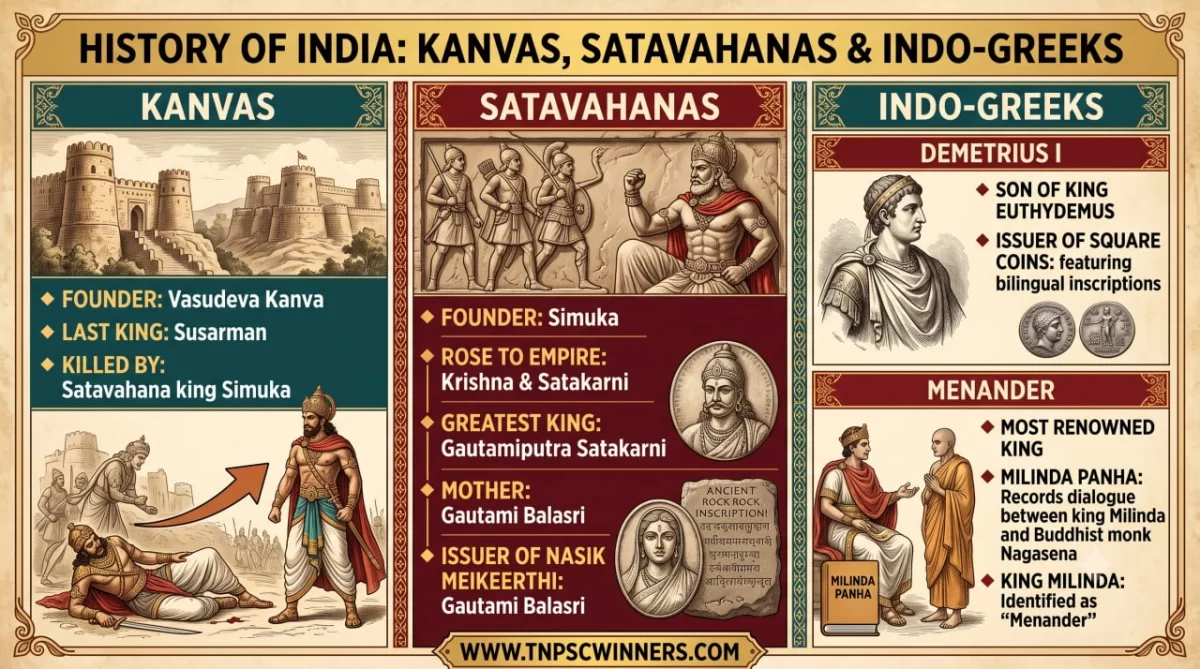
- The founder of the Kanva dynasty was Vasudeva Kanvar.
- The last king of the Kanva dynasty = Susarman.
- The last king of the Kanva dynasty, who killed Susarman, was the Satavahana king Simuka.
- Post Mauryan Indian History Major Dynasties
Satavahanas
- The period during which the Kushans ruled in North India = 300 years.
- The period during which the Satavahanas (Andhras) ruled in South India = 450 years.
- The founder of the Satavahana dynasty was Simuka.
- How many years did Simuka, who founded the Satavahana dynasty, rule = 23 years.
- The person who succeeded Simuka to power = Krishna.
- During whose reign the Satavahana kingdom rose to power = Krishna, Satakarni.
- The Satavahana king who performed the Aswamedha sacrifice = Satakarni.
- The greatest of the Satavahana kings = Gautamiputra Satakarni.
- Gautamiputra Satakarni’s mother = Gautami Palasri.
- “Nasik Meikirthi” (Prasasthi) was published by = Gautami Palasri.
- Coins that speak of the maritime prowess and naval strength of the Satavahanas (Andhras) = Vasisthaputra Sripulamayi coins engraved with the shape of a ship.
- Post Mauryan Indian History Major Dynasties
Greeks and Parthians
- When Alexander left India, he appointed his regional governors to administer the areas he had conquered.
- Among them, 2 satrapies (states) located in the eastern part = Bactria and Parthia (Day-dwellers).
- Bactria became an independent state under the leadership of the satrap “Diodatus I”.
- Parthia emerged as an independent state under the leadership of the Satrap “Arsaces”.
Indo-Greeks
- They settled in the northwestern part of India and, through intermarriage with Indians, assimilated into Indian culture.
Demetrius I
- He was the son of the Indo-Greek king “Yudithemis”.
- The king of Macedonia was Demetrius I.
- Issuer of square-shaped coins with bilingual inscriptions = Demetrius I.
- Of the currency,
- In the header = Greek language
- There were also Kharoshti languages in the flower region.
- There have been three people named Demetrius.
- Post Mauryan Indian History Major Dynasties
Minander
- The most famous of the Indo-Greek kings = Minander.
- Milinda Banga is a book that tells about the conversation between the Bactrian king “Milinda” and the Buddhist monk “Nagashena”.
- This king Milinda is said to be “Minander”.
- Post Mauryan Indian History Major Dynasties