
Sher Shah Suri – Life, Administration, Reforms, Battles & Achievements
Learn about Sher Shah Suri, his life, battles, administration, land revenue system, currency reforms, Grand Trunk Road and major achievements for TNPSC and competitive exams.
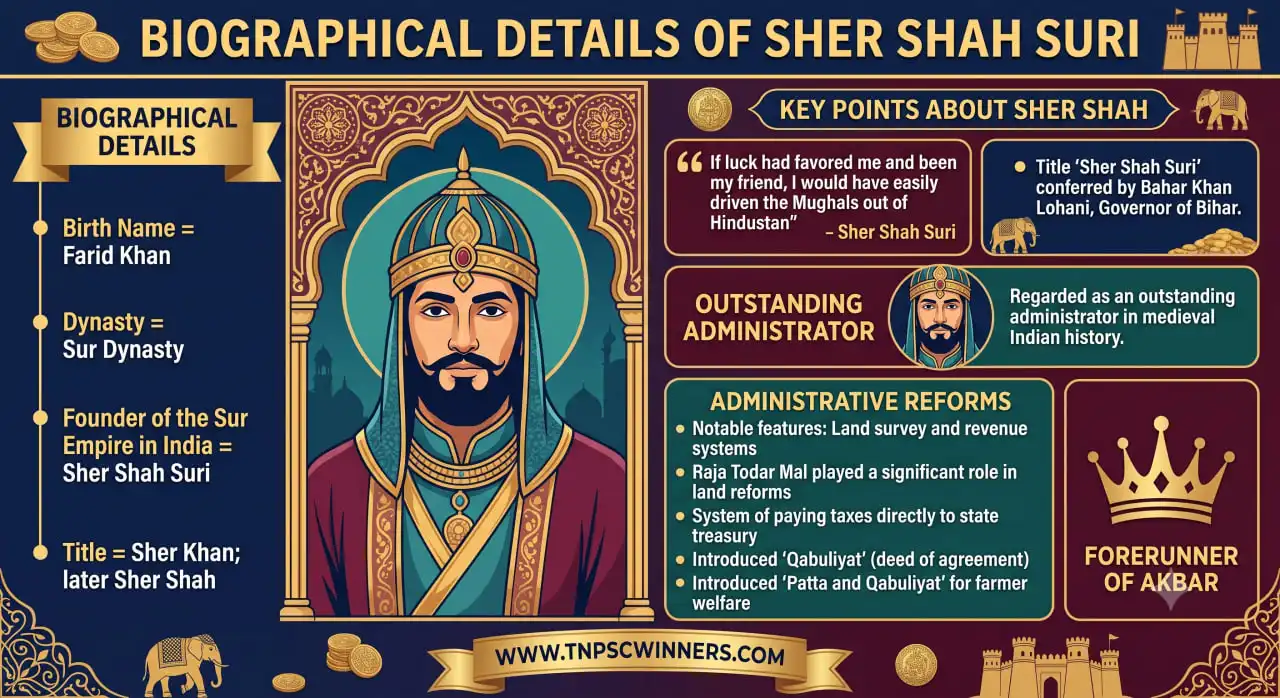
Biographical Details of Sher Shah Suri
- Birth Name = Farid Khan
- Famous Name = Sher Shah Suri
- Dynasty = Sur Dynasty
- Reign = 1540–1545 AD
- Capital = Delhi
- Founder of the Sur Empire in India = Sher Shah Suri
- Father = Hasan Khan Sur
- Birthplace = Sasaram, Bihar
- Title = Sher Khan; later Sher Shah
- He initially served under Bahadur Khan Lohani, the ruler of Bihar.
- Sher Shah Suri – Biography, Reforms and Battles
JOIN OUR TELEGRAM CHANNEL – T.ME/TNPSC_WINNERS

Sher Shah Suri – Biography, Reforms and Battles
- The person who said, “If luck had favored me and been my friend, I would have easily driven the Mughals out of Hindustan” was Sher Shah Suri.
- The title “Sher Shah Suri” was conferred upon him by Bahar Khan Lohani, the Governor of Bihar.
- He defeated Humayun, conquered North India, and established Delhi as his capital.
- The rulers of the Mughal dynasty belonged to Turkish and Mongol ethnic origins.
- Sher Shah Suri belonged to an Afghan dynasty.
- He introduced innovations in the land revenue system and the military.
- In 1545 AD, he invaded and besieged the Kalinjar Fort, which was ruled by Kirat Singh. During the siege, he lost his life on May 26, 1545, due to the accidental explosion of one of the cannons.
- Sher Shah is regarded as an “outstanding administrator” in the history of medieval India.
- His administrative structure was centralized.
- Five key departments functioned under the King.
- To ensure efficient governance, he divided his territories into 47 *Sarkars*.
- He further subdivided the *Sarkars* into *Parganas*.
- The most notable features of Sher Shah’s administration were the land survey and revenue systems.
- Raja Todar Mal played a significant role in Sher Shah’s land reforms.
- Land revenue was determined by surveying the entire land under the supervision of Raja Todar Mal.
- He accurately surveyed all agricultural lands and determined the revenue for each unit of land (generally, one-third of the produce).
- He fixed the tax at one-third of the agricultural produce.
- He employed the “Sikandari Gaj” method for land measurement (32 inches = 39 points).
- Sher Shah Suri introduced the system of paying taxes directly into the state treasury.
- Details regarding the sown area, crops cultivated, and the amount payable by each farmer were recorded on a document called “Patta” and communicated to the respective farmer.
- Sher Shah Suri introduced the “Qabuliyat” (deed of agreement) system.
- He introduced the “Patta and Qabuliyat” schemes for the welfare of farmers.
- In military matters, Sher Shah followed the practices of Alauddin Khilji; he paid soldiers’ salaries in cash.
- Abbas Khan Sarwani described Sher Shah Suri’s administrative skills in detail in the book “Tarikh-i-Sher Shahi.”
- The ruler who succeeded Sher Shah was Islam Shah Suri (Jalal Khan).
- Sher Shah Suri is known as the “Forerunner of Akbar.”
- Sher Shah Suri – Biography, Reforms and Battles
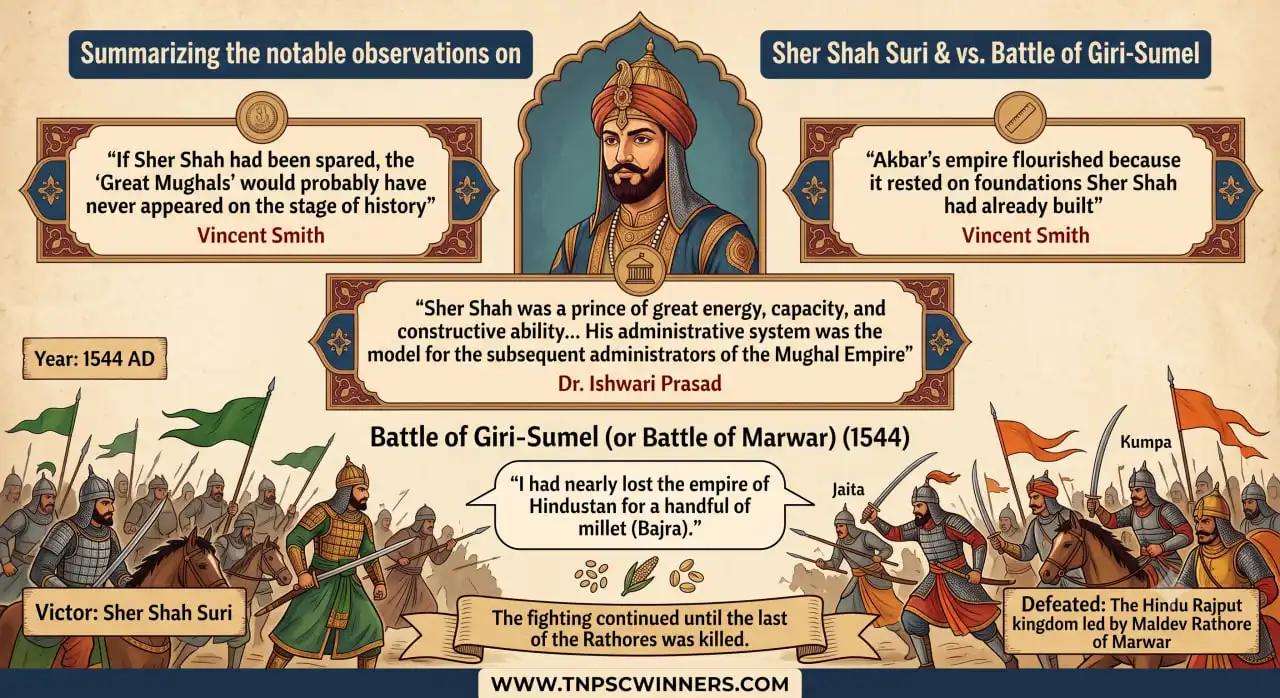
Notable Observations on Sher Shah
- “If Sher Shah had been spared, the ‘Great Mughals’ would probably have never appeared on the stage of history” — Vincent Smith
- “Akbar’s empire flourished because it rested on foundations Sher Shah had already built” — Vincent Smith
- “Sher Shah was a prince of great energy, capacity, and constructive ability… His administrative system was the model for the subsequent administrators of the Mughal Empire” — Dr. Ishwari Prasad
- Sher Shah Suri – Biography, Reforms and Battles
Battle of Giri-Sumel (or Battle of Marwar) (1544)
- Year: 1544 AD.
- Victor: Sher Shah Suri.
- Defeated: The Hindu Rajput kingdom led by Maldev Rathore of Marwar.
- Following the battle, Sher Shah Suri lamented, “I had nearly lost the empire of Hindustan for a handful of millet (Bajra).”
- The Rajput commanders Jaita and Kumpa were the ones who brought Sher Shah Suri to the brink of defeat in this battle.
- It is said that the fighting continued until the last of the Rathores was killed.
- Sher Shah Suri – Biography, Reforms and Battles
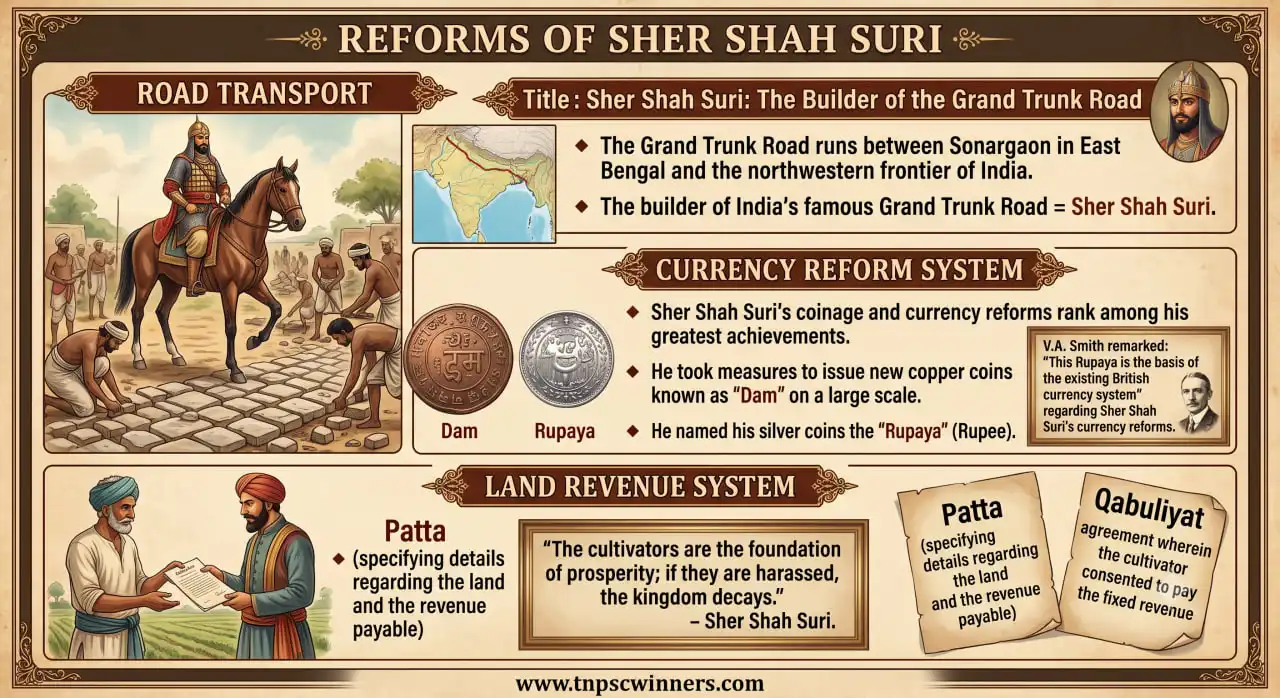
Road Transport System of Sher Shah Suri
- The Grand Trunk Road runs between Sonargaon in East Bengal and the northwestern frontier of India.
- A road connecting Agra to Burhanpur in the Deccan.
- A road connecting Agra and Jodhpur with Chittor in Rajputana.
- A road connecting Lahore and Multan.
- The builder of India’s famous Grand Trunk Road = Sher Shah Suri.
Currency Reform System of Sher Shah Suri
- Sher Shah Suri’s coinage and currency reforms rank among his greatest achievements.
- He took measures to issue new copper coins known as “Dam” on a large scale.
- He named his silver coins the “Rupaya” (Rupee).
- This remained in circulation until 1835.
- The ruler who first named coins “Rupaya” = Sher Shah Suri.
- The person who remarked that “this Rupaya is the basis of the existing British currency system” regarding Sher Shah Suri’s currency reforms = V.A. Smith.
- This silver Rupaya served as a crucial foundation for India’s subsequent currency system.
- He also issued copper coins known as “Dam“.
- Sher Shah Suri – Biography, Reforms and Battles
Land Revenue System of Sher Shah Suri
- The ‘Patta’ was a written document specifying details regarding the land and the revenue payable.
- The ‘Qabuliyat’ was an agreement wherein the cultivator (farmer) consented to pay the fixed revenue.
- This system later influenced Akbar’s revenue administration.
- The person who stated, “The cultivators are the foundation of prosperity; if they are harassed, the kingdom decays,” was Sher Shah Suri.
Administrative Divisions
- The empire was divided into ‘Sarkars’.
- The Sarkars were further divided into ‘Parganas’.
- Officials were appointed to handle administration, revenue collection, and the maintenance of law and order.
Sarais (Travelers’ Inns)
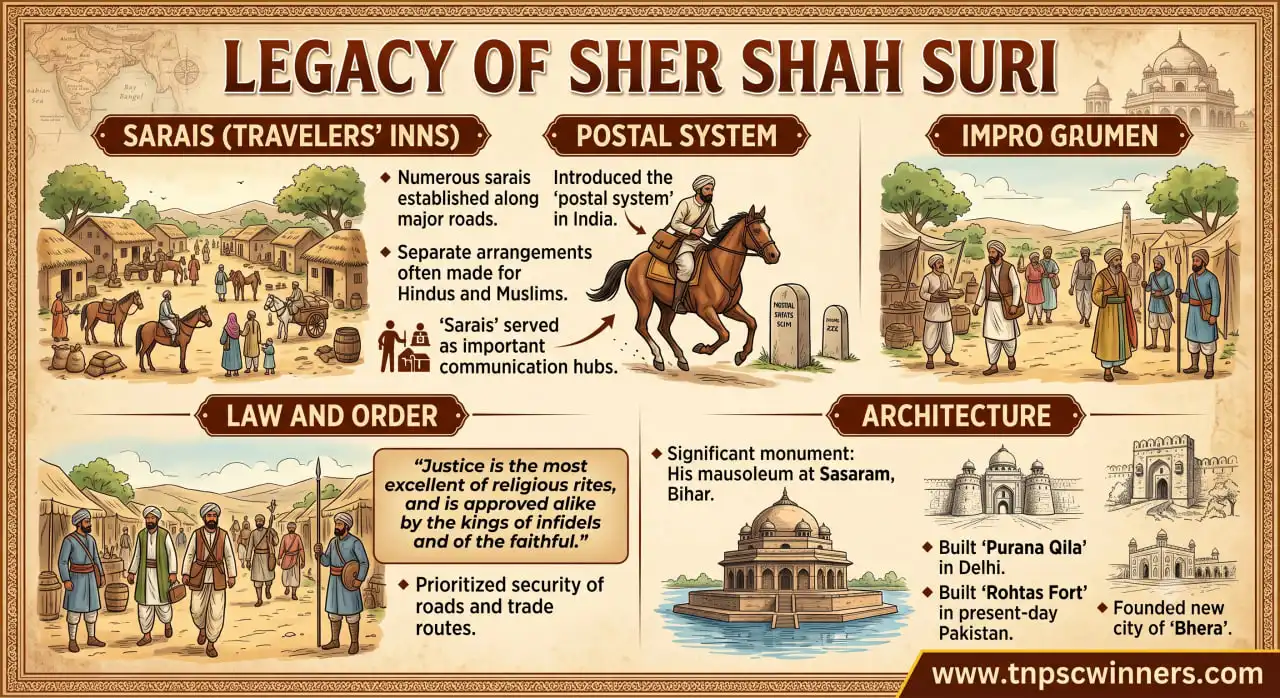
- Sher Shah established numerous sarais (travelers’ inns) along the major roads.
- These provided accommodation for travelers and merchants.
- The sarais also served as important centers for the exchange of information.
- In many sarais, separate arrangements were made for Hindus and Muslims.
- Sher Shah Suri – Biography, Reforms and Battles
Postal System of Sher Shah Suri
- The person who introduced the “postal system” in India = Sher Shah Suri.
- Sher Shah established an efficient postal and intelligence network.
- Horsemen and runners (messengers) carried messages.
- ‘Sarais’ (inns for travelers) served as important communication hubs.
Law and Order
- Sher Shah enforced a strict system of law and order.
- Local officials were held accountable for crimes committed within their jurisdictions.
- His administration prioritized the security of roads and trade routes.
- Sher Shah Suri famously stated, “Justice is the most excellent of religious rites, and is approved alike by the kings of infidels and of the faithful.”
Architecture
- The most significant monument associated with Sher Shah is his mausoleum located at Sasaram in Bihar.
- He constructed an octagonal mausoleum at Sasaram, Bihar.
- Sher Shah’s mausoleum reflects a harmonious blend of Hindu and Muslim architectural styles.
- Sher Shah Suri built the “Purana Qila” in Delhi.
- He built the “Rohtas Fort” in the Punjab region of present-day Pakistan.
- Sher Shah Suri founded the new city of “Bhera.”
- Sher Shah Suri – Biography, Reforms and Battles
Death of Sher Shah Suri
- Year = 1545 AD
- Place = Kalinjar
- He was besieging the Kalinjar Fort.
- He lost his life due to an explosion involving gunpowder or explosives during the siege.
- He was succeeded by his son, Islam Shah Suri.
15 Key Exam Points (One-liners)
- Sher Shah Suri’s original name → Farid Khan
- Dynasty founded by Sher Shah → Sur Dynasty
- Sher Shah’s reign → 1540–1545 AD
- First battle where Sher Shah defeated Humayun → Chausa (1539)
- Battle that drove Humayun out of India → Kannauj / Bilgram (1540)
- Silver coin introduced/standardized by Sher Shah → Rupiya
- Copper coin → Dam
- Document detailing land/revenue particulars → Patta
- Cultivator’s agreement to pay revenue → Kabuliyat
- Major road constructed by Sher Shah → Grand Trunk Road
- Sher Shah’s famous tomb → Sasaram, Bihar
- Place of Sher Shah’s death → Kalinjar
- Year of death → 1545 AD
- Successor → Islam Shah Suri
- Sher Shah’s administrative reforms influenced → Akbar’s administration
- Sher Shah Suri – Biography, Reforms and Battles