
Chhatrapati Shivaji Maharaj – Life, Battles, Administration and Achievements
Learn about Shivaji Maharaj for TNPSC exams, including his early life, Maratha kingdom, important battles, administration, Ashtapradhan system, forts, navy, coronation and achievements.
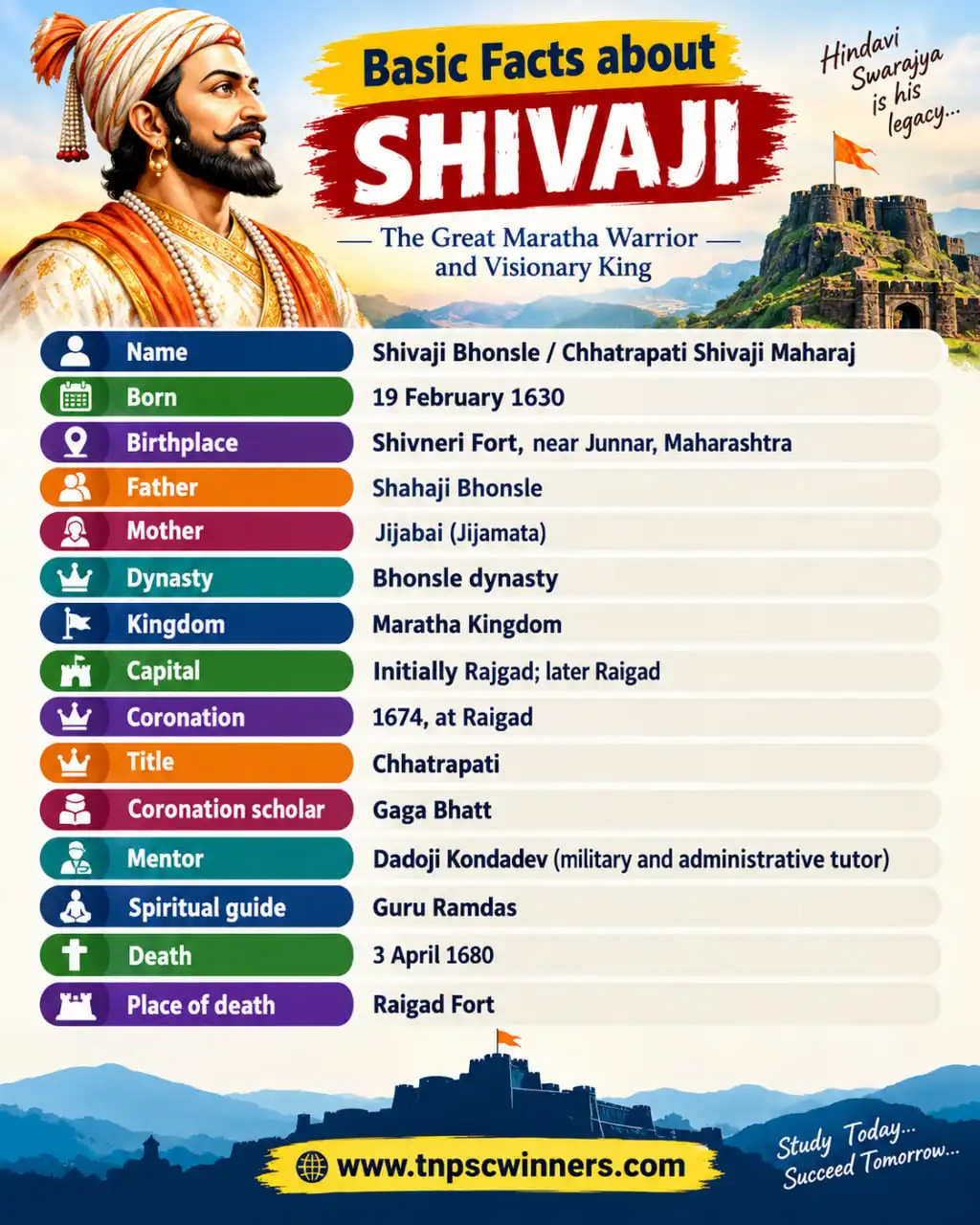
Shivaji Maharaj – Life, Battles & Achievements
- Name = Shivaji Bhonsle / Chhatrapati Shivaji Maharaj
- Born = 19 February 1630
- Birthplace = Shivneri Fort, near Junnar, Maharashtra
- Father = Shahaji Bhonsle
- Mother = Jijabai (Jijamata)
- Dynasty = Bhonsle dynasty
- Kingdom = Maratha Kingdom
- Capital = Initially Rajgad; later Raigad
- Coronation = 1674, at Raigad
- Title = Chhatrapati
- Coronation scholar = Gaga Bhatt
- Mentor = Dadoji Kondadev (military and administrative tutor)
- Spiritual guide = Guru Ramdas
- Death = 3 April 1680
- Place of death = Raigad Fort
JOIN OUR TELEGRAM CHANNEL – T.ME/TNPSC_WINNERS

Shivaji’s Early Conquest
- Torna Fort – 1646 = Generally regarded as Shivaji’s first major fort conquest. He renamed it Prachandagad.
- Rajgad = Developed into an important early capital of Shivaji’s kingdom.
- Kondana Fort = Later became famous as Sinhagad. Associated with Tanaji Malusare.
- Shivaji Maharaj – Life, Battles & Achievements
Shivaji’s Conflict with Bijapur
- Shivaji’s expansion brought him into conflict with the Adil Shahi Sultanate of Bijapur.
- Afzal Khan, a powerful Bijapur general, was sent against Shivaji.
- The famous meeting between Shivaji and Afzal Khan took place at the foothills of Pratapgad in 1659.
- Afzal Khan was killed during the encounter.
- Shivaji subsequently strengthened his position in the region.
- Exam Fact = Battle/Encounter at Pratapgad – 1659 → Shivaji vs Afzal Khan
- Shivaji Maharaj – Life, Battles & Achievements
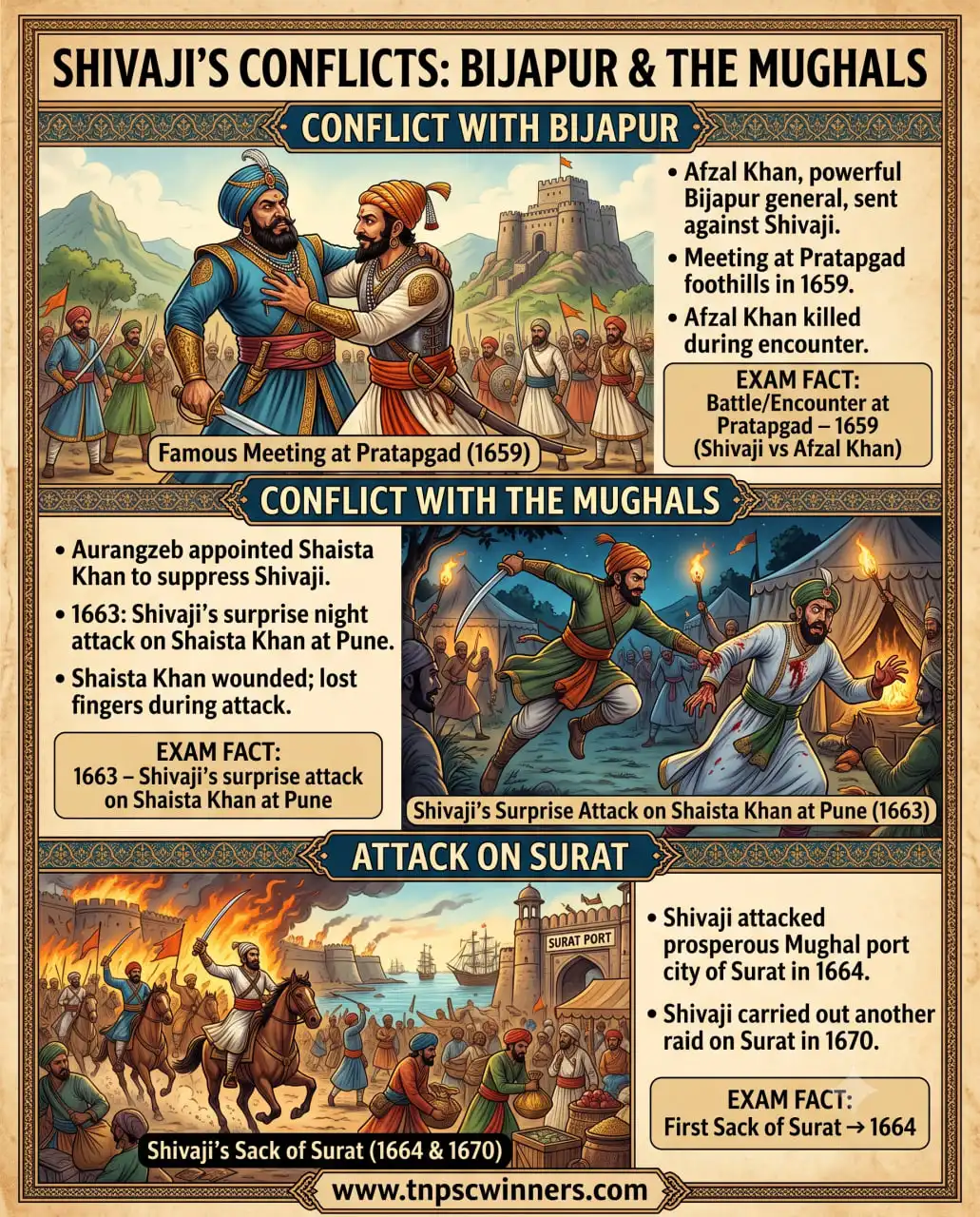
Shivaji’s Conflict with the Mughals
- Shivaji also came into conflict with the Mughal Empire, particularly during the reign of Aurangzeb.
- Aurangzeb appointed Shaista Khan to suppress Shivaji.
- Shaista Khan occupied Pune.
- In 1663, Shivaji conducted a surprise attack on Shaista Khan at Pune.
- Shaista Khan was wounded and lost fingers during the attack.
- Exam Fact = 1663 → Shivaji’s surprise attack on Shaista Khan at Pune
Shivaji’s Attack on Surat
- Shivaji attacked the prosperous Mughal port city of Surat in 1664.
- Surat was an important commercial centre of the Mughal Empire.
- Shivaji carried out another raid on Surat in 1670.
- Exam Fact = First Sack of Surat → 1664
Treaty of Purandar – 1665
- The Mughal general Mirza Raja Jai Singh I was sent against Shivaji.
- After military pressure, Shivaji entered into the Treaty of Purandar in 1665.
- Important Provisions in Treaty of Purandar are
- Shivaji agreed to surrender 23 forts to the Mughals.
- He retained 12 forts.
- Shivaji agreed to cooperate with the Mughals against Bijapur.
- His son Sambhaji entered Mughal service.
- Exam Fact = Treaty of Purandar – 1665 → Shivaji and Jai Singh
- Shivaji Maharaj – Life, Battles & Achievements
Shivaji’s Visit to Agra – 1666
- Shivaji visited the Mughal court at Agra in 1666.
- He met Aurangzeb.
- Shivaji felt insulted by the treatment he received at the Mughal court.
- He was placed under surveillance/house arrest.
- He famously escaped from Agra with Sambhaji.
- Exam Fact = 1666 → Shivaji’s Agra visit and escape
Coronation of Shivaji – 1674
- Shivaji was formally crowned at Raigad Fort in 1674.
- Gaga Bhatt, a scholar from Varanasi, conducted the coronation ceremony.
- Shivaji assumed the title Chhatrapati.
- The coronation formally established Shivaji as an independent sovereign.
- Second Coronation = A second coronation ceremony was held later in 1674, reportedly because of ritual objections and circumstances surrounding the first ceremony.
- Important Exam Facts = Coronation → 1674, Place → Raigad, Scholar → Gaga Bhatt, Title → Chhatrapati
- Shivaji Maharaj – Life, Battles & Achievements
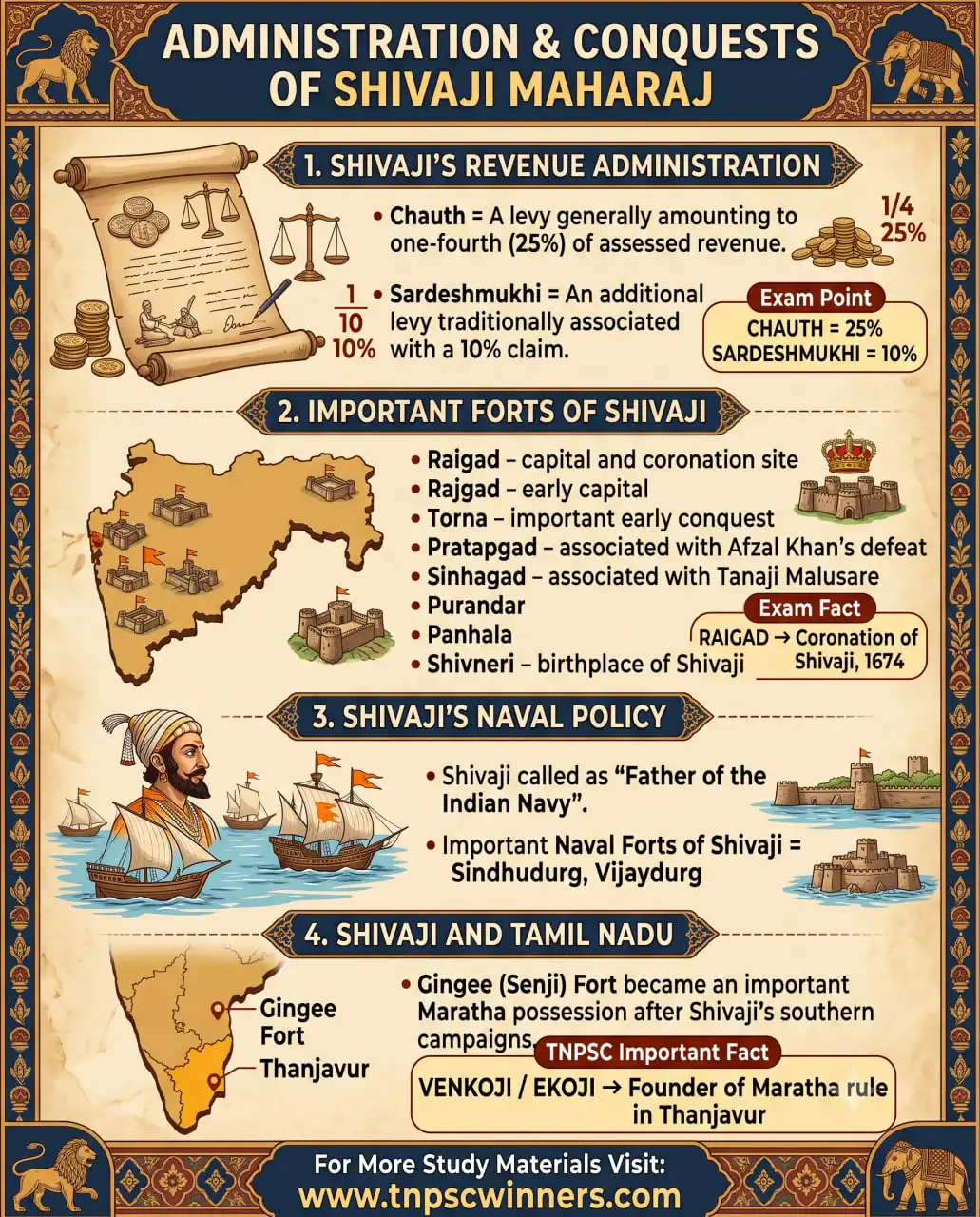
Shivaji’s Revenue Administration
- Shivaji introduced systematic revenue collection in his territories.
- Land was surveyed and assessed.
- Revenue was generally based on the productivity of the land.
- He reduced the role of intermediaries in revenue collection in areas under his direct administration.
- Chauth = A levy generally amounting to one-fourth (25%) of assessed revenue.
- Sardeshmukhi = An additional levy traditionally associated with a 10% claim.
- Exam Point = Chauth = 25%, Sardeshmukhi = 10%
- Shivaji Maharaj – Life, Battles & Achievements
Important Forts of Shivaji
- Raigad – capital and coronation site
- Rajgad – early capital
- Torna – important early conquest
- Pratapgad – associated with Afzal Khan’s defeat
- Sinhagad – associated with Tanaji Malusare
- Purandar
- Panhala
- Shivneri – birthplace of Shivaji
- Exam Fact = Raigad → Coronation of Shivaji, 1674
Shivaji’s Naval Policy
- Shivaji called as “Father of the Indian Navy”.
- Shivaji recognized the strategic importance of the Konkan coast and developed a naval force.
- Important Naval Forts of Shivaji = Sindhudurg, Vijaydurg
- His naval policy was intended partly to protect the Konkan coast and challenge maritime threats, including the Siddis of Janjira and European maritime powers.
- Exam Fact = Shivaji is often regarded as one of the pioneers of organized naval power in medieval/early-modern western India.
Shivaji and Tamil Nadu
- Shivaji’s southern campaign has significance for South Indian history.
- Gingee (Senji) Fort became an important Maratha possession after Shivaji’s southern campaigns.
- Gingee later became especially important during the Mughal-Maratha conflict after Shivaji’s death.
- Shivaji’s half-brother Venkoji (Ekoji) established the Maratha rule of Thanjavur.
- TNPSC Important Fact = Venkoji/Ekoji → Founder of Maratha rule in Thanjavur
- Shivaji Maharaj – Life, Battles & Achievements
Death and Succession
- Shivaji died on 3 April 1680 at Raigad.
- He was succeeded after a succession struggle by his elder son Sambhaji.
- Sambhaji continued the struggle against the Mughals under Aurangzeb.
Important Personalities Associated with Shivaji
- Jijabai = Mother of Shivaji
- Shahaji Bhonsle = Father
- Dadoji Konddev = early teacher
- Afzal Khan = Bijapur general defeated at Pratapgad
- Shaista Khan = Mughal commander attacked by Shivaji at Pune
- Mirza Raja Jai Singh I = Negotiated Treaty of Purandar
- Gaga Bhatt = Conducted Shivaji’s coronation
- Tanaji Malusare = Associated with the capture of Kondana/Sinhagad
- Sambhaji = Elder son and successor
- Venkoji/Ekoji = Half-brother; founder of Maratha rule in Thanjavur
- Shivaji Maharaj – Life, Battles & Achievements
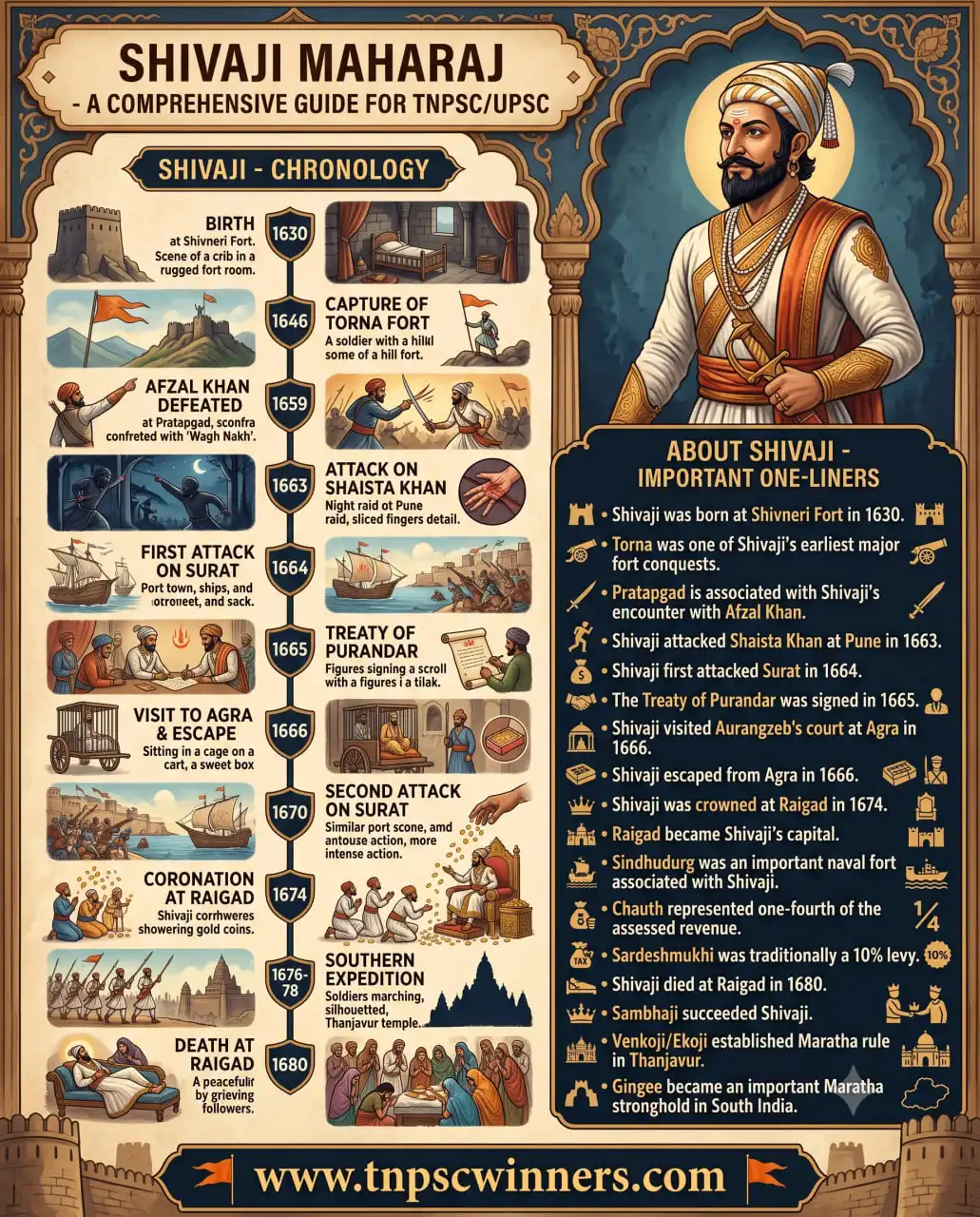
Shivaji – Chronology
- 1630 = Birth of Shivaji at Shivneri
- 1646 = Capture of Torna
- 1659 = Afzal Khan defeated/killed at Pratapgad
- 1663 = Attack on Shaista Khan at Pune
- 1664 = First attack on Surat
- 1665 = Treaty of Purandar
- 1666 = Visit to Agra and escape
- 1670 = Second attack on Surat
- 1674 = Coronation at Raigad
- 1676–78 = Southern expedition
- 1680 = Death of Shivaji at Raigad
About Shivaji – Important One-Liners for TNPSC/UPSC
- Shivaji was born at Shivneri Fort in 1630.
- Shivaji’s father was Shahaji Bhonsle.
- Shivaji’s mother was Jijabai.
- Torna was one of Shivaji’s earliest major fort conquests.
- Pratapgad is associated with Shivaji’s encounter with Afzal Khan.
- Shivaji attacked Shaista Khan at Pune in 1663.
- Shivaji first attacked Surat in 1664.
- The Treaty of Purandar was signed in 1665.
- Mirza Raja Jai Singh negotiated with Shivaji in the Treaty of Purandar.
- Shivaji visited Aurangzeb’s court at Agra in 1666.
- Shivaji escaped from Agra in 1666.
- Shivaji was crowned at Raigad in 1674.
- Gaga Bhatt conducted the coronation ceremony.
- Shivaji assumed the title Chhatrapati.
- Ashtapradhan was the council of eight ministers.
- Ganimi Kava is associated with Shivaji’s unconventional warfare tactics.
- Raigad became Shivaji’s capital.
- Sindhudurg was an important naval fort associated with Shivaji.
- Chauth represented one-fourth of the assessed revenue.
- Sardeshmukhi was traditionally a 10% levy.
- Shivaji died at Raigad in 1680.
- Sambhaji succeeded Shivaji.
- Venkoji/Ekoji established Maratha rule in Thanjavur.
- Gingee became an important Maratha stronghold in South India.
- Shivaji Maharaj – Life, Battles & Achievements