
Tipu Sultan of Mysore
Learn about Tipu Sultan of Mysore, his life, administration, Anglo-Mysore Wars, military innovations, treaties, achievements, and important facts for TNPSC and competitive exams.
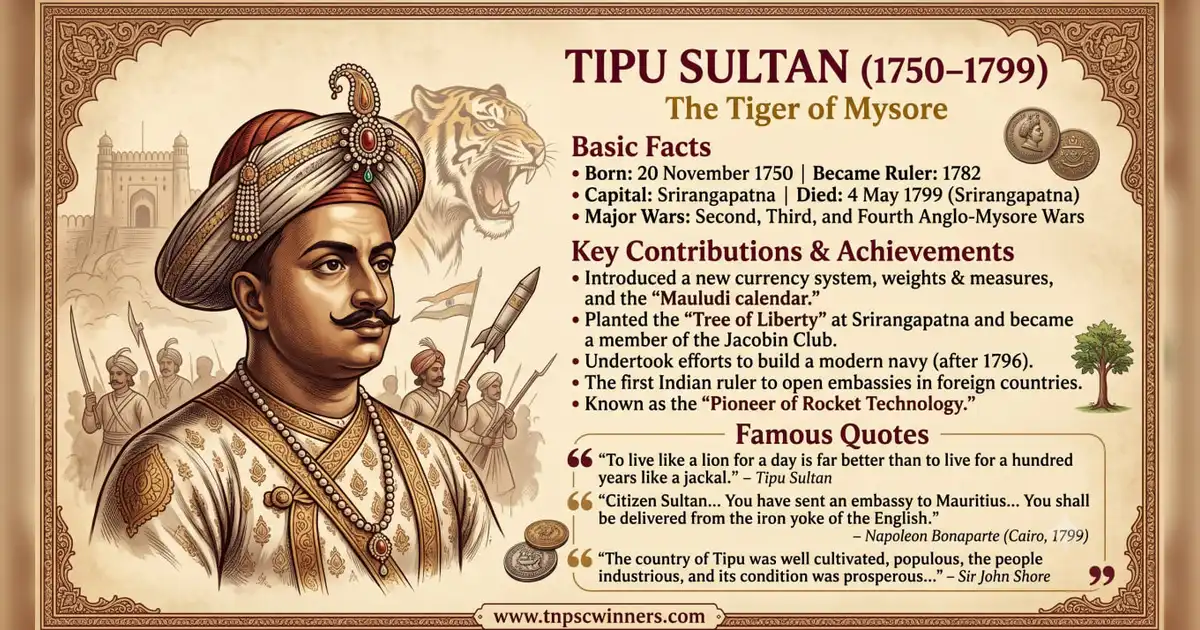
Tipu Sultan
- He introduced a new currency system and a new system of weights and measures.
- Tipu Sultan supported the French government in India.
- He took a keen interest in the French Revolution.
- He planted the “Tree of Liberty” at Srirangapatna.
- He became a member of the Jacobin Club.
- He introduced the “Mauludi calendar.”
- After 1796, he undertook efforts to build a modern navy.
- The person who said, “It is better to live one day as a lion than a lifetime as a sheep” = Tipu Sultan.
- “To live like a lion for a day is far better than to live for a hundred years like a jackal” said by = Tipu Sultan (for Subsidiary Alliance)
- He sent envoys to France, Turkey, Iran, and Burma to promote foreign trade.
- The first Indian ruler to open embassies in foreign countries = Tipu Sultan.
- He also traded with China.
- He sought to boost trade with Russia and Arabia by establishing state trading companies in port cities.
- He provided funds for the restoration of the idol of Goddess Sharada at the Sringeri temple, which had been plundered by Maratha cavalrymen in 1791.
- The person known as the “Pioneer of Rocket Technology” = Tipu Sultan.
- “Citizen Sultan, you are informed of our victories. You have sent an embassy to Mauritius… You shall be delivered from the iron yoke of the English.” said by = Napoleon Bonaparte (Letter written from Cairo, 1799)
- “The country of Tipu was well cultivated, populous, the people industrious, and its condition was prosperous beyond that of any other state in India.” said by = Sir John Shore (Governor-General, 1793–1798)
JOIN OUR TELEGRAM CHANNEL – T.ME/TNPSC_WINNERS
Tipu Sultan – Basic Facts
- Name = Tipu Sultan
- Also known as = Tiger of Mysore
- Father = Hyder Ali
- Mother = Fatima Fakhr-un-Nisa
- Born = 20 November 1750
- Birthplace = Devanahalli, near Bengaluru
- Became ruler = 1782
- Capital = Srirangapatna
- Died = 4 May 1799
- Place of death = Srirangapatna
- Major opponents = British East India Company
- Major wars = Second, Third and Fourth Anglo-Mysore Wars
Tipu Sultan’s Early Military Career
- Tipu Sultan received military training from an early age.
- He participated in military campaigns under his father.
- During the Second Anglo-Mysore War, he played an important military role.
- After Hyder Ali died in 1782, Tipu Sultan took over the leadership of Mysore.
Tipu Sultan and the Second Anglo-Mysore War
- After Hyder Ali’s death, Tipu continued the war.
- The conflict finally ended with = Treaty of Mangalore – 1784
Significance
- The war ended without a decisive British conquest of Mysore.
- The parties restored territories captured during the war.
- It is often regarded as the last major treaty in India negotiated by the British East India Company on relatively equal terms with an Indian power.
- Exam Point = Second Anglo-Mysore War → 1780–84 → Hyder Ali + Tipu → Treaty of Mangalore
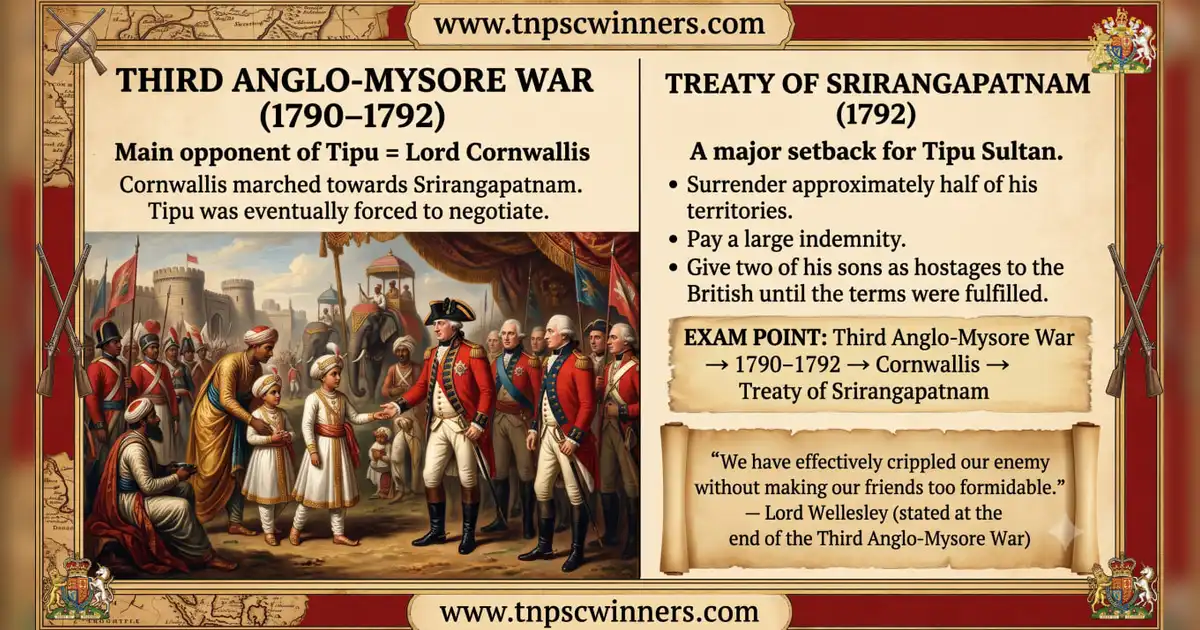
Third Anglo-Mysore War – 1790–1792
- Main opponent of Tipu = Lord Cornwallis
- Cornwallis marched towards Srirangapatnam.
- Tipu was eventually forced to negotiate.
Treaty of Srirangapatnam – 1792
- The war ended with the = Treaty of Srirangapatnam (1792)
- This was a major setback for Tipu Sultan.
- Surrender approximately half of his territories.
- Pay a large indemnity.
- Give two of his sons as hostages to the British until the terms were fulfilled.
- Exam Point = Third Anglo-Mysore War → 1790–1792 → Cornwallis → Treaty of Srirangapatnam
- At the end of the Third Anglo-Mysore War, the person who stated, “We have effectively crippled our enemy without making our friends too formidable,” was Lord Wellesley.
Tipu Sultan’s Foreign Policy
- Tipu Sultan attempted to obtain foreign assistance against the British.
- He maintained diplomatic relations with = France, Ottoman Empire, Afghanistan and other powers in the broader Islamic world
- French connection = Planted a “Tree of Liberty” at Srirangapatna (1797) and enrolled as a member of the French Jacobin Club (styled as “Citizen Tipu”).
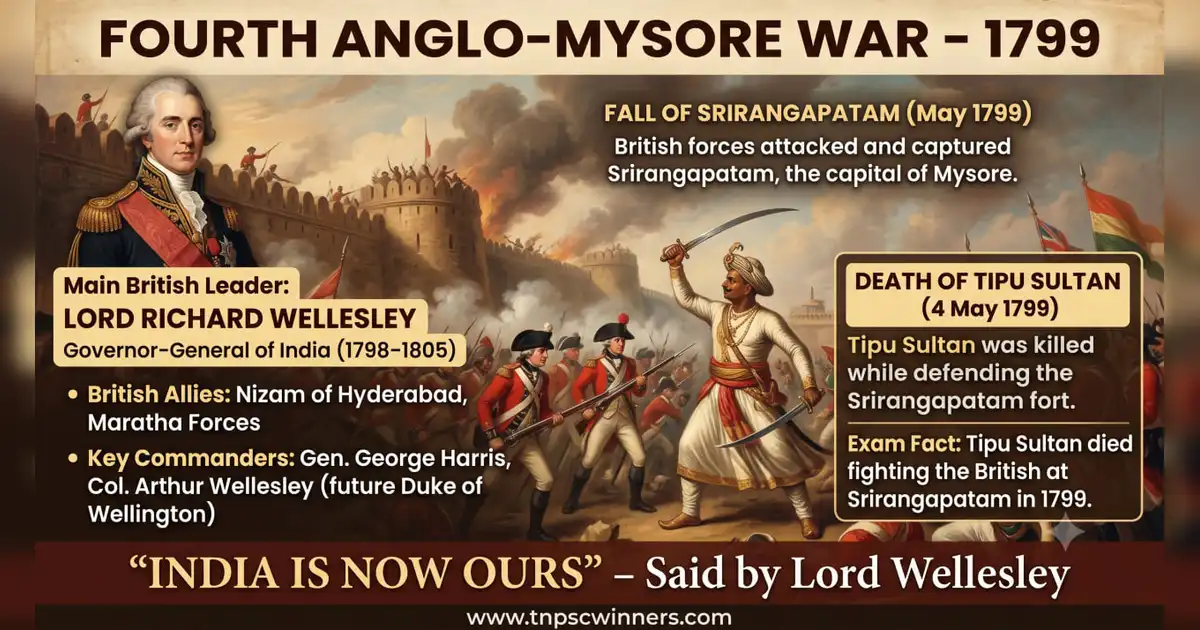
Fourth Anglo-Mysore War – 1799
- Main British leader = Lord Richard Wellesley
- He was the Governor-General of India from 1798 to 1805.
- British allies = Nizam of Hyderabad, Maratha forces/Maratha political interests, British commanders
- Important commanders included = General George Harris, Colonel Arthur Wellesley, the future Duke of Wellington
Fall of Srirangapatam – 1799
- British forces attacked Srirangapatam, the capital of Mysore.
- The city fell in May 1799.
- Tipu Sultan fought during the defence of the city.
Death of Tipu Sultan
- 4 May 1799
- Tipu Sultan was killed while defending Srirangapatam.
- Exam fact = Tippu Sultan died fighting the British at Srirangapatam in 1799.
- “India is now ours” said by = Lord Wellesley (Richard Wellesley, Governor-General)
After the Death of Tipu Sultan
- The British dismantled much of Tipu’s political power.
- Mysore’s territories were redistributed among the victors and allies.
- The Wodeyar dynasty was restored to the Mysore throne.
- A subsidiary alliance relationship was established with Mysore.
- Exam Point = 1799 → Tipu defeated → Wodeyar dynasty restored → British influence greatly increased.
TNPSC One-Liner Facts
- Tippu Sultan became ruler of Mysore in 1782.
- The Third Anglo-Mysore War occurred from 1790–1792.
- Lord Cornwallis led the British during the Third Anglo-Mysore War.
- The Third Anglo-Mysore War ended with the Treaty of Seringapatam.
- Tipu surrendered approximately half his territory in 1792.
- Tippu’s two sons were given as hostages under the 1792 settlement.
- The Fourth Anglo-Mysore War took place in 1799.
- Lord Wellesley was Governor-General during the Fourth Anglo-Mysore War.
- Tippu Sultan died on 4 May 1799.
- Tippu Sultan died defending Srirangapatam.
- After Tipu’s defeat, the Wodeyar dynasty was restored.
- Mysore became subject to increased British influence.
- Mysore was famous for its iron-cased rockets.
- Tipu promoted sericulture.
- Tipu maintained diplomatic relations with France.
- Tippu Sultan is commonly called the Tiger of Mysore.
- The Fourth Anglo-Mysore War ended Mysore’s major independent resistance to British expansion in South India.