
World Cerebral Palsy Day 2026
World Cerebral Palsy Day 2026: Learn the theme “Unique and United,” significance, objectives, cerebral palsy facts, and key points for TNPSC and competitive exams.
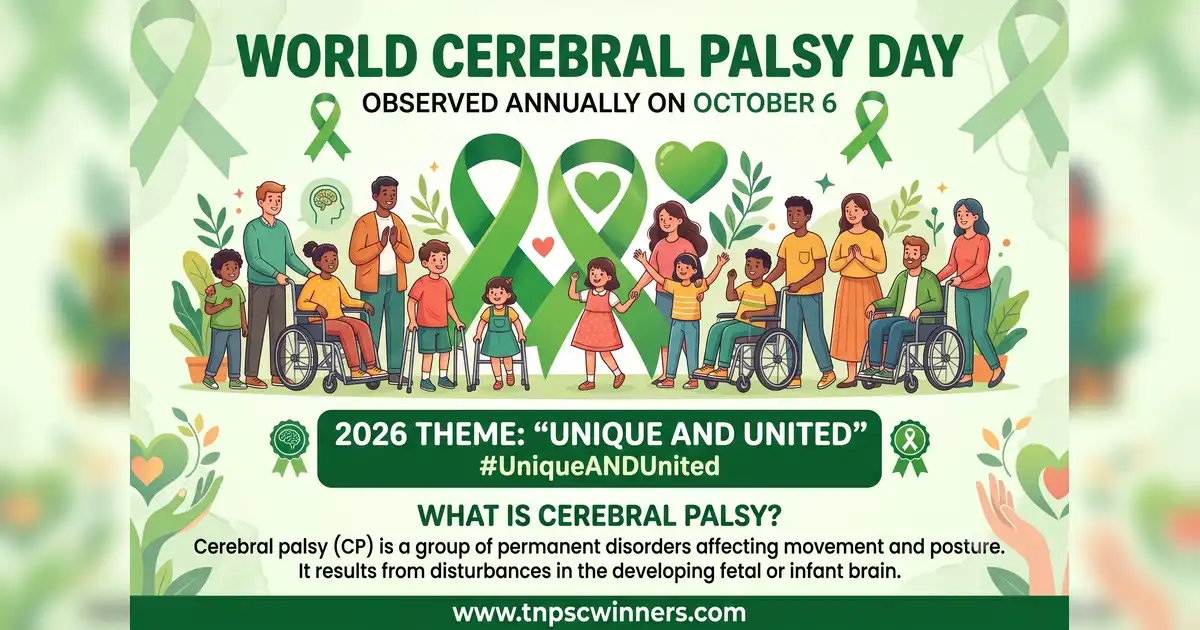
World Cerebral Palsy Day
- World Cerebral Palsy Day is observed annually on October 6 to raise global awareness, advocate for civil rights, and celebrate the achievements of people living with cerebral palsy (CP).
JOIN OUR TELEGRAM CHANNEL – T.ME/TNPSC_WINNERS

World Cerebral Palsy Day – Basic Facts
- World Cerebral Palsy Day = 6 October
- Observed every year = 6 October
- Purpose = To raise awareness about cerebral palsy and promote inclusion, rights and opportunities for people with cerebral palsy
- Cerebral Palsy (CP) A group of neurological disorders affecting movement, posture and coordination
- Key focus = Awareness, accessibility, inclusion, equality and empowerment
- First observed = 2012
- Major initiative = World Cerebral Palsy Initiative
- Global campaign = Led by the World Cerebral Palsy Day movement
- World Cerebral Palsy Day 2026
World Cerebral Palsy Day 2026
- The theme for World Cerebral Palsy Day 2026 is “Unique and United” (promoted alongside the campaign hashtag #UniqueANDUnited).
What is Cerebral Palsy?
- Cerebral palsy (CP) is a group of permanent disorders affecting movement and posture.
- It results from disturbances in the developing fetal or infant brain.
- It can affect muscle tone, coordination, balance, communication and mobility.
- CP is not contagious and is generally non-progressive—the brain injury does not worsen, although symptoms and functional needs can change over time.
- World Cerebral Palsy Day 2026
Objectives of World Cerebral Palsy Day
- Create global awareness about cerebral palsy.
- Promote the rights and dignity of people with cerebral palsy.
- Encourage social inclusion and equal participation.
- Improve accessibility in education, employment, healthcare and public spaces.
- Support families and caregivers.
- Promote research, innovation and assistive technologies.
Types of Cerebral Palsy
- Spastic CP = Stiff or tight muscles; most common type
- Dyskinetic CP = Involuntary and uncontrolled movements
- Ataxic CP = Problems with balance and coordination
- Mixed CP = Combination of features of different types
Indian Policy & Legal Framework
- RPwD Act, 2016 = Cerebral Palsy is recognised as one of the 21 specified disabilities under the Rights of Persons with Disabilities Act, 2016.
- National Trust Act, 1999 = Specifically addresses welfare and legal guardianship for four conditions: Autism, Cerebral Palsy, Mental Retardation (Intellectual Disability), and Multiple Disabilities.
- Nodal Ministry = Ministry of Social Justice and Empowerment (Department of Empowerment of Persons with Disabilities — DEPwD).
- Nodal Institute = National Institute for Empowerment of Persons with Multiple Disabilities (NIEPMD), located in Muttukadu, Chennai, Tamil Nadu.
- World Cerebral Palsy Day 2026
Important Indian Context
- Cerebral palsy is covered within India’s broader disability rights and inclusion framework.
- The Rights of Persons with Disabilities Act, 2016 (RPwD Act) is an important legislation concerning the rights, accessibility and inclusion of persons with disabilities.
- Key areas include inclusive education, accessibility, non-discrimination and equal opportunities.
TNPSC / Competitive Exam One-Liners
- World Cerebral Palsy Day → 6 October
- Cerebral Palsy primarily affects → Movement and posture
- Cerebral palsy is → Non-contagious
- CP is associated with → Damage/disturbance to the developing brain
- Most common type of CP → Spastic cerebral palsy
- CP mainly affects → Motor function
- RPwD Act → 2016
- Main message of the observance → Awareness, inclusion and equal rights