
14 Major Rock Edicts of Ashoka
14 Major Rock Edicts of Ashoka
What are the 14 Major Rock Edicts of Ashoka? Read a concise breakdown of each edict’s meaning, moral teachings, administrative reforms, and historical context.
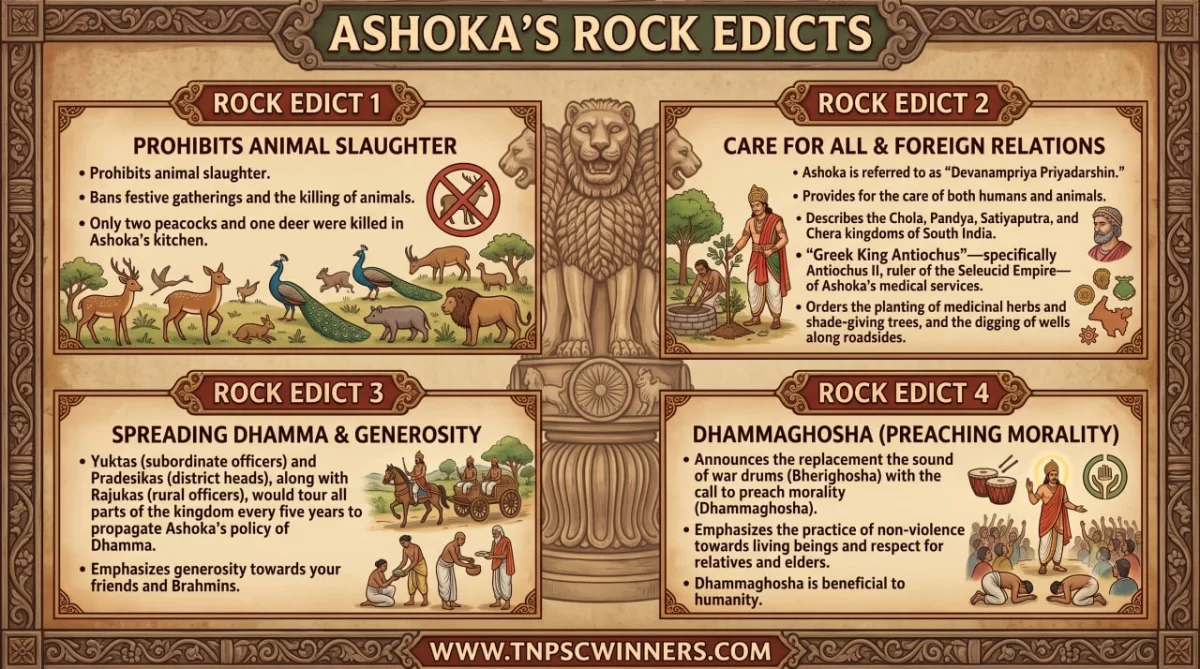
Rock Edict 1 = prohibhits animal salughter
- Prohibits the slaughter of animals.
- Bans festive gatherings and the killing of animals.
- Only two peacocks and one deer were killed in Ashoka’s kitchen.
- He wished to put an end to this practice of killing two peacocks and one deer.
JOIN OUR TELEGRAM CHANNEL – T.ME/TNPSC_WINNERS

Rock Edict 2 = care for all and foreign relations
- Ashoka is referred to as “Devanampriya Priyadarshi.”
- Provides for the care of both humans and animals.
- Describes the South Indian kingdoms of the Cholas, Pandyas, Satyaputras, and Cheras.
- Mentions the Greek King Antiochus II and his neighboring realms as recipients of these measures.
- Mentions the “Tamraparni” river in South India.
- “Greek King Antiochus”—specifically Antiochus II, ruler of the Seleucid Empire—is noted as a recipient of Ashoka’s medical services.
- Two types of medical facilities were established everywhere by King Devanampriya Priyadarshi: medical treatment for humans and medical treatment for animals.
- Orders the planting of medicinal herbs and shade-giving trees, and the digging of wells along roadsides.
Rock Edict 3 = spreading dhamma and generosity
- Issued 12 years after Ashoka’s coronation.
- States that *Yuktas* (subordinate officers) and *Pradeshikas* (district heads), along with *Rajukas* (rural officers), would tour all parts of the kingdom every five years to propagate Ashoka’s policy of *Dhamma*.
- Emphasizes obedience to parents,
- Generosity towards friends and Brahmins,
- And moderation in spending and saving.
- 14 Major Rock Edicts of Ashoka
Rock Edict 4 = dhammoghosha (preaching morality)
- It announces the replacement of the sound of war drums (*Bherighosha*) with the call to practice righteousness (*Dhammaghosha*).
- It emphasizes the practice of non-violence towards living beings and respect for relatives and elders.
- *Dhammaghosha* is beneficial for humanity.
- 14 Major Rock Edicts of Ashoka
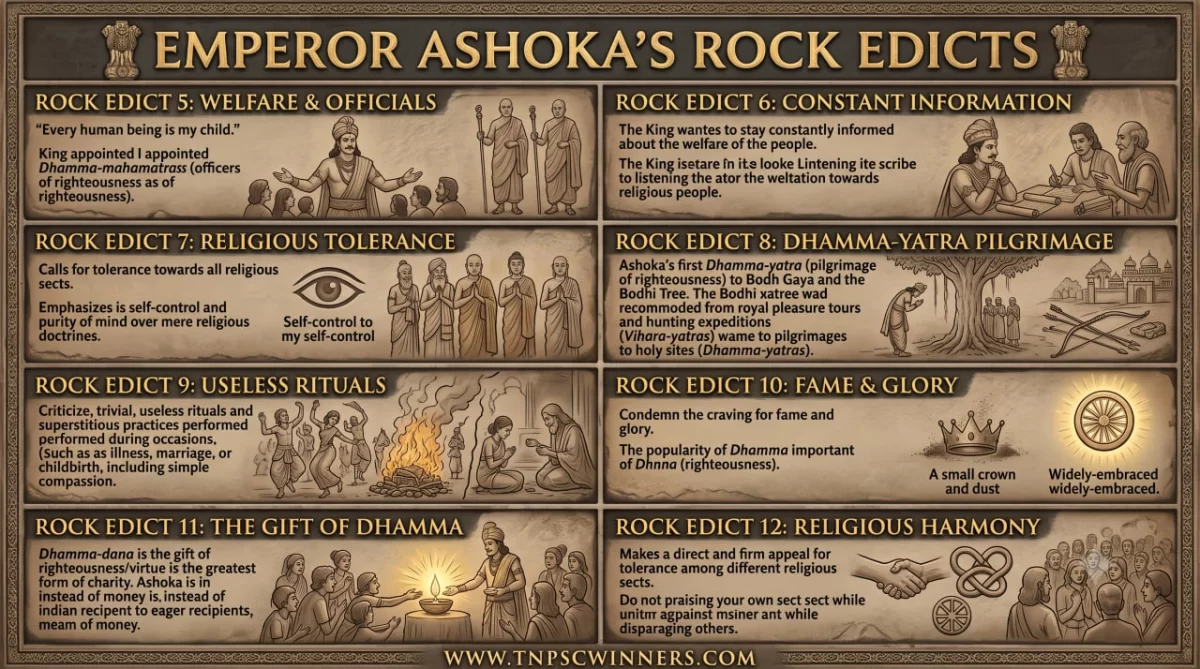
Rock Edict 5 = welfare and officials
- Concerns regarding the policy towards slaves.
- In this rock edict, he states, “Every human being is my child.”
- The appointment of *Dhamma-mahamatras* (officers of righteousness) is mentioned.
- Prevention of unjust imprisonment.
Rock Edict 6 = constant information
- Describes the King’s desire to stay constantly informed about the condition of the people.
- Discusses welfare measures.
- 14 Major Rock Edicts of Ashoka
Rock Edict 7 = religious tolerance
- Calls for tolerance towards all religions.
- “Promoting one’s own sect while disparaging others out of attachment to one’s own—thereby exalting one’s own sect—actually causes grave harm to one’s own sect.”
- Emphasizes self-control and purity of mind over religious doctrines.
Rock Edict 8 = dhamma – yatra pilgrimage
- Mentions Ashoka’s first *Dhamma-yatra* (pilgrimage of righteousness) to Bodh Gaya and the Bodhi Tree.
- Replaces the King’s pleasure tours and hunting expeditions (*Vihara-yatras*) with pilgrimages to religious sites (*Dhamma-yatras*).
- 14 Major Rock Edicts of Ashoka
Rock Edict 9 = useless rituals
- Criticizes trivial, useless rituals and superstitious practices performed during occasions like illness, marriage, or childbirth.
- Urges people to follow the true rituals of *Dhamma* (righteousness), which include kindness towards subordinates, respect for teachers, and acts of charity.
Rock Edict 10 = fame and glory
- Condemns the desire for fame and glory.
- Emphasizes the importance of Dharma.
Rock Edict 11 = the gift of dhamma
- It defines ‘Dhamma-dana’ (the gift of righteousness or moral teaching)—which includes treating slaves and servants with respect, supporting ascetics, and practicing non-violence towards all living beings—as the supreme gift.
- It defines ‘Dhamma-dana’ (righteous gift) as the greatest gift of all.
Rock Edict 12 = religious harmony
- A direct and firm appeal for tolerance among different religious sects.
- It warns against praising one’s own sect while disparaging others.
- It emphasizes that the growth of essential virtues across all religions brings honor to everyone.
- Ashoka’s Kandahar Greek Edict (the final section) is inscribed in the Greek language.
- 14 Major Rock Edicts of Ashoka
Rock Edict 13 = from war to dhamma-vijaya
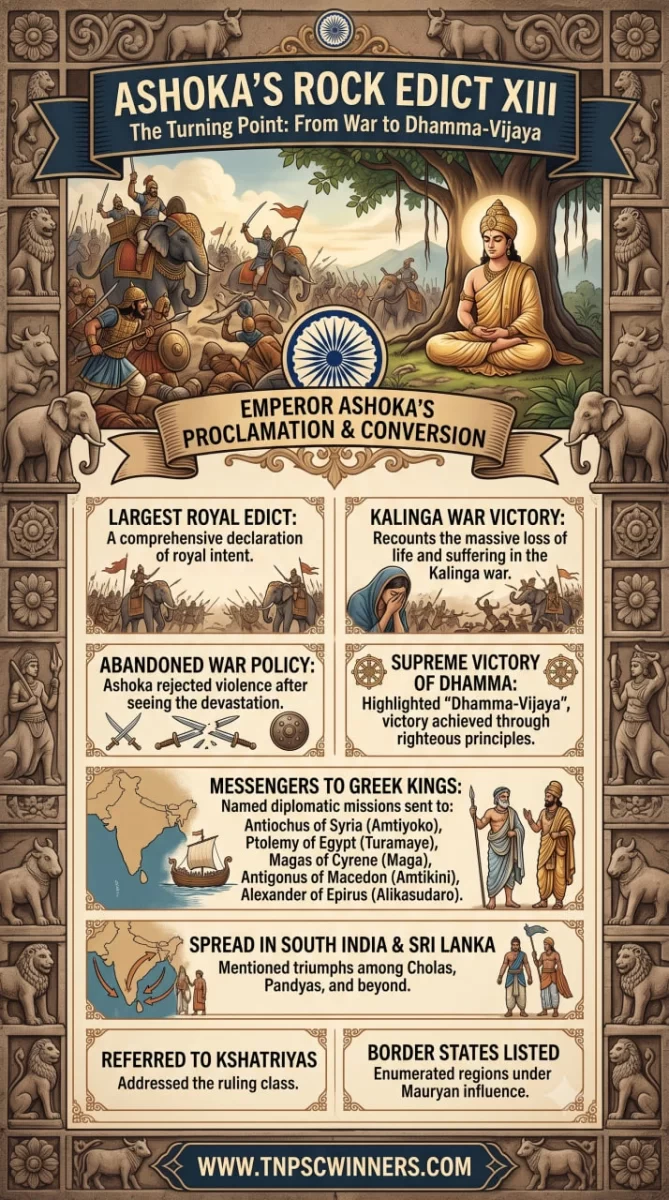
- This is the largest of the edicts.
- It speaks of Ashoka’s victory over Kalinga and mentions the massive loss of life in that war.
- The King regarded the victory achieved through “Dhamma” as the supreme victory; he highlights this “Dhamma-conquest.”
- A reference regarding the Kshatriyas.
- It also mentions the spread of Dhamma in South India—among the Cholas and Pandyas—and as far as Sri Lanka.
- It records the victory over Kalinga.
- It also mentions diplomatic missions sent to Greek kings: Antiochus of Syria (Amtiyoko), Ptolemy of Egypt (Turamaye), Magas of Cyrene (Maga), Antigonus of Macedon (Amtikini), and Alexander of Epirus (Alikasudara). • It mentions the Pandyas, Cholas, and others.
- It also states that after the Kalinga War, Emperor Ashoka abandoned the policy of war and adopted the policy of Dhamma.
- It lists the names of the border states of Emperor Ashoka’s empire.
- 14 Major Rock Edicts of Ashoka
Rock Edict 14 = engraving inscriptions
- It describes the engraving of inscriptions in various parts of the country.