
Anglo Mysore Wars
Explore the Anglo Mysore Wars (1767–1799): Key causes, treaties, and battles fought by Hyder Ali and Tipu Sultan against the British East India Company.
Anglo Mysore Wars
First Anglo-Mysore War (1767–1769)
- First Anglo-Mysore War (1767–1769) = Hyder Ali of Mysore defeated the British and their allies, leading to the Treaty of Madras (1769), which provided for mutual assistance in case of attack.
JOIN OUR TELEGRAM CHANNEL – T.ME/TNPSC_WINNERS

Causes
- Mysore’s rapid expansion under Hyder Ali alarmed the Madras Presidency.
- The British formed a tripartite coalition with the Nizam of Hyderabad and the Marathas.
Key Events
- Hyder Ali tactfully broke the alliance using diplomacy and money, winning over both the Marathas and the Nizam.
- Hyder Ali launched a sudden cavalry thrust and appeared directly outside the walls of Madras in March 1769, forcing the British to capitulate.
- Anglo Mysore Wars
Treaty of Madras (1769)
- Mutual return of captured territories and prisoners.
- Mutual defensive alliance: the British pledged to assist Mysore if attacked by a foreign power (a promise they later broke when the Marathas attacked Mysore in 1771).
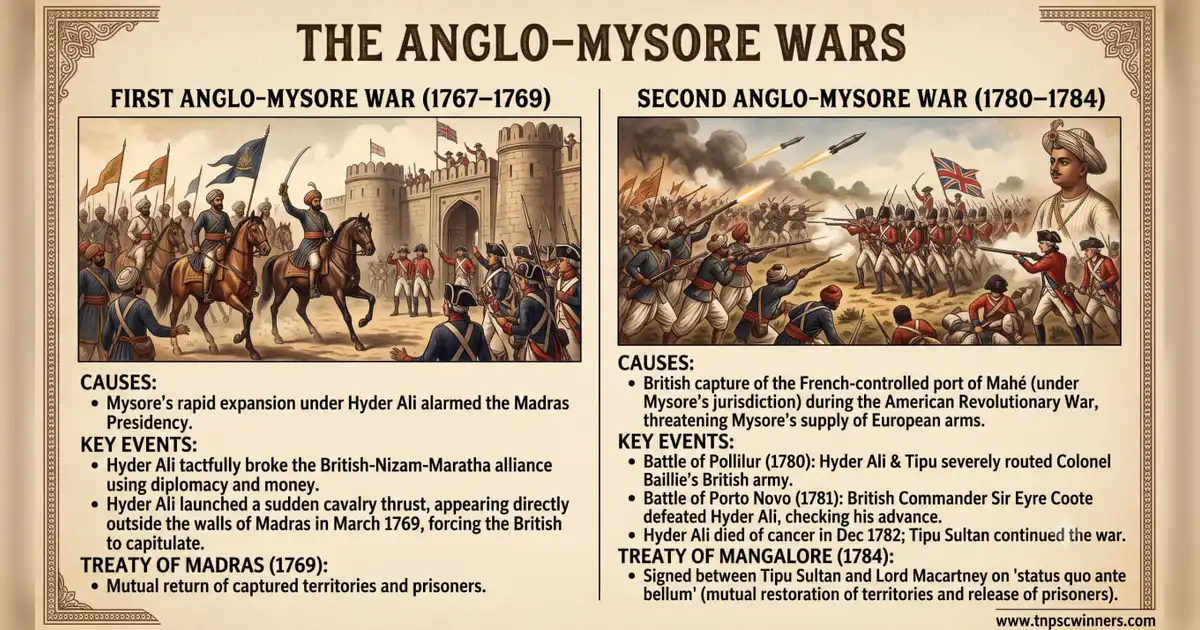
Second Anglo-Mysore War (1780–1784)
- Second Anglo-Mysore War (1780–1784) = Hyder Ali fought the British due to British interference and the capture of Mahé; the war ended with the Treaty of Mangalore (1784) under Tipu Sultan.
Causes
- British failure to honour the Treaty of Madras during the Maratha invasion of 1771.
- British capture of the French-controlled port of Mahé (under Mysore’s jurisdiction) during the American Revolutionary War, threatening Mysore’s supply line of European arms.
Key Events
- Hyder Ali forged an anti-British confederacy with the Nizam and the Marathas.
- Battle of Pollilur (1780) = Hyder Ali and Tipu severely routed Colonel Baillie’s British army.
- Battle of Porto Novo (1781) = British Commander Sir Eyre Coote defeated Hyder Ali, checking his advance.
- Hyder Ali died of cancer in December 1782; Tipu Sultan continued the war vigorously.
- Anglo Mysore Wars
Treaty of Mangalore (1784)
- Signed between Tipu Sultan and Lord Macartney (Governor of Madras) based on status quo ante bellum (mutual restoration of territories and release of prisoners).
- Last time an Indian power dictated terms to the British East India Company.
Third Anglo-Mysore War (1790–1792)
- Third Anglo-Mysore War (1790–1792) = Fought between Tipu Sultan and the British East India Company under Lord Cornwallis, ending with the Treaty of Seringapatam (1792), by which Tipu Sultan ceded about half of his territory to the allies.
Causes
- Tipu Sultan’s growing power, modernisation of his military, and contact with the Ottoman Empire and revolutionary France.
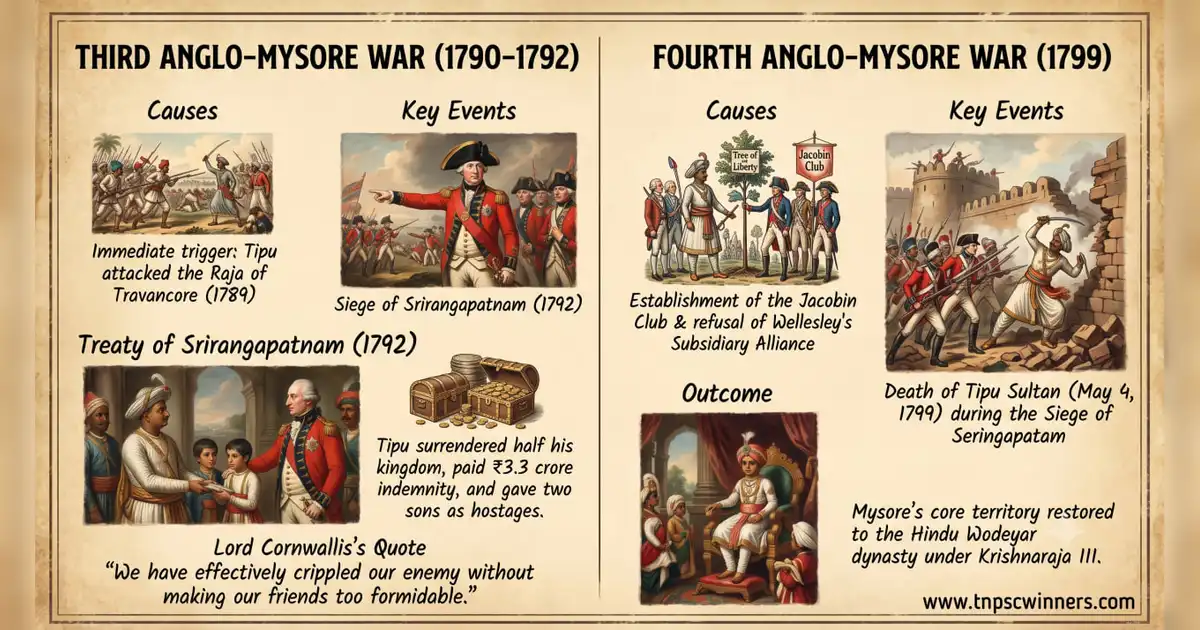
- Immediate trigger = Tipu attacked the Raja of Travancore (an ally of the British) in 1789 over the possession of Cranganore and Ayacottah.
Key Events
- Lord Cornwallis formed a triple alliance with the Marathas and the Nizam, promising them equal shares in territorial gains.
- Cornwallis personally assumed command, advanced through Bangalore, and besieged Tipu’s capital, Srirangapatnam, in 1792.
Treaty of Srirangapatnam (1792)
- Tipu surrendered nearly half of his kingdom:
- British acquired Malabar, Dindigul, Baramahal, and Coorg.
- Marathas received territory up to the Tungabhadra river.
- The Nizam obtained territories extending from the Krishna to beyond the Pennar river.
- Tipu had to pay a heavy indemnity of ₹3.3 crore and surrendered two of his young sons as hostages until the indemnity was cleared.
- Famous quote by Cornwallis = “We have effectively crippled our enemy without making our friends too formidable.”
- Anglo Mysore Wars
Fourth Anglo-Mysore War (1799)
- Fourth Anglo-Mysore War (1799) = Fought between Tipu Sultan and the British East India Company, ending with Tipu Sultan’s death at Srirangapatna and the fall of Mysore.
Causes
- Tipu’s desire to avenge the humiliation of 1792.
- Tipu’s correspondence with Napoleon Bonaparte (in Egypt), Zaman Shah of Afghanistan, and the French Governor of Mauritius.
- Tipu established a Jacobin Club at Seringapatam (1797) and planted the Tree of Liberty, styling himself as “Citizen Tipu”.
- Lord Wellesley, an ardent imperialist, used this French connection as a pretext, demanding Tipu accept the Subsidiary Alliance, which Tipu categorically refused.
- Anglo Mysore Wars
Key Events
- Combined invasion = British forces under General George Harris, General Stuart, and Arthur Wellesley (later Duke of Wellington), supported by the Nizam.
- Siege of Seringapatam = Tipu Sultan was killed fighting at the breach of the city walls on 4 May 1799.
Outcome
- Mysore’s core territory was restored to the ancient Hindu Wodeyar dynasty under the child king Krishnaraja III.
- A stringent Subsidiary Alliance was imposed on Mysore (1799).
- Outlying territories were partitioned among the British and the Nizam.
Very Important Personalities at Anglo-Mysore Wars
- Hyder Ali = Mysore ruler → First & Second Anglo-Mysore Wars
- Tipu Sultan = Mysore ruler → Second, Third & Fourth Anglo-Mysore Wars
- Sir Eyre Coote = British commander → defeated Hyder Ali at Porto Novo
- William Baillie = British commander → defeated at Pollilur
- Lord Cornwallis = Third Anglo-Mysore War → Treaty of Seringapatam
- Lord Wellesley = Fourth Anglo-Mysore War → defeat and death of Tipu Sultan
- George Harris = British commander → Srirangapatam campaign, 1799
- Arthur Wellesley = Participated in the Fourth Anglo-Mysore War and later became famous as the Duke of Wellington.
- Anglo Mysore Wars
Quick Revision
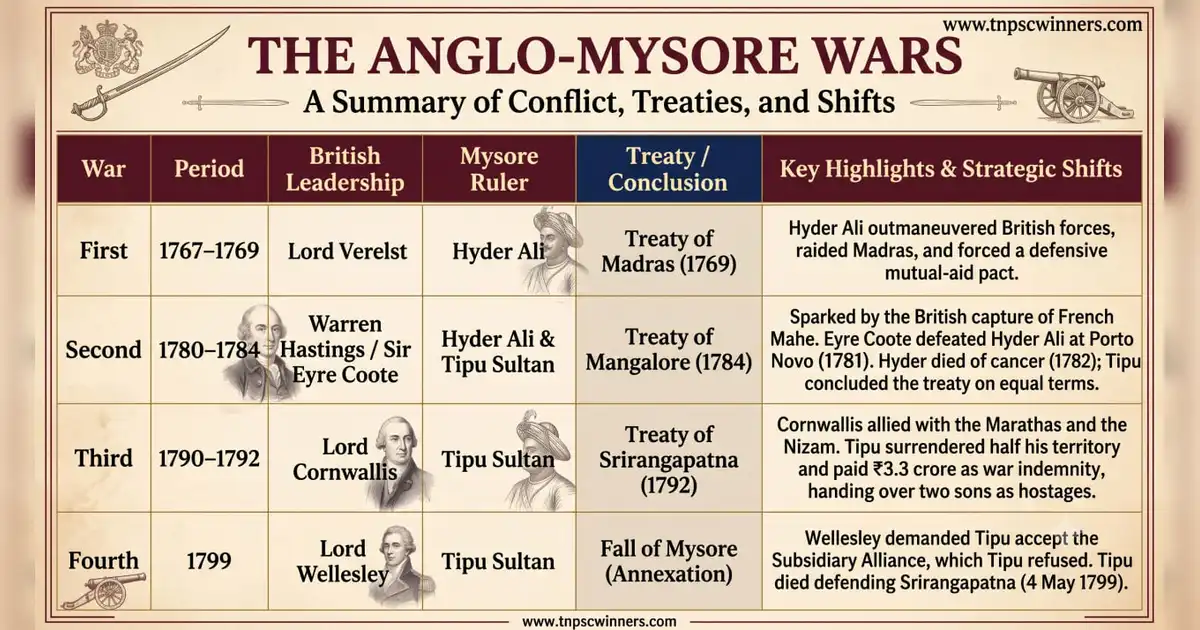
- 1767–69 → First War → Hyder Ali → Harry Verelst → Treaty of Madras
- 1780–84 → Second War → Hyder Ali/Tipu → Warren Hastings → Treaty of Mangalore
- 1790–92 → Third War → Tipu Sultan → Cornwallis → Treaty of Seringapatam
- 1799 → Fourth War → Tipu Sultan → Wellesley → Death of Tipu Sultan
- Anglo Mysore Wars