
Harsha The Last Great Hindu Emperor
Harsha The Last Great Hindu Emperor
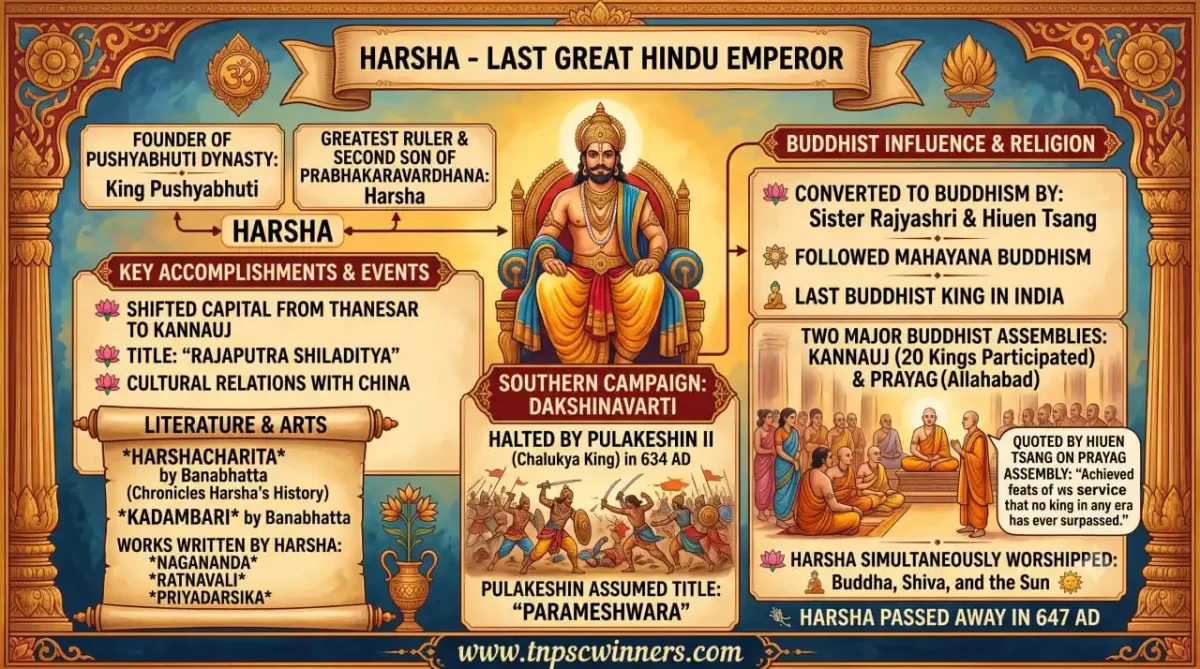
- How is the Vardhana dynasty called = Pushyabhuti dynasty.
- The capital of the Vardhana or Pushyabhuti dynasty rulers = Thaneshwaram.
- Who did Pushyabhuti serve as the army commander for? = The Guptas.
- After the fall of the Gupta Empire, Pushyabhuti seized power.
- Prabhakaravardhana’s son = Rajavardhana.
- Rajavardhana’s sister = Rajyashri.
- The husband of Rajyashri, the king of Kannasi.
- The king of Kannasi was killed by the Gauda dynasty king “Sasangar” from Bengal.
JOIN OUR TELEGRAM CHANNEL – T.ME/TNPSC_WINNERS

- Sashankar also killed Rajavardhana in the battle.
- Rajavardhana’s younger brother, Harsha, took over as the king of Thaneswaram and the king of Kannasi.
- Harsha shifted his capital from Thaneswaram to Kannauj.
- The greatest king of the Vardhana dynasty was Harsha.
- Total reign of Harsha = 41 years.
- Harsha, who conquered the northern Indian regions, was unable to conquer the southern Indian regions.
- The person who stopped Harsha’s invasion of South India was = Chalukya king Pulikesi II.
- Year of death of Harsha = 647
- Harsha The Last Great Hindu Emperor
Harsha Life Events
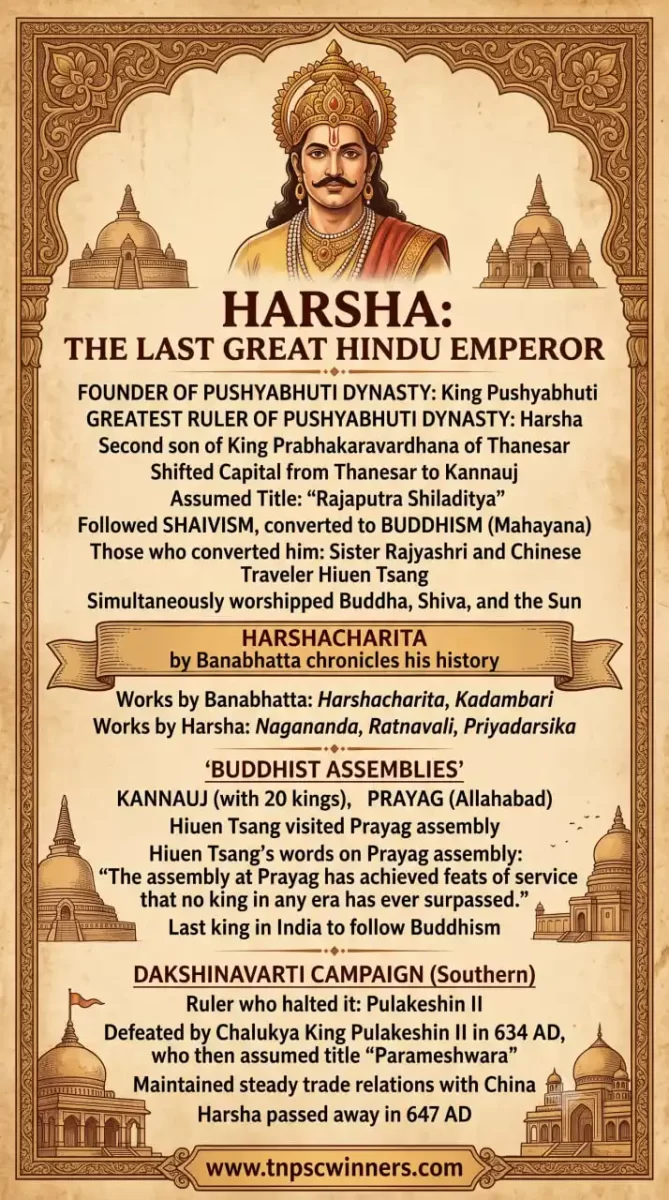
- The founder of the Pushyabhuti dynasty = King Pushyabhuti
- The greatest king of the Pushyabhuti dynasty = Harsha .
- Harsha was the second son of the Thaneswar king Prabhakaravardhana.
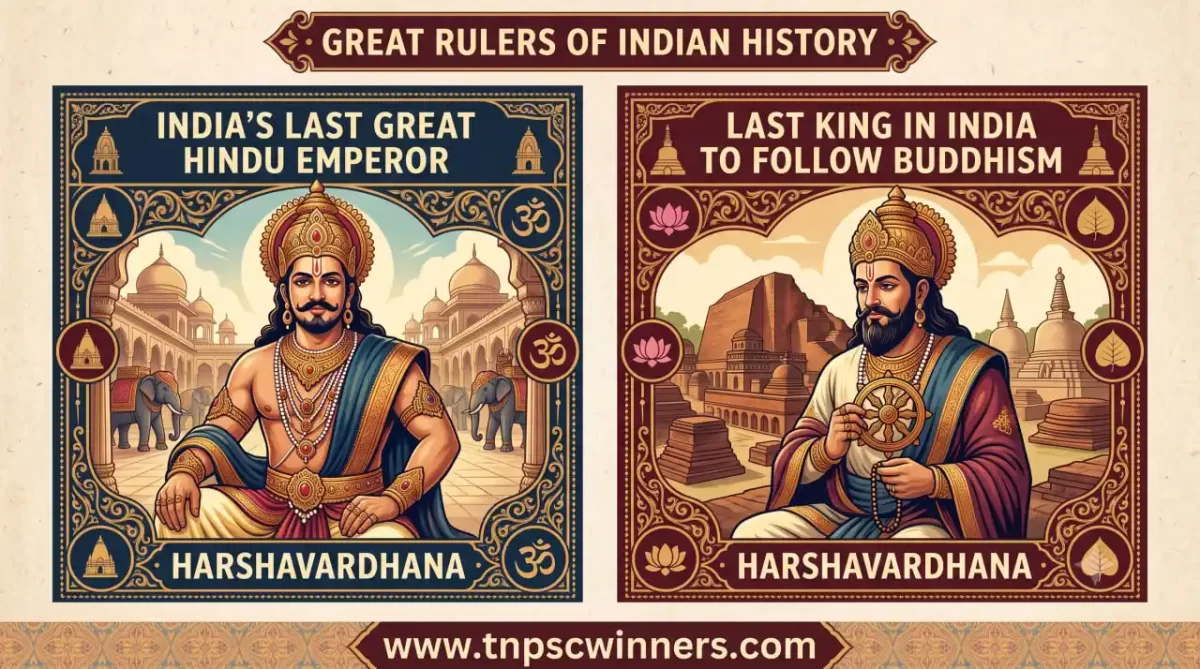
- Harshar is considered to be the last great Hindu emperor of India.
- Harsha moved his capital from Thaneswaram to “Kannoshi”.
- He himself bestowed the title “Rajputra Silathithiya”.
- The author of the book “Harshacharitam” which tells the history of Harsha = Banabhatta.
- Hiuen Tsang visited the Buddhist conference held by Harsha in the city of Prayag.
- Hiuen Tsang stayed in Harsha’s court for eight years.
- Book written by Hiuen Tsang = Chi-Yu-Ki
- The so-called “Prince of Travelers” = Hiuen Tsang.
- The person called “modern Sakyamuni” = Hiuen Tsang.
- Books written by Banabhatta = Harshacharitam, Kadambari.
- The name of Harsha’s southern invasion = Dakshinavarti.
- The one who stopped Harsha’s Dakshinavarti = Pulikesi II.
- In 634 AD, the Chalukya king Pulikesi II defeated Harsha. Pulikesi assumed the title “Parameshwara” for his victory over Harsha.
- Harsher smoothly handled trade relations with China.
- Books written by Harsha = Nagananda, Ratnavali, Priyadarsika.
- Books written by Parthrihari = Nidhi Sadaka, Sringar Sadaka, Vairagya Sadaka.
- Harsha, who initially followed Shaivism, later converted to Buddhism.
- He held two large Buddhist conferences, one in the city of “Khannosi” and the other in the city of “Prayag” (Allahabad).
- He bequeathed a huge amount of wealth to Nalanda University.
- Harshar donated the revenue of 200 villages for the use of Nalanda University.
- Hiuen Tsang said about Harsher’s Prayag Buddhist Council = “The council at Prayag has achieved a record of charity that no king of any era has ever surpassed.”
- Harsha died in 647 AD.
- Harsha The Last Great Hindu Emperor
Harsha’s administration
- The taxes in force during Harsha’s reign were three (Baga, Hiranya, Pali).
- Punishments were severe during the reign of Harsha.
- Those who broke the laws and those who plotted against the king were given the death penalty.
- Harsha initially worshipped Shiva.
- Those who converted Harsha to Buddhism = Harsha’s sister Rajyashri, Chinese traveler Hiuen Tsang.
- The Buddhist sect followed by Harsha = Mahayana Buddhism.
- Harsha treated Hindu monks and Buddhist monks equally.
- The last king to follow Buddhism in India = Harsha.
- Harsha banned the killing of animals for food.
- Harsher was known for his religious tolerance.
- Harsha worshipped the images of “Buddha, Shiva, and the Sun” simultaneously.
- Harsha convened two Buddhist councils. They were,
- One in the Kannauj
- Another one is in Prayagraj.
- Books written by Harsha = Ratnavali, Nagananda, Priyadarshika.
- Harsha The Last Great Hindu Emperor
Kannauj Prayag Buddhist Council
- Number of kings who attended the Kannauj Buddhist Council meeting = 20.
- At the Kannauj Council ceremony, a three-foot-tall statue of Pathar was carried in a procession.
- At the four-day Prayagraj Council, Harsha presented untold gifts to Buddhist monks.
- Harsha The Last Great Hindu Emperor
Hiuen Tsang
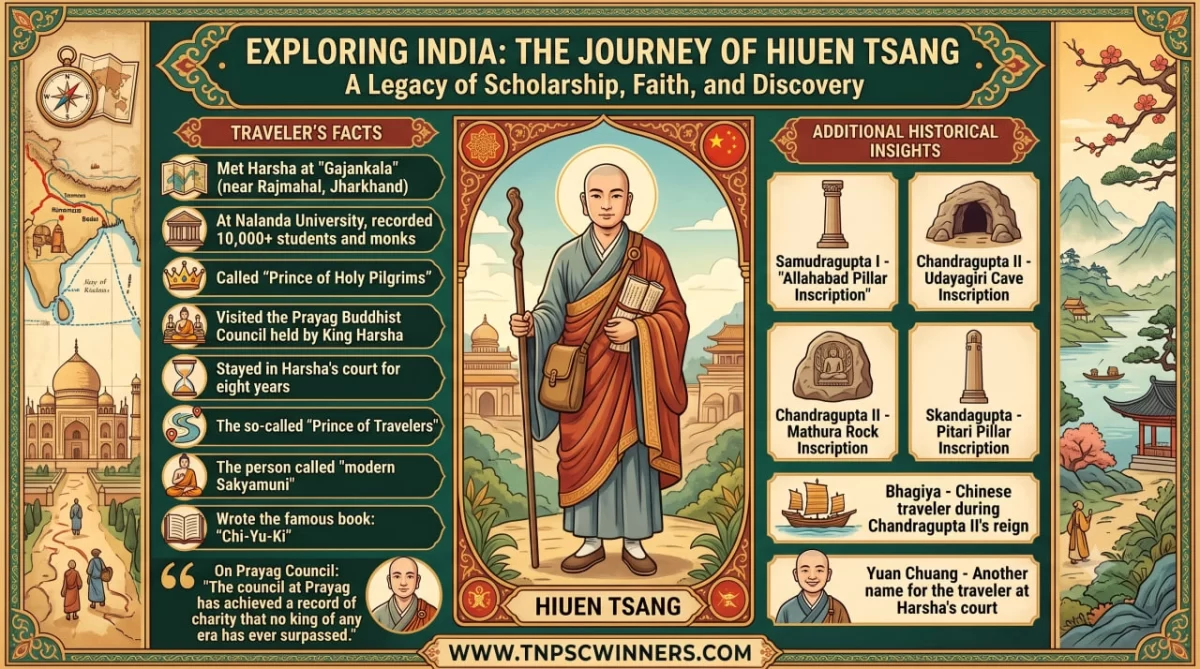
- The place where Harsher first met the Chinese traveler Hiuen Tsang = “Gajankala” near Rajmahal (Jharkhand).
- When Hiuen Tsang arrived at Nalanda University, he recorded that more than 10,000 students and monks were staying and studying there.
- The one called “Prince of Holy Pilgrims” = Hiuen Tsang.
- Hiuen Tsang visited the Buddhist conference held by Harsha in the city of Prayag.
- Hiuen Tsang stayed in Harsha’s court for eight years.
- The so-called “Prince of Travelers” = Hiuen Tsang.
- The person called “modern Sakyamuni” = Hiuen Tsang.
- During whose reign did Hiuen Tsang come to India = During the reign of Harsha.
- The book of Hiuen Tsang = Chi-Yu-Ki.
- Hiuen Tsang’s travel notes are useful for understanding Indian history during the reign of Harsha.
- Hiuen Tsang mentions in his book that Harsha, although a Buddhist, attended the great Kumbh Mela festival held in Prayagraj.
- Hiuen Tsang said about Harsher’s Prayag Buddhist Council = “The council at Prayag has achieved a record of charity that no king of any era has ever surpassed.”
- Harsha The Last Great Hindu Emperor
Additional information
- The king associated with the “Allahabad Pillar Inscription” = Samudragupta I.
- The king associated with the Udayagiri cave inscription = Chandragupta II.
- The king associated with the Mathura rock inscription = Chandragupta II.
- The king associated with the Pitari Pillar Inscription = Skandagupta.
- The Chinese traveler who visited during the reign of Chandragupta II was Fahien.
- The Chinese traveler who visited Harsha’s court = Hiuen Tsang.
- Harsha The Last Great Hindu Emperor