
Mughal Ruler Humayun: Biography, Wars, and Rule in India
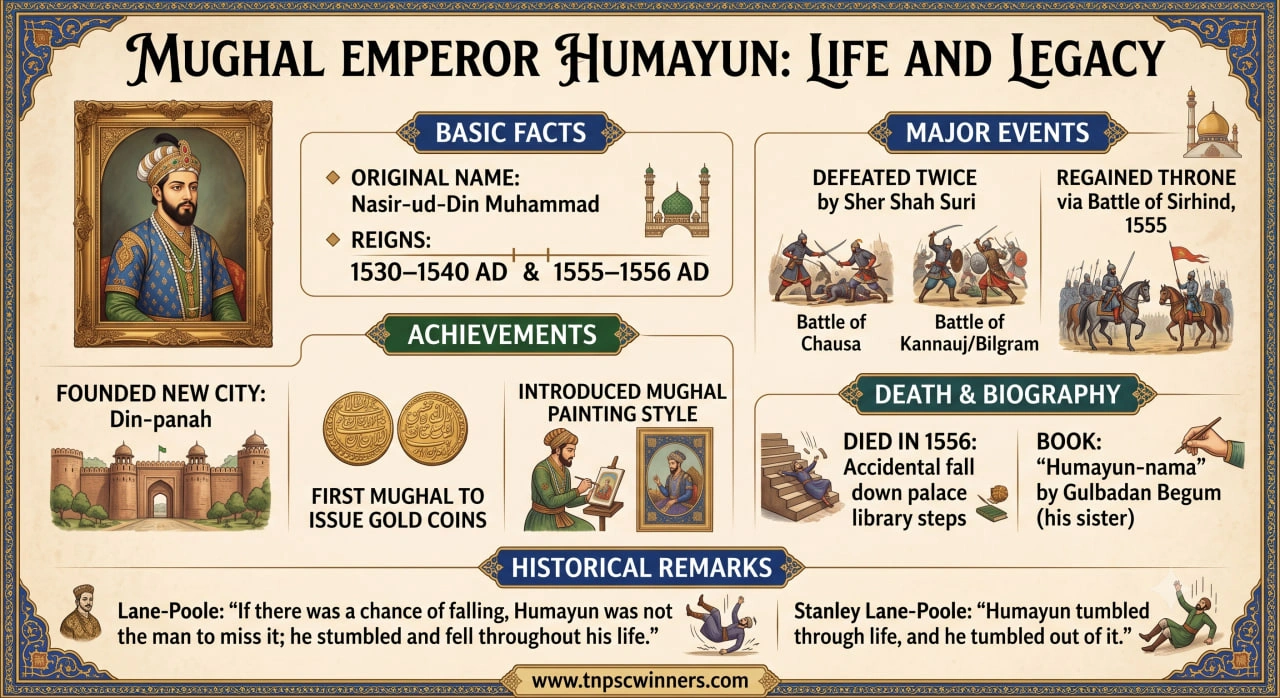
A complete overview of Mughal ruler Humayun’s reign. Discover key facts about his lineage, military campaigns, loss and recapture of Delhi, and historical legacy.
Humayun: Mughal Empire History & Key Facts
- Humayun was born in Kabul in 1508 AD to Babur and Mahim Begum.
- Humayun’s original name was Nasir-ud-din Muhammad.
- Humayun ascended the throne after various struggles.
- Humayun was the Mughal ruler who held a strong belief in astrology.
- He ascended the throne at the age of 23.
- He ruled on two separate occasions:
-
- 1530–1540 AD and 1555–1556 AD.
-
- A major blunder committed by Humayun was dividing his kingdom among his brothers—Kamran, Hindal, and Askari.
- Humayun founded the new city of “Dinpanah.”
- Humayun declared Dinpanah as his second capital.
- He lived in Persia for 15 years.
- The Sur dynasty ruled India for 15 years.
- The Sur dynasty was the second Afghan dynasty to rule Delhi.
JOIN OUR TELEGRAM CHANNEL – T.ME/TNPSC_WINNERS

- Sher Shah Suri defeated Humayun twice (in the Battle of Chausa and the Battle of Kannauj/Bilgram).
- With the assistance of the Persian King and his trusted guardian Bairam Khan, he launched a campaign against Delhi again in 1554 AD.
- Humayun recaptured his throne through the “Battle of Sirhind” in 1555 AD.
- He died in 1556 AD after accidentally falling down the stairs of the palace library.
- Humayun was the first Mughal ruler to issue gold coins.
- Author of the book “Humayun-nama” = Gulbadan Begum (Humayun’s sister).
- The person who introduced the “Mughal style of painting” = Humayun.
- During Humayun’s reign, the Persian language gradually rose to become the language of administration and courtly discourse.
- The famous historian “Lane-Poole” remarked: “If there was a chance of falling, Humayun was not the man to miss it; he stumbled and fell throughout his life.”
- Stanley Lane-Poole famously remarked: “Humayun tumbled through life, and he tumbled out of it.”
- Humayun: Mughal Empire History & Key Facts
HUMAYUN’S MAJOR BATTLES
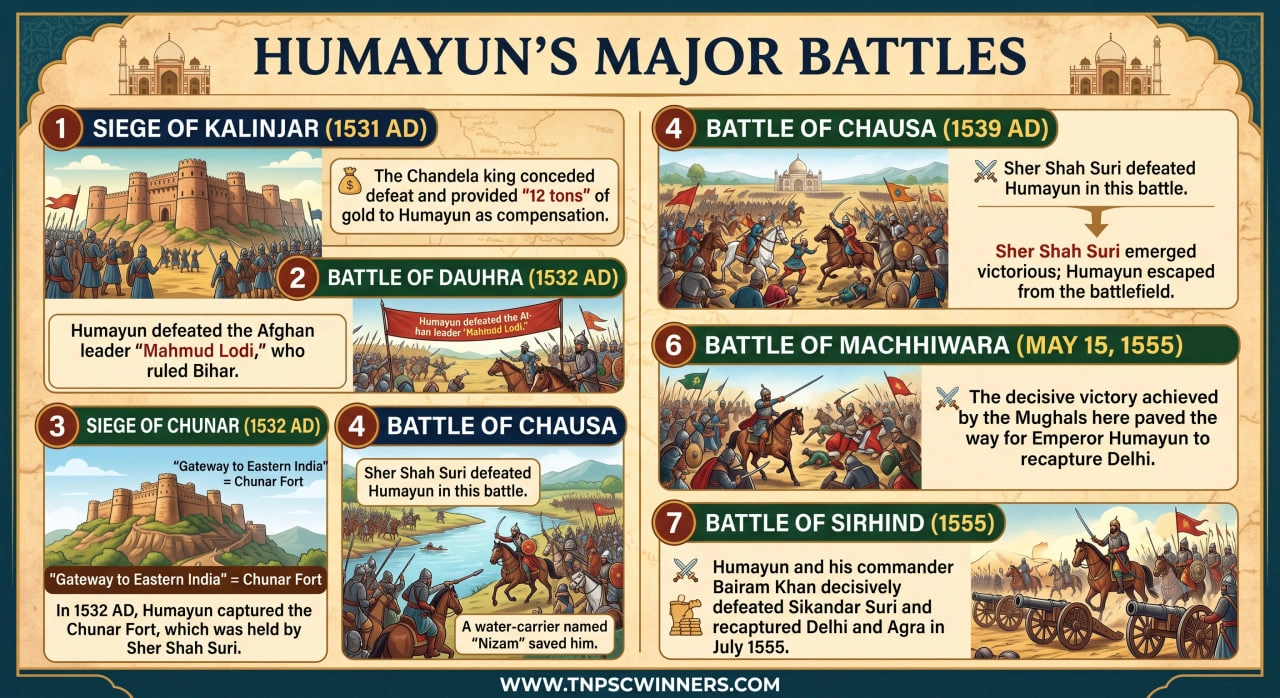
Humayun’s major battles include the siege of Kalinjar fort, siege of Chunar, Battle of Dauhra, Battle of Chausa, Battle of Kannauj, Battle of Machhiwara and Battle of Sirhind.
Humayun: Mughal Empire History & Key Facts
Siege of Kalinjar
- Year: 1531 AD.
- He besieged the Kalinjar Fort in Bundelkhand.
- The Chandela king admitted defeat and provided “12 tons” of gold to Humayun as compensation.
Battle of Dauhra (1532 AD)
- He defeated the Afghan leader “Mahmud Lodi,” who was ruling Bihar.
Siege of Chunar (1532 AD)
- The place known as the “Gateway to Eastern India” = Chunar Fort.
- In 1532 AD, Humayun captured the Chunar Fort, which was under the control of Sher Shah Suri.
Battle of Chausa
- Year: 1539 AD.
- Sher Shah Suri defeated Humayun in this battle.
- Humayun fled from the battlefield.
- A water carrier named “Nizam” saved him.
- In return, Humayun agreed to let Nizam serve as “Badshah” (Emperor) for half a day.
- Humayun: Mughal Empire History & Key Facts
Battle of Kannauj
- Battle of Kannauj (or) Battle of Bilgram.
- Year: 1540 AD.
- Sher Shah Suri emerged victorious; Humayun escaped from the battlefield.
- Humayun met “Guru Angad,” the second Sikh Guru.
- Humayun: Mughal Empire History & Key Facts
Battle of Machhiwara (1555)
- The Battle of Machhiwara took place on May 15, 1555.
- Location: Machhiwara, on the banks of the Sutlej River in the Indian state of Punjab.
- The decisive victory achieved here paved the way for Emperor Humayun to recapture Delhi.
- Humayun: Mughal Empire History & Key Facts
Battle of Sirhind (1555)
- Year: 1555.
- Date: June 22, 1555
- Location: Sirhind, Punjab (present-day India).
- Humayun and his commander Bairam Khan decisively defeated Sikandar Sur and recaptured Delhi and Agra in July 1555.
- Humayun: Mughal Empire History & Key Facts

Humayun’s Tomb
- Humayun’s Tomb: Delhi
- Commissioned by: Hamida Banu Begum (for Humayun)
- Architect: Mirak Mirza Ghiyas
- Construction began: 1565
- Construction completed: 1572
- It is considered a significant early example of the Mughal ‘garden-tomb’ architectural style.
- It had a profound influence on the subsequent evolution of Mughal architecture; notably, it paved the way for the architectural tradition that culminated in the construction of the Taj Mahal.
- It is the first major example in the Indian subcontinent of the ‘Charbagh’ (garden-tomb divided into four quadrants) layout and the double-dome structural design; it served as a precursor to the architecture of the Taj Mahal.
- Humayun’s wife, Hamida Banu Begum, commissioned the construction of this marble-domed mausoleum for him near Delhi.
- First building in India constructed using white marble: Humayun’s Tomb.
- First building in India featuring a double-layered dome: Humayun’s Tomb.
- Known as the “precursor to the Taj Mahal“: Humayun’s Tomb.
- Humayun: Mughal Empire History & Key Facts