
Later Mughals – Rulers, Reign and Important Facts
Learn about the Later Mughals after Aurangzeb, including Bahadur Shah I, Farrukhsiyar, Muhammad Shah, Shah Alam II and Bahadur Shah Zafar, with important dates and TNPSC exam facts.
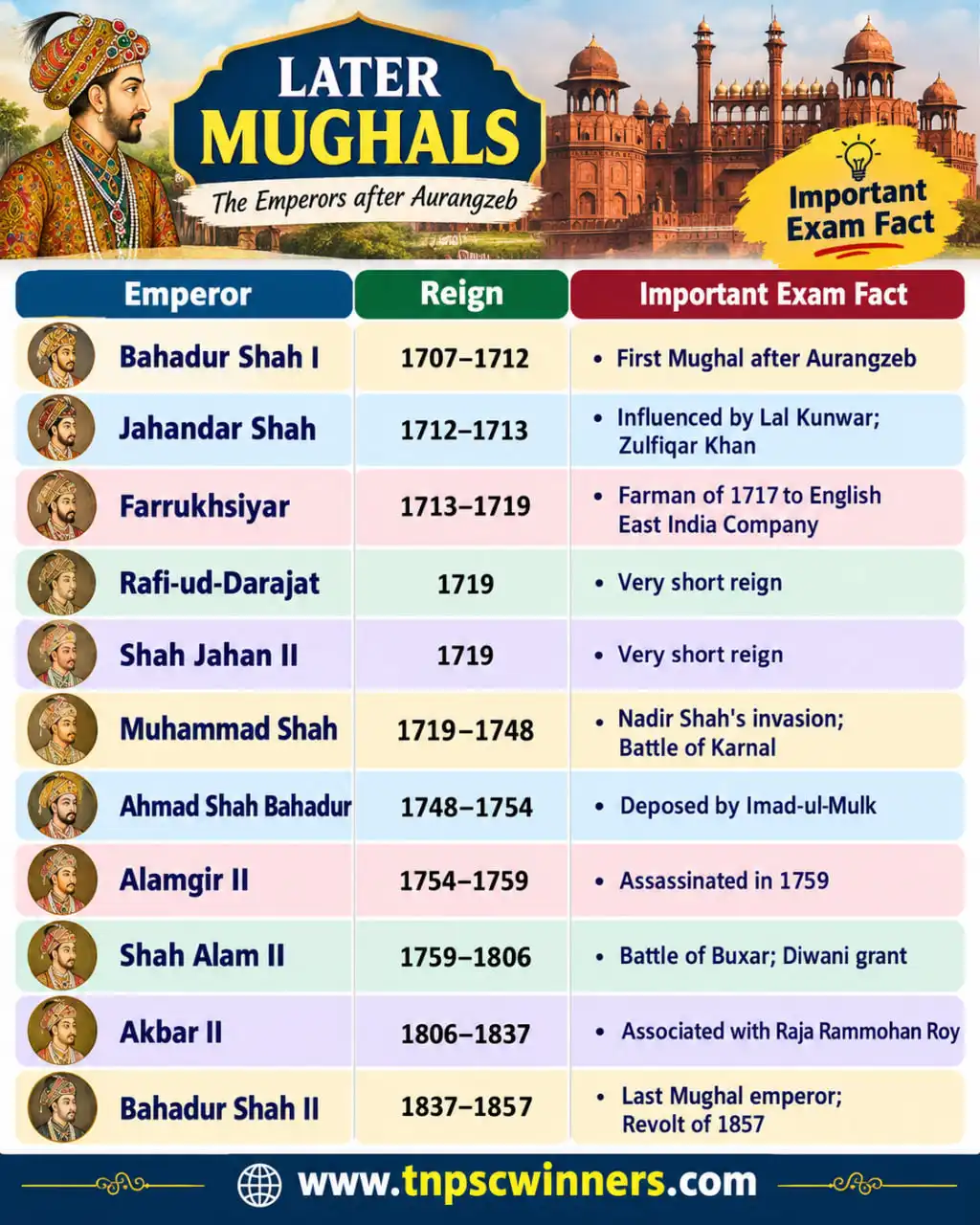
Later Mughals – List, Rulers & Important Facts
- Later Mughals refers to the Mughal emperors who ruled after Aurangzeb (1658–1707).
- The Mughal Empire rapidly weakened during this period due to succession struggles, weak emperors, court factionalism, regional rebellions and the rise of independent powers.
List of Later Mughals
- Bahadur Shah I (Shah Alam I) = 1707–1712
- Jahandar Shah = 1712–1713
- Farrukhsiyar = 1713–1719
- Rafi-ud-Darajat = 1719
- Rafi-ud-Daulah (Shah Jahan II) = 1719
- Muhammad Shah (Rangeela) = 1719–1748
- Ahmad Shah Bahadur = 1748–1754
- Alamgir II = 1754–1759
- Shah Alam II = 1759–1806
- Akbar II = 1806–1837
- Bahadur Shah II (Bahadur Shah Zafar) = 1837–1857
JOIN OUR TELEGRAM CHANNEL – T.ME/TNPSC_WINNERS

Bahadur Shah I (1707–1712)
- Original name = Muazzam
- Titles = Shah Alam I, Bahadur Shah I
- Reign = 1707–1712
- Father = Aurangzeb
- He succeeded Aurangzeb after a war of succession.
- He followed a relatively conciliatory policy towards the Rajputs and Sikhs.
- He attempted to reconcile with Guru Gobind Singh.
- After Guru Gobind Singh’s death, Banda Singh Bahadur led the Sikh struggle against the Mughals.
- Died: 1712.
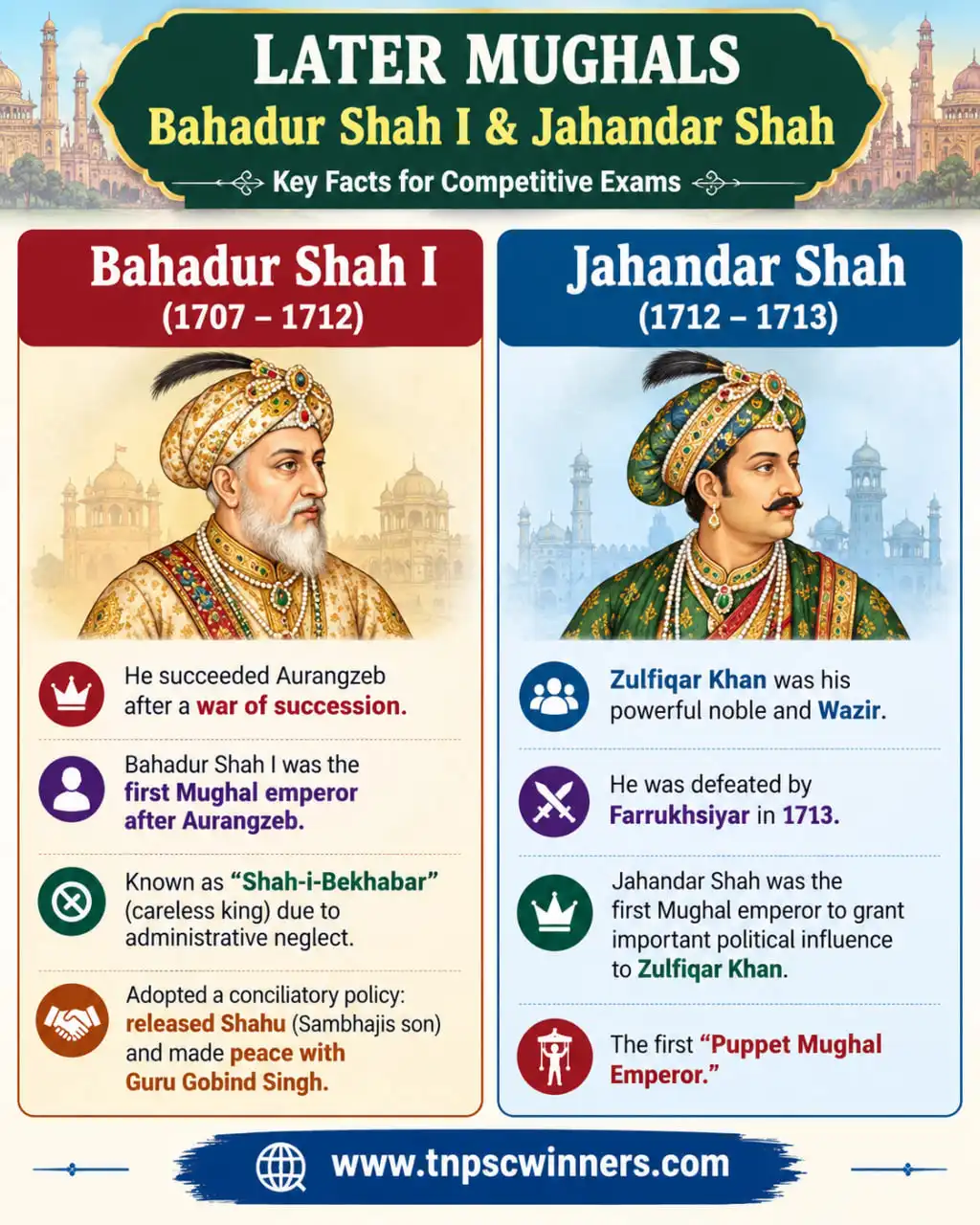
- Bahadur Shah I was the first Mughal emperor after Aurangzeb.
- Ascended at age 63.
- known as “Shah-i-Bekhabar” (careless king) due to administrative neglect.
- Adopted a conciliatory policy: released Shahu (Sambhajis son) and made peace with Guru Gobind Singh.
- Later Mughals – List, Rulers & Important Facts
Jahandar Shah (1712–1713)
- Reign = 1712–1713
- Father = Bahadur Shah I
- His reign was very short.
- He was strongly influenced by his favourite Lal Kunwar.
- Zulfiqar Khan was his powerful noble and Wazir.
- He adopted a policy of reconciliation towards the Rajputs and Marathas.
- He was defeated by Farrukhsiyar in 1713.
- Jahandar Shah was the first Mughal emperor to grant important political influence to Zulfiqar Khan.
- The first “Puppet Mughal Emperor.”
- Brought to power by wazir Zulfiqar Khan.
- Abolished Jizya.
- Promoted the Ijarah system (revenue farming), ruining state finances.
- Later Mughals – List, Rulers & Important Facts
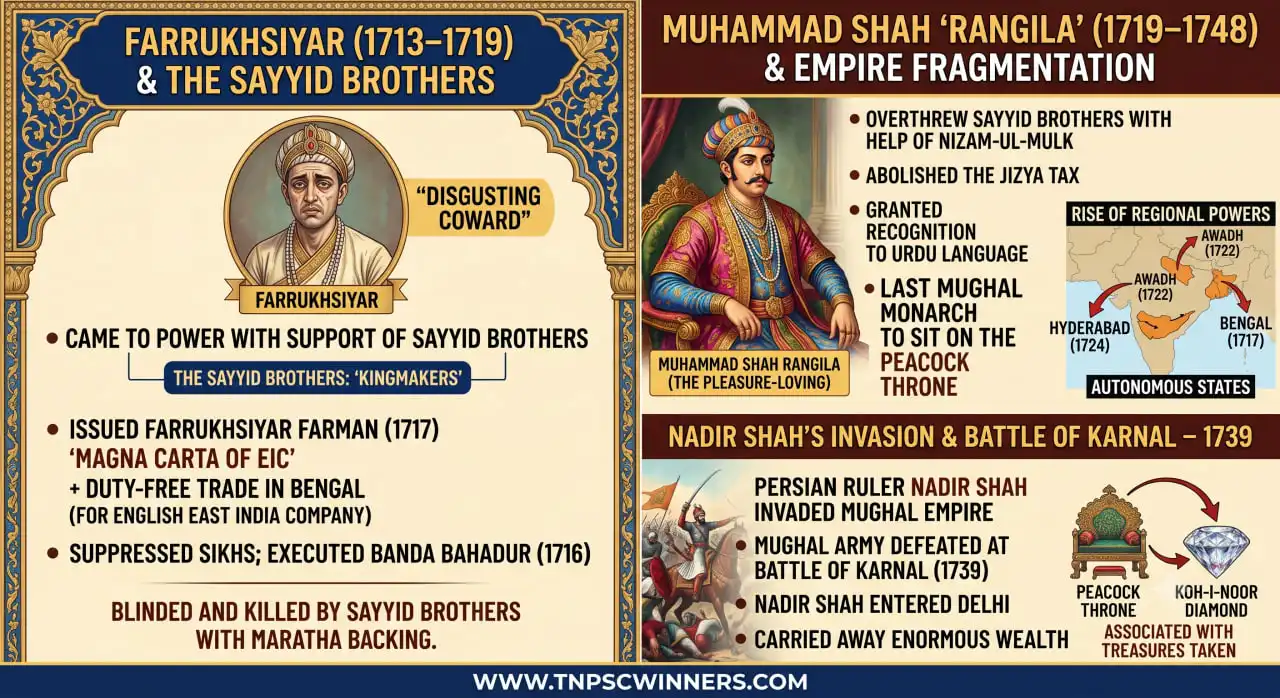
Farrukhsiyar (1713–1719)
- Reign = 1713–1719
- Father = Azim-ush-Shan
- He came to power with the support of the Sayyid Brothers.
- The Sayyid Brothers were:
-
-
-
- Sayyid Abdullah Khan – Wazir
- Sayyid Hussain Ali Khan – Mir Bakshi
-
-
- They became known as the “Kingmakers”.
- Farrukhsiyar eventually turned against them.
- Known as the “Disgusting Coward” = Farrukhsiyar.
- In 1717, he granted important trading privileges to the English East India Company.
- The Farrukhsiyar Farman of 1717 granted significant commercial privileges to the English East India Company in Bengal.
- Issued the Farman of 1717 (often called the Magna Carta of the EIC), granting duty-free trade in Bengal.
- Suppressed the Sikhs; executed Banda Bahadur (1716).
- Blinded and killed by the Sayyid Brothers with Maratha backing.
- Later Mughals – List, Rulers & Important Facts
Rafi-ud-Darajat
- Reign = February–June 1719
- Placed on the throne by the Sayyid Brothers.
- Died after a very short reign.
Shah Jahan II
- Original name = Rafi-ud-Daulah
- Reign = June–September 1719
- Brother of Rafi-ud-Darajat.
- Also controlled by the Sayyid Brothers.
- Died in 1719.
Muhammad Shah (1719–1748)
- Reign = 1719–1748
- Title/Nickname = Muhammad Shah Rangila
- He came to the throne as a teenager.
- Initially controlled by the Sayyid Brothers.
- In 1720, the Sayyid Brothers were overthrown.
- During his reign, several provinces became virtually independent.
- Overthrew the Sayyid Brothers with the help of Nizam-ul-Mulk (Chin Qilich Khan)
- Empire fragmented: Hyderabad (1724), Awadh (1722), and Bengal (1717) broke away into autonomous states.
- The Mughal ruler who finally abolished the Jizya tax.
- He led a life of indulgence in wine and women.
- Known as “Rangila” (The Pleasure-loving) = Muhammad Shah.
- The first Muslim ruler to grant recognition to the “Urdu language” = Muhammad Shah.
- He was the last Mughal monarch to sit on the “Peacock Throne.”
- Later Mughals – List, Rulers & Important Facts
Rise of Regional Powers
- The weakening of Mughal authority encouraged the rise of:
- Hyderabad – Nizam-ul-Mulk Asaf Jah
- Bengal – Murshid Quli Khan
- Awadh – Saadat Khan Burhan-ul-Mulk
- Marathas – expanding under the Peshwas
Nadir Shah’s Invasion / Battle of Karnal – 1739
- Persian ruler Nadir Shah invaded the Mughal Empire.
- Mughal army was defeated at the Battle of Karnal (1739).
- Nadir Shah entered Delhi.
- He carried away enormous wealth.
- The famous Peacock Throne and Koh-i-Noor are traditionally associated with the treasures taken during this invasion.
- Later Mughals – List, Rulers & Important Facts
Ahmad Shah Bahadur (1748–1754)
- Reign = 1748–1754
- Father = Muhammad Shah
- He was considered a weak ruler.
- Mughal authority continued to decline.
- Safdar Jang, Nawab of Awadh, served as Wazir.
- The Marathas expanded their influence in northern India.
- Invasions by Ahmad Shah Abdali (Durrani of Afghanistan) began
- Blinded and deposed by his wazir, Imad-ul-Mulk.
- Later Mughals – List, Rulers & Important Facts
Alamgir II (1754–1759)
- Original name = Aziz-ud-Din
- Reign = 1754–1759
- He assumed the title Alamgir II.
- He was placed on the throne by Imad-ul-Mulk.
- Actual political power remained largely with powerful nobles.
- Ahmad Shah Abdali (Ahmad Shah Durrani) repeatedly invaded northern India.
- Alamgir II was assassinated in 1759.
- Alamgir II was the last Mughal emperor to exercise even limited authority before the major decline of imperial power.
- Key event = Battle of Plassey (1757) was fought during his reign.
- Murdered by Imad-ul-Mulk.
- Later Mughals – List, Rulers & Important Facts
Shah Alam II (1759–1806)
- Original name: Ali Gauhar
- Reign: 1759–1806
- He spent much of his early reign away from Delhi.
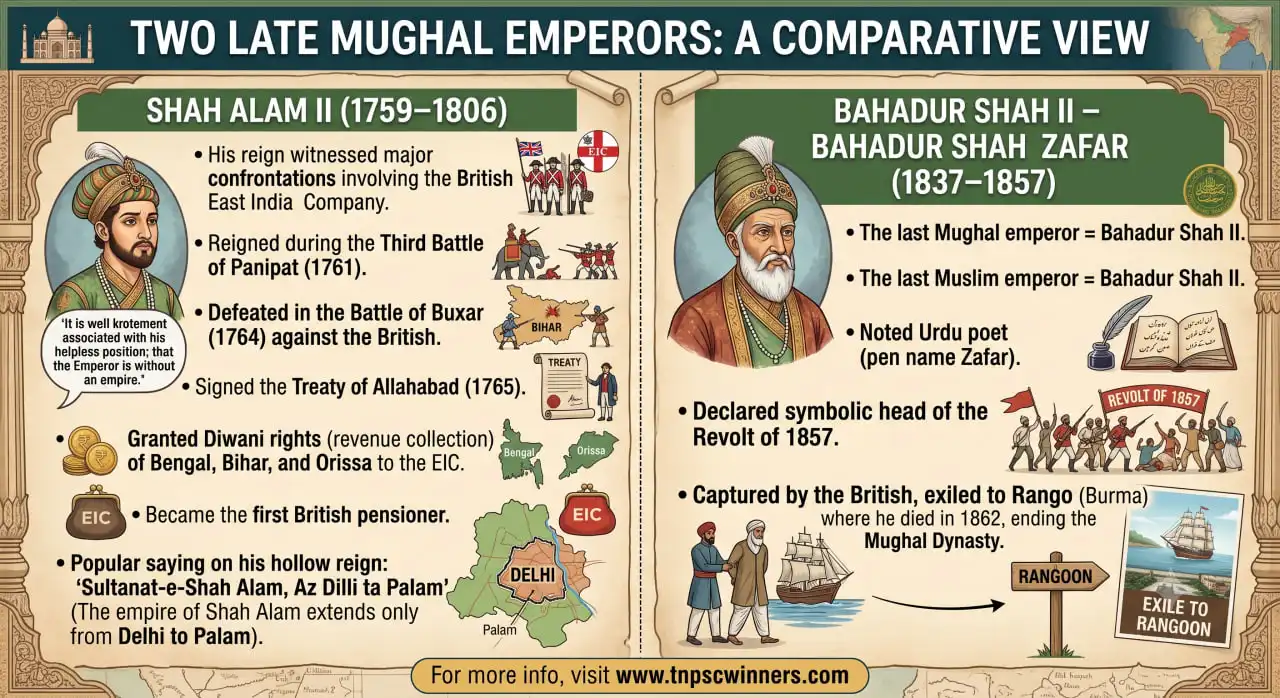
- His reign witnessed major confrontations involving the British East India Company.
- Reigned during the Third Battle of Panipat (1761)
- Defeated in the Battle of Buxar (1764) against the British.
- Signed the Treaty of Allahabad (1765)
- Granted Diwani rights (revenue collection) of Bengal, Bihar, and Orissa to the EIC;
- Became the first British pensioner.
- Popular saying on his hollow reign: “Sultanat-e-Shah Alam, Az Dilli ta Palam” (The empire of Shah Alam extends only from Delhi to Palam).
Battle of Buxar – 1764
- Shah Alam II joined
- Mir Qasim – Nawab of Bengal
- Shuja-ud-Daulah – Nawab of Awadh
- They fought the British East India Company under Hector Munro.
- Result = British victory.
Treaty of Allahabad – 1765
- After the Battle of Buxar:
- Shah Alam II granted the Diwani rights of Bengal, Bihar and Orissa to the East India Company.
- This marked a major step in the Company’s acquisition of political and revenue authority in India.
Later Life of Shah Alam II
- Shah Alam II later came under the protection of the Marathas.
- In 1803, the British captured Delhi.
- Shah Alam II then came under British protection.
- Famous statement associated with his helpless position: “It is well known that the Emperor is without an empire.”
Akbar II (1806–1837)
- Reign = 1806–1837
- Original name = Mirza Akbar
- He was largely a nominal ruler under British control.
- He was the first Mughal emperor to rule with the support of the British government.
- He conferred the title Raja on Rammohan Roy.
- Rammohan Roy represented the Mughal emperor in Britain.
- Akbar II’s reign witnessed the growing influence of the British over Delhi.
- Conferred the title of “Raja” on Ram Mohan Roy and sent him to England to lobby for an increase in the royal pension.
- Mughal-era coins ceased to be in general circulation during his reign.
- Later Mughals – List, Rulers & Important Facts
Bahadur Shah II – Bahadur Shah Zafar (1837–1857)
- Original name = Abu Zafar Siraj-ud-din Muhammad
- Popular name = Bahadur Shah Zafar
- Reign = 1837–1857
- He was primarily a symbolic ruler under British authority.
- The last Mughal emperor = Bahadur Shah II.
- The last Muslim emperor = Bahadur Shah II.
- Noted Urdu poet (pen name Zafar)
- Declared symbolic head of the Revolt of 1857.
- Captured by the British, exiled to Rangoon (Burma) where he died in 1862, ending the Mughal Dynasty.
Revolt of 1857
- During the Revolt of 1857, rebel soldiers reached Delhi and proclaimed Bahadur Shah Zafar as their leader/emperor.
- His position provided the revolt with a symbolic Mughal legitimacy.
- After the British recaptured Delhi, he was arrested.
- He was tried by the British.
- He was exiled to Rangoon (present-day Yangon, Myanmar).
- Died: 1862 in Rangoon.
- Bahadur Shah Zafar was the last Mughal emperor.
- Later Mughals – List, Rulers & Important Facts
Later Mughal Emperors – Quick Revision Table
| Emperor | Reign | Important Exam Fact |
| Bahadur Shah I | 1707–1712 | First Mughal after Aurangzeb |
| Jahandar Shah | 1712–1713 | Influenced by Lal Kunwar; Zulfiqar Khan |
| Farrukhsiyar | 1713–1719 | Farman of 1717 to English East India Company |
| Rafi-ud-Darajat | 1719 | Very short reign |
| Shah Jahan II | 1719 | Very short reign |
| Muhammad Shah | 1719–1748 | Nadir Shah’s invasion; Battle of Karnal |
| Ahmad Shah Bahadur | 1748–1754 | Deposed by Imad-ul-Mulk |
| Alamgir II | 1754–1759 | Assassinated in 1759 |
| Shah Alam II | 1759–1806 | Battle of Buxar; Diwani grant |
| Akbar II | 1806–1837 | Associated with Raja Rammohan Roy |
| Bahadur Shah II | 1837–1857 | Last Mughal emperor; Revolt of 1857 |
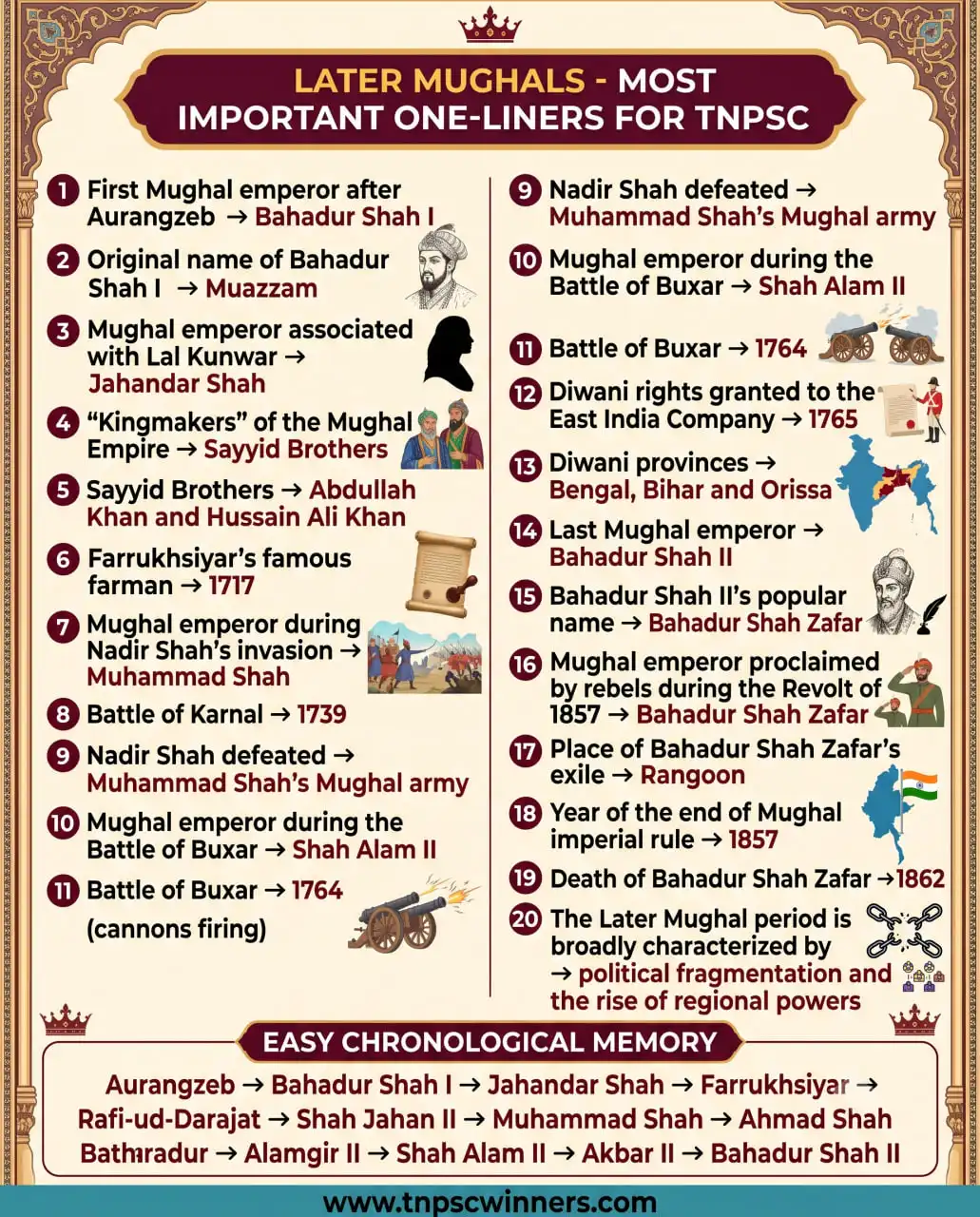
Later Mughals – Most Important One-Liners for TNPSC
- First Mughal emperor after Aurangzeb → Bahadur Shah I
- Original name of Bahadur Shah I → Muazzam
- Mughal emperor associated with Lal Kunwar → Jahandar Shah
- “Kingmakers” of the Mughal Empire → Sayyid Brothers
- Sayyid Brothers → Abdullah Khan and Hussain Ali Khan
- Farrukhsiyar’s famous farman → 1717
- Mughal emperor during Nadir Shah’s invasion → Muhammad Shah
- Battle of Karnal → 1739
- Nadir Shah defeated → Muhammad Shah’s Mughal army
- Mughal emperor during the Battle of Buxar → Shah Alam II
- Battle of Buxar → 1764
- Diwani rights granted to the East India Company → 1765
- Diwani provinces → Bengal, Bihar and Orissa
- Last Mughal emperor → Bahadur Shah II
- Bahadur Shah II’s popular name → Bahadur Shah Zafar
- Mughal emperor proclaimed by rebels during the Revolt of 1857 → Bahadur Shah Zafar
- Place of Bahadur Shah Zafar’s exile → Rangoon
- Year of the end of Mughal imperial rule → 1857
- Death of Bahadur Shah Zafar → 1862
- The Later Mughal period is broadly characterized by → political fragmentation and the rise of regional powers.
Later Mughals – Easy Chronological Memory
- Aurangzeb → Bahadur Shah I → Jahandar Shah → Farrukhsiyar → Rafi-ud-Darajat → Shah Jahan II → Muhammad Shah → Ahmad Shah Bahadur → Alamgir II → Shah Alam II → Akbar II → Bahadur Shah II