
World Ozone Day
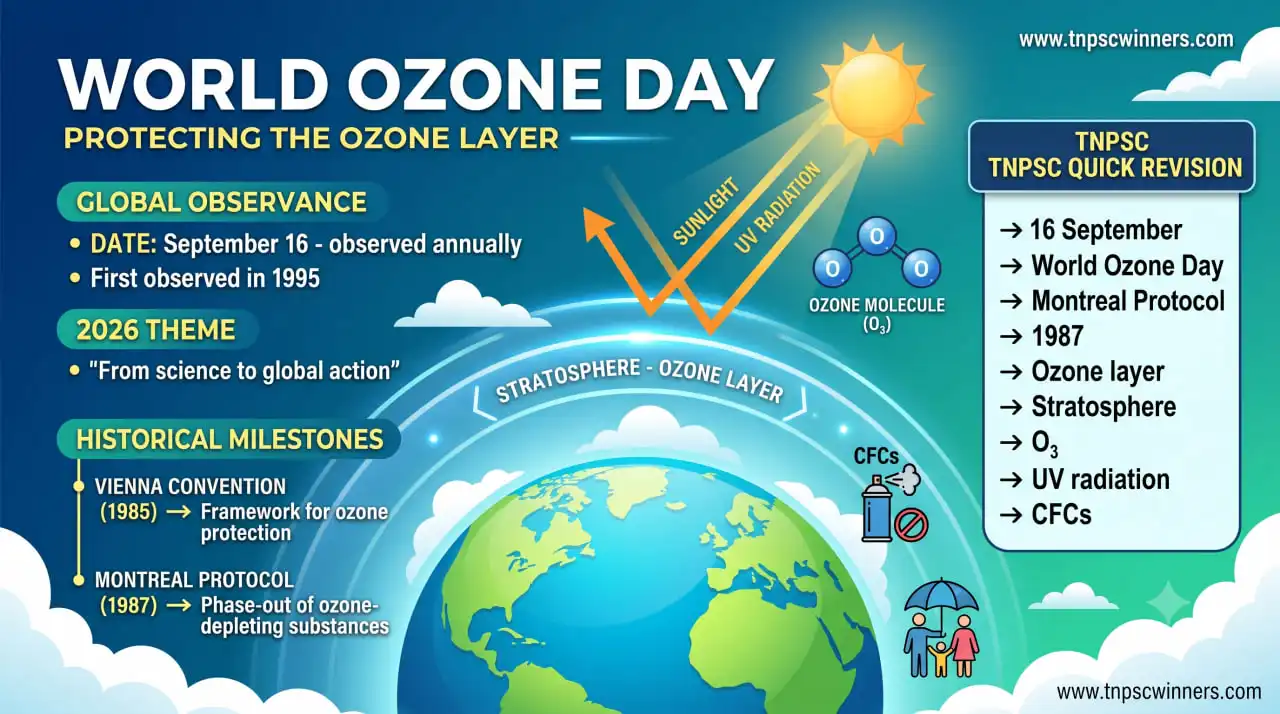
World Ozone Day
- Date = September 16 — observed annually
- Established = 1994 by the United Nations General Assembly.
- Purpose = To raise awareness about the importance of the ozone layer and promote actions to protect it from ozone-depleting substances.
- Ozone Layer = A region of the stratosphere rich in ozone (O₃) that absorbs most of the Sun’s harmful ultraviolet (UV) radiation.
- Key Agreement = The Montreal Protocol on Substances that Deplete the Ozone Layer was adopted on 16 September 1987.
- First observed = 16 September 1995.
- 2026 Theme = “From science to global action”.
JOIN OUR TELEGRAM CHANNEL – T.ME/TNPSC_WINNERS

International Day for the Preservation of the Ozone Layer
- International Day for the Preservation of the Ozone Layer is observed every year on 16 September.
- Also called as World Ozone Day.
What is Ozone Layer
- Ozone Layer = A region of the stratosphere rich in ozone (O₃) that absorbs most of the Sun’s harmful ultraviolet (UV) radiation.
- Ozone layer location: Stratosphere.
- Chemical formula of ozone: O₃
- Major function: Absorbs harmful ultraviolet (UV) radiation, particularly UV-B.
- Ozone-depleting substances (ODS): Mainly CFCs (chlorofluorocarbons), halons and related chemicals.
- Ozone hole: Most prominently observed over Antarctica.
- Vienna Convention: Adopted in 1985; provides the framework for international cooperation on ozone protection.
- Montreal Protocol: Adopted in 1987 under the Vienna Convention.
- India: India is a party to both the Vienna Convention and Montreal Protocol.
- Vienna Convention (1985) → framework for ozone protection
- Montreal Protocol (1987) → phase-out of ozone-depleting substances
Why the Ozone Layer Matters
- The Shield: Located primarily in the stratosphere (15-35 km above Earth), ozone (O3) absorbs 97–99% of incoming medium-frequency ultraviolet (UV-B) radiation.
- Impact of Depletion: Excess UV radiation causes skin cancers, cataracts, immune system damage in humans, and severe disruptions to marine ecosystems (phytoplankton) and agricultural crop yields.
TNPSC Quick Revision
- 16 September → World Ozone Day → Montreal Protocol → 1987 → Ozone layer → Stratosphere → O₃ → UV radiation → CFCs
TNPSC Eam Oriented Important Points
- Do not confuse ozone depletion with global warming.
- Ozone depletion primarily concerns increased UV radiation reaching Earth.
- While global warming is mainly associated with the enhanced greenhouse effect.
- Measurement Unit: Dobson Unit (DU).
- Conversion: = 1DU = 0.01 mm
- Normal Thickness = 300-400 DU.
- Ozone Hole Definition: An area where total column ozone drops below 220 DU.
- Discovery of Ozone Layer: Discovered in 1913 by French physicists Charles Fabry and Henri Buisson.
- Discovery of the Ozone Hole (1985): Detected over Antarctica by British Antarctic Survey scientists Joseph Farman, Brian Gardiner, and Jonathan Shanklin.