
Arrival of Europeans in India
Learn about the Arrival of Europeans in India, including the Portuguese, Dutch, English and French, their trading centres, important events and exam-oriented facts for TNPSC and competitive exams.
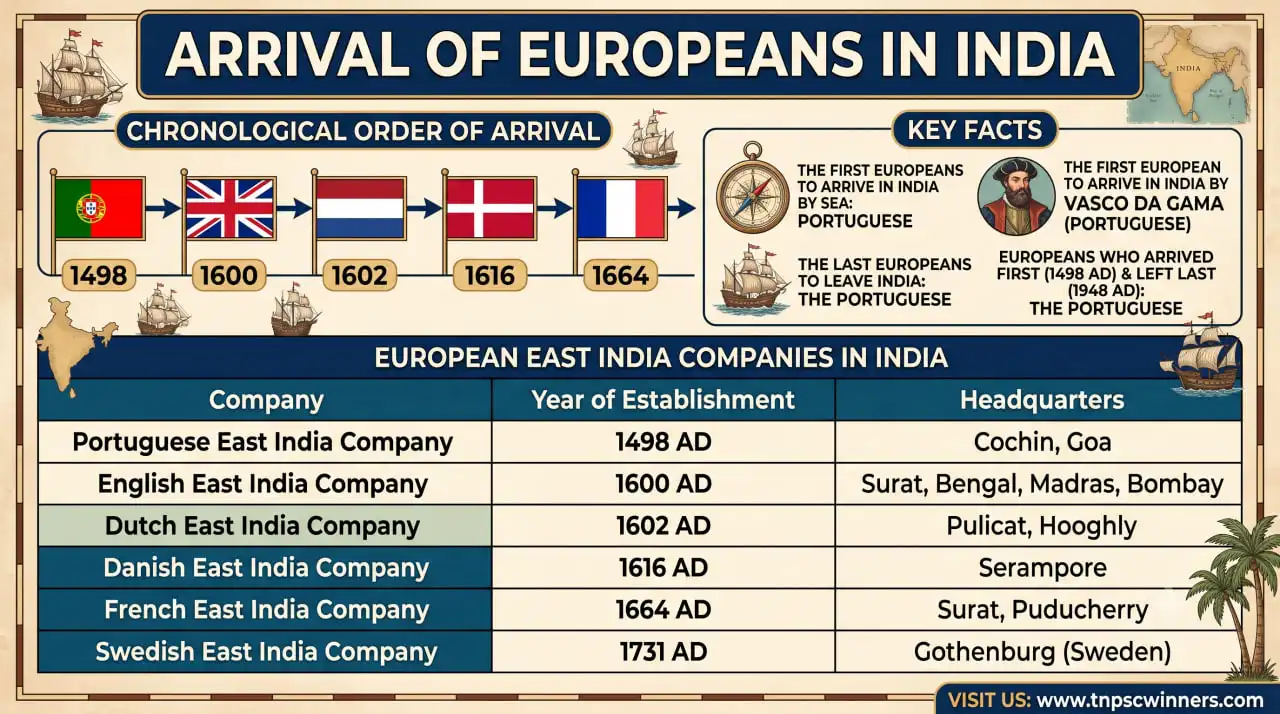
Arrival of Europeans in India
- The first Europeans to arrive in India by sea = The Portuguese.
- The first European to arrive in India by sea = Vasco da Gama (Portuguese).
- Chronological order of European arrivals in India = Portuguese → British → Dutch → Danes → French.
- The last Europeans to leave India = The Portuguese.
- Europeans who arrived first (1498 AD) and left last (1948 AD) = The Portuguese.
- Arrival of Europeans in India
JOIN OUR TELEGRAM CHANNEL – T.ME/TNPSC_WINNERS

| Company | Year of Establishment | Headquarters |
| Portuguese East India Company | 1498 AD | Cochin, Goa |
| English East India Company | 1600 AD | Surat, Bengal, Madras, Bombay |
| Dutch East India Company | 1602 AD | Pulicat, Hooghly |
| Danish East India Company | 1616 AD | Serampore |
| French East India Company | 1664 AD | Surat, Puducherry |
| Swedish East India Company | 1731 AD | Gothenburg (Sweden) |
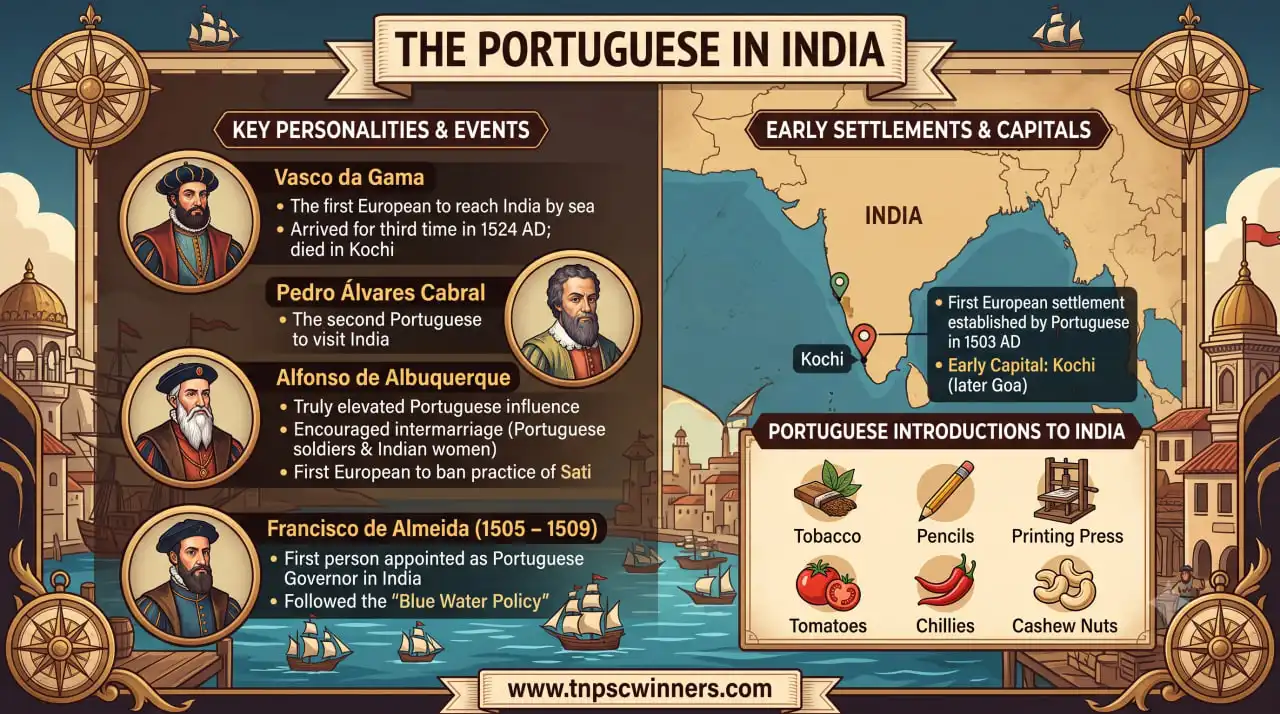
The Portuguese
- The first European to reach India by sea was Vasco da Gama.
- After reaching the “Cape of Good Hope” in South Africa, Vasco da Gama arrived at Calicut (Kozhikode) in India on May 20, 1498, with the assistance of a Gujarati Indian navigator named Abdul Ibn Majid.
- The local ruler, known as the “Zamorin,” welcomed Vasco da Gama.
- Vasco da Gama returned to Portugal in 1499.
- In 1500, a Portuguese navigator named Pedro Álvares Cabral arrived in India.
- The second Portuguese person to visit India was Pedro Álvares Cabral.
- Vasco da Gama visited India for the second time in 1502.
- Vasco da Gama visited India for the third time in 1524; he passed away in Kochi due to ill health.
- The first European settlement in India was established by the Portuguese in Kochi in 1503.
- The location where the Portuguese established their first trading post in India was Kochi.
- As a result of Vasco da Gama’s second voyage, the Portuguese established trading posts in Kochi, Cannanore (Kannur), and Calicut.
- In 1535 AD, the Portuguese Governor “Nino da Cunha” captured Diu and Bassein from Bahadur Shah of Gujarat.
- The Portuguese introduced “tobacco” in India.
- The Portuguese introduced the “pencil” in India.
- The Portuguese introduced the “printing press” in India.
- The Portuguese introduced the “tomato” in India.
- The Portuguese introduced “chili peppers” in India.
- The Portuguese introduced “cashew nuts” in India.
- Arrival of Europeans in India
- The first printing press in India was established by the Portuguese in Goa in 1556.
- The first scientific work on Indian medicinal plants by a European author was also printed in Goa in 1563 AD.
- The renowned missionary Francis Xavier arrived in India during the tenure of Martin Alfonso de Souza to spread Christianity across India and Asia. He converted fishing communities—the Paravars on the Coromandel Coast and the Mukkuvas on the Malabar Coast—to Christianity.
- The Portuguese capital in India was initially Cochin (later shifted to Goa).
- Governor “Nino da Cunha” declared “Goa” as the capital of the Portuguese territories.
- In 1632, the Mughal Emperor Shah Jahan completely destroyed the Portuguese settlement at Hooghly and took more than a thousand Portuguese people as prisoners.
- In 1661 AD, when Charles II married Catherine, the King of Portugal gave the region of Bombay to Charles II of England as a dowry.
- Arrival of Europeans in India
Francisco de Almeida (1505 – 1509):
- The first person appointed as the Portuguese Governor in India = Francisco de Almeida.
- He sought to break Arab dominance in the Indian Ocean.
- Who followed the “Blue Water Policy” = Almeida.
- Arrival of Europeans in India
Alfonso de Albuquerque (1509 – 1519)
- The second Portuguese Governor of India = Alfonso de Albuquerque.
- He firmly established a Portuguese base on the west coast of India.
- He cultivated friendly relations with the Vijayanagara Empire.
- He encouraged Portuguese soldiers to marry Indian women (intermarriage).
- He was the one who truly elevated Portuguese influence in India.
- He captured “Goa” from the Sultan of Bijapur in 1510 AD.
- The first European to ban the practice of “Sati” = Alfonso de Albuquerque.
- The Portuguese Governor who banned the practice of “Sati” in India = Alfonso de Albuquerque.
- Arrival of Europeans in India
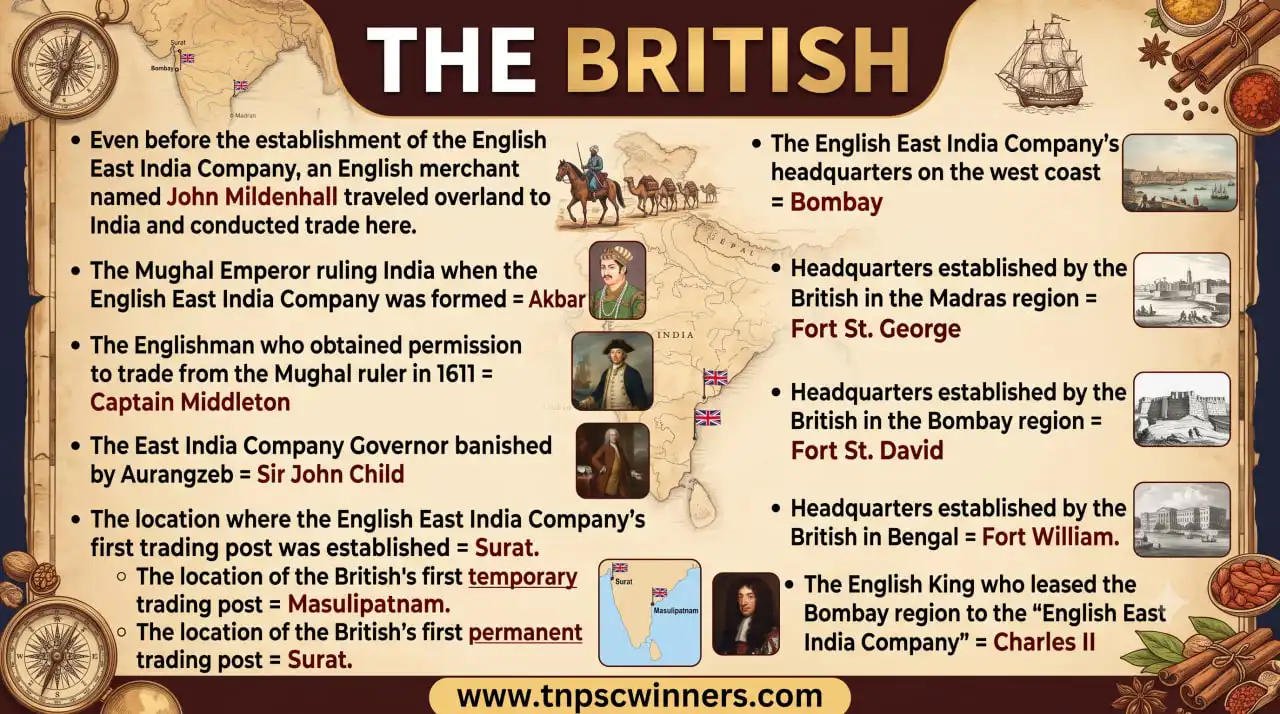
The British
- Even before the establishment of the English East India Company, an English merchant named John Mildenhall traveled overland to India and conducted trade here.
- Date of the English East India Company’s formation = December 31, 1600.
- The Mughal Emperor ruling India when the English East India Company was formed = Akbar.
- In 1608 AD, English Captain William Hawkins presented a letter from King James I to the Mughal Emperor Jahangir and sought permission to trade.
- However, permission was not granted due to Portuguese interference.
- The Englishman who obtained permission to trade from the Mughal Emperor in 1611 = Sir John Child.
- In 1615, a British delegation led by Sir Thomas Roe obtained permission from the Mughal Emperor Jahangir to trade in India without paying customs duties.
- The East India Company Governor banished by Aurangzeb = Sir John Child.
- The location where the English East India Company’s first trading post was established = Surat.
- The location of the British first temporary trading post = Masulipatnam.
- The location of the British first permanent trading post = Surat.
- Headquarters of the English East India Company on the west coast = Bombay.
- Headquarters established by the British in the Madras region = Fort St. George.
- Headquarters established by the British in the Bombay region = Fort St. David.
- Headquarters established by the British in Bengal = Fort William.
- When Charles II married Catherine in 1661, the King of Portugal gave the Bombay region to Charles II of England as a dowry.
- The English King who leased the Bombay region to the “English East India Company” was Charles II.
- The company leased Bombay from Charles II in 1668 for an annual rent of ten pounds.
- Arrival of Europeans in India
First coin of modern India
- Who issued the first coin of modern India = British.
- Year of issue of first coin of modern India = 1862.
- Issuer of first coinage of modern India = King Edward VII of England.
- King Edward VII of England minted the first coin of modern India to bear his image in AD. Published in 1862.
- Arrival of Europeans in India
Key Years in the Rise of the British
| 1600 | Formation of the English East India Company |
| 1608 | Arrival of William Hawkins at the court of Jahangir |
| 1612 | Establishment of the first permanent British trading post at Surat |
| 1616 | The English East India Company established its second trading post at Masulipatnam.
The first British trading post in South India = Masulipatnam. |
| 1633 | The first British trading post in the eastern region was established at Balasore in Odisha. |
| 1662 | The city of Bombay was given as a dowry to the English King Charles II upon his marriage to a Portuguese princess. |
| 1687 | Relocation of the English East India Company’s headquarters from Surat to Bombay. |
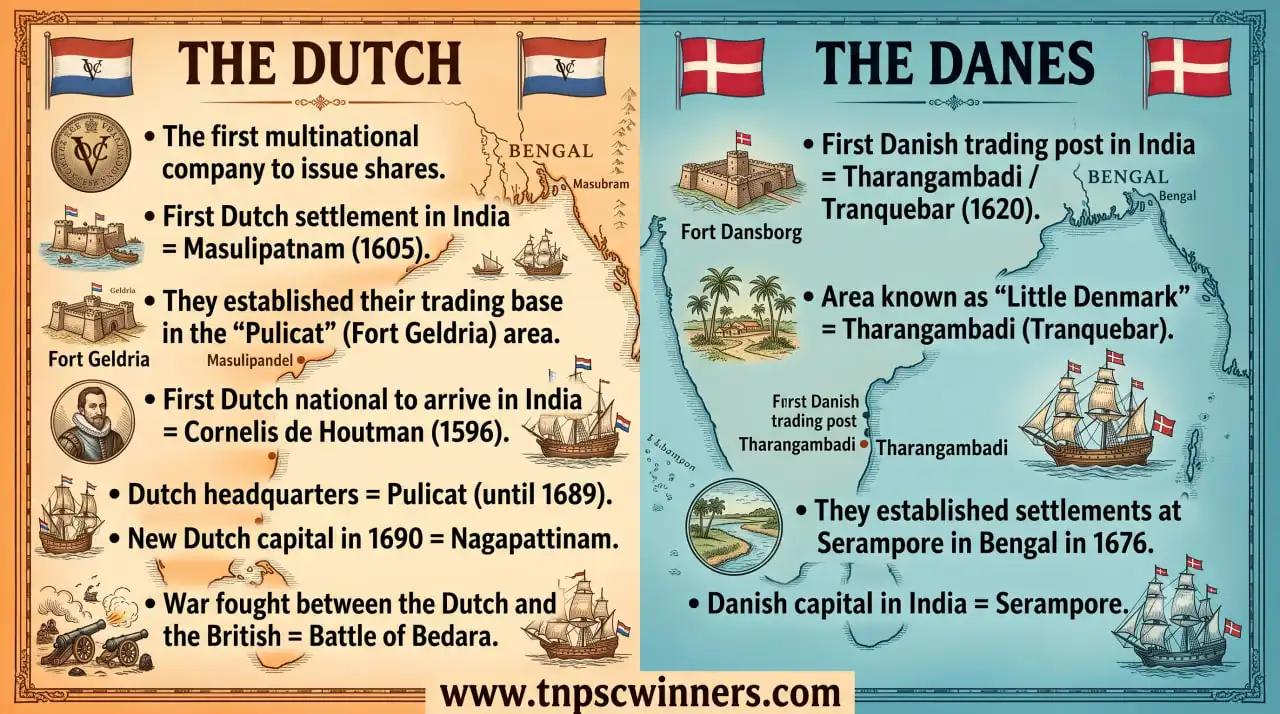
The Dutch
- The Dutch = Holland, Netherlands.
- Year of establishment of the Dutch East India Company (VOC) = 1602.
- It was the first multinational company to issue shares.
- First Dutch settlement in India = Masulipatnam (1605).
- They established their trading base in the “Pulicat” area (Fort Geldria).
- Unlike other Europeans who traded in spices, the Dutch primarily traded in Indian cotton.
- First Dutch national to arrive in India = Cornelis de Houtman (1596).
- Other Dutch settlements = Surat (1616) and Nagapattinam.
- The Dutch East India Company established a factory (trading post) at Masulipatnam and a fort (Fort Geldria) at Pulicat.
- Dutch headquarters = Pulicat (until 1689).
- New Dutch capital in 1690 = Nagapattinam.
- War fought between the Dutch and the British = Battle of Bedara.
- Arrival of Europeans in India
The Danes
- Danes = Denmark.
- Year the Danish East India Company was established = 1616.
- First Danish trading post in India = Tranquebar (Tharangambadi) (1620).
- Area known as “Little Denmark” = Tharangambadi (Tranquebar).
- They established settlements at Serampore in Bengal in 1676.
- Danish capital in India = Serampore.
- Arrival of Europeans in India
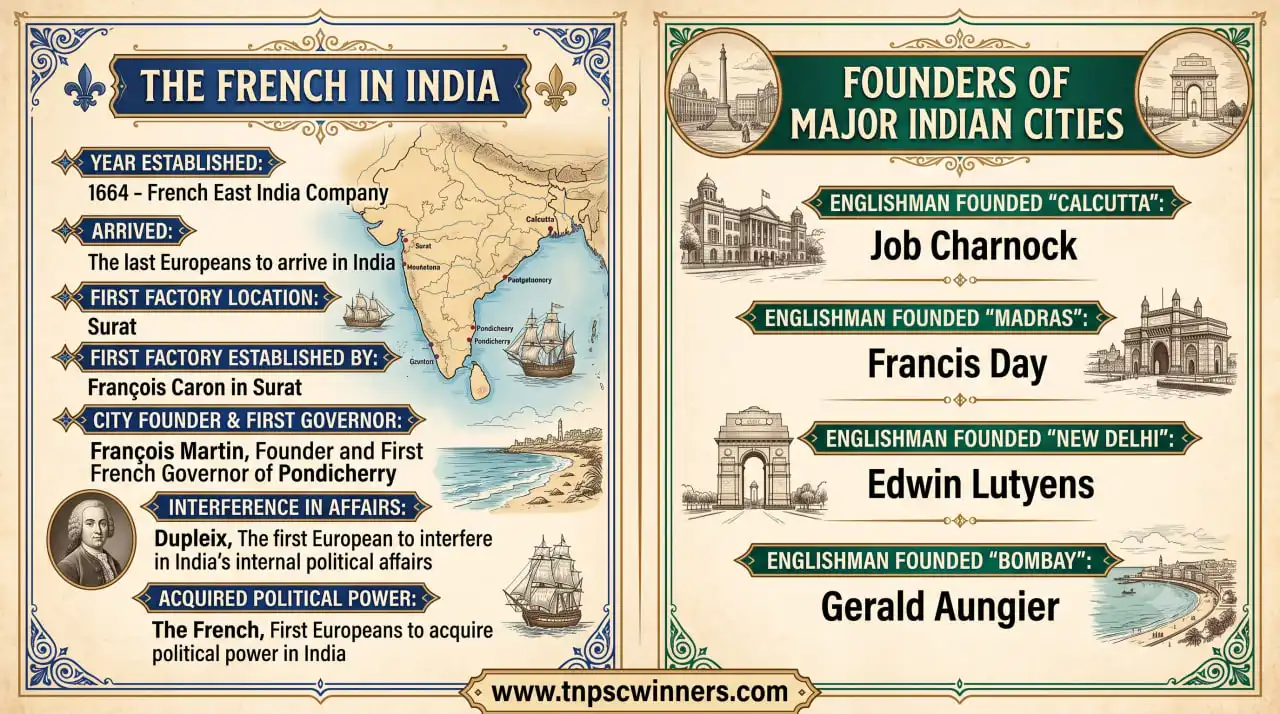
The French
- Year the French East India Company was established = 1664.
- The last Europeans to arrive in India = The French.
- Location of the first French factory in India = Surat.
- Person who established the first French factory in Surat = François Caron.
- Person who established a French factory at “Masulipatnam” in 1669 = Marcara.
- Person who acquired the “Vallikondapuram” area from Sher Khan Lodi and established a new French factory there = François Martin.
- The “Vallikondapuram” area was later transformed into “Pondicherry”.
- Founder of the city of Pondicherry = François Martin.
- First French Governor of Pondicherry = François Martin.
- The most outstanding French Governor = Dupleix.
- The first European to interfere in India’s internal political affairs = Dupleix.
- The first Europeans to gain political power in India = The French; however, this lasted only for a short period.
- Arrival of Europeans in India
- Arrival of Europeans in India
Founders of Major Indian Cities
- The Englishman who founded the city of “Calcutta” = Job Charnock.
- The Englishman who founded the city of “Madras” = Francis Day.
- The Englishman who founded the city of “New Delhi” = Edwin Lutyens.
- The Englishman who founded the city of “Bombay” = Gerald Aungier.
- Arrival of Europeans in India