
Babur the First Mughal Emperor
Babur the First Mughal Emperor
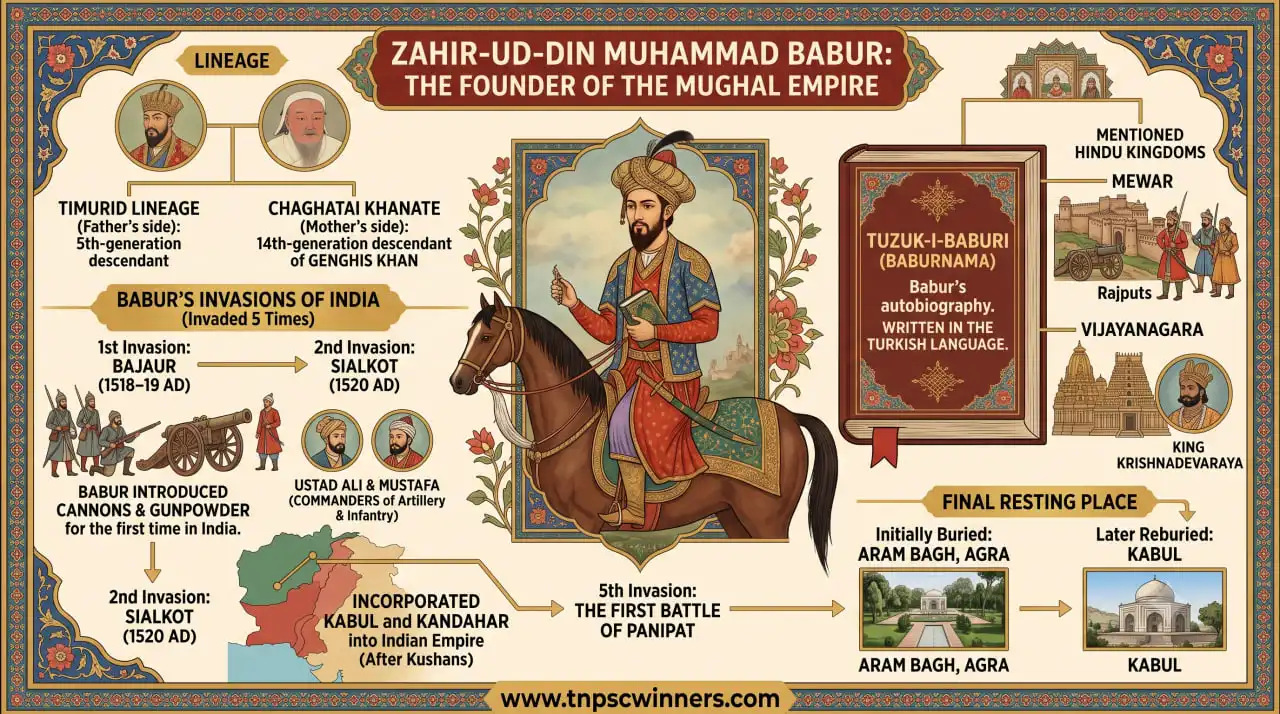
- Babur’s full name = Zahir-ud-din Muhammad Babur.
- Father’s name = Umar Shaikh Mirza.
- Babur was the fifth-generation descendant of Timur on his father’s side and the fourteenth-generation descendant of Genghis Khan on his mother’s side.
- Babur ascended the throne of Fergana in 1494 AD at the age of 12.
- He was unable to capture his ancestral land, “Samarkand” (Shaibani Khan prevented him).
- Babur belonged to the “Chaghatai” branch of the Turkic race.
JOIN OUR TELEGRAM CHANNEL – T.ME/TNPSC_WINNERS

- He was called “Qalandar” due to his honesty.
- The year Babur first invaded India = 1518–19 AD.
- The place where Babur first invaded India = Bajaur.
- It was in this battle that Babur used gunpowder for the first time.
- The person who introduced cannons to India = Babur.
- Babur’s second invasion was against “Sialkot” (1520 AD).
- At this juncture, Daulat Khan, the Governor of Punjab, invited Babur to invade India.
- A message inviting Babur to invade India was also sent by “Rana Sanga,” the ruler of Mewar.
- Those who invited Babur to invade India = Daulat Khan (Governor of Punjab), Alam Khan (uncle of Ibrahim Lodi), and Rana Sanga (of Mewar).
- Accepting this invitation, Babur invaded the territory of “Ibrahim Lodi,” who was ruling Delhi at the time.
- Babur’s fifth invasion of India = The First Battle of Panipat.
- Babur invaded India five times.
- Kabul and Kandahar were once again incorporated into India.
- The ruler who integrated the regions of Kabul and Kandahar into the Indian empire after the Kushans was Babur.
- The commanders of Babur’s artillery and infantry were Ustad Ali and Mustafa.
- Babur was skilled in writing poetry.
- The languages known to Babur were Persian and Arabic.
- Babur’s autobiography is *Tuzuk-i-Baburi* (also known as *Baburnama*), written in the Turkish language.
- The two Hindu kingdoms mentioned by Babur in his *Tuzuk-i-Baburi* were Mewar and Vijayanagara (ruled by King Krishnadevaraya).
- In his autobiography *Tuzuk-i-Baburi*, Babur also recorded details about animals, plants, trees, flowers, and fruits.
- *Tuzuk-i-Baburi* was translated into Persian (under the title *Baburnama*) by Abdur Rahim Khan-i-Khanan.
- The person who translated *Tuzuk-i-Baburi* into English was Madame Beveridge.
- Another work by Babur is *Risal-i-Usaz* (Babur’s letters).
- Babur obtained the Koh-i-Noor diamond from Raja Vikramajit, the King of Gwalior, and gifted it to Humayun.
- Babur introduced the practice of laying out gardens in a systematic, orderly fashion in India.
- Babur passed away in Agra in 1530 AD.
- Initially, his body was buried at a place called “Aram Bagh” in Agra; later, his remains were exhumed and reburied in Kabul.
- “Mir Baqi” built the “Babri Masjid” (Babur’s Mosque).
- Babur the First Mughal Emperor
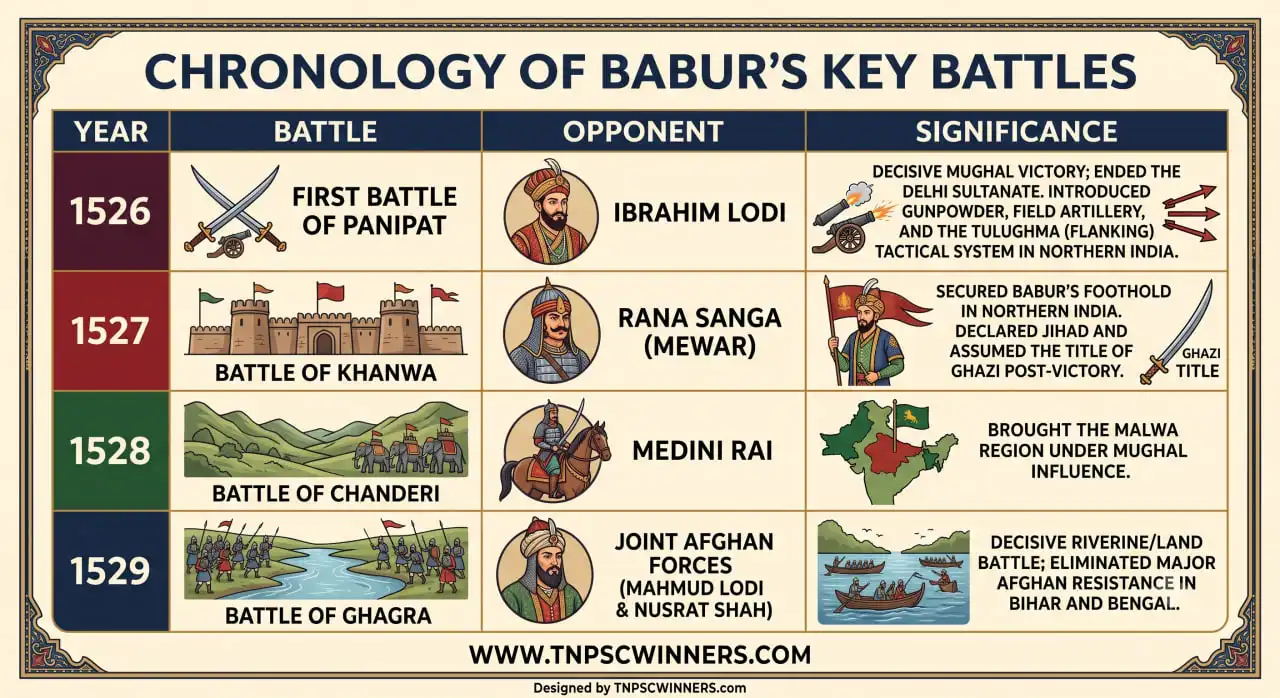
First Battle of Panipat
- Year: 1526 AD (April 21)
- Babur defeated Ibrahim Lodi.
- The rule of the Delhi Sultans came to an end.
- Mughal rule began.
- Key factor in Babur’s victory: Artillery.
- Methods used by Babur: Rumi (or Ottoman) method.
- Tactical strategy used by Babur: Tulughma warfare method.
- Babur the First Mughal Emperor
Battle of Khanwa
- Year: 1527 AD
- Defeated Rana Sanga (Sangram Singh) of Mewar.
- Babur assumed the title “Ghazi” following this victory.
- Babur declared the Battle of Khanwa a “Jihad.”
Battle of Chanderi
- Year: 1528 AD (January 29)
- Babur defeated Medini Rai, the Rajput king of Malwa.
- Babur the First Mughal Emperor
Battle of Ghaghra
- Year: 1529 AD
- Babur defeated the allied Afghan forces led by Mahmud Lodi, the brother of Ibrahim Lodi.
- Babur the First Mughal Emperor
Titles & Honors
- Padshah (Badshah): Assumed in Kabul (1507), abandoning the traditional Timurid title Mirza.
- Qalandar: Bestowed by locals for his immense generosity; distributed silver coins to every resident of Kabul after the victory at Panipat.
- Ghazi: Adopted after defeating Rana Sanga at Khanwa.
- Babur the First Mughal Emperor
Important Contributions of Babur
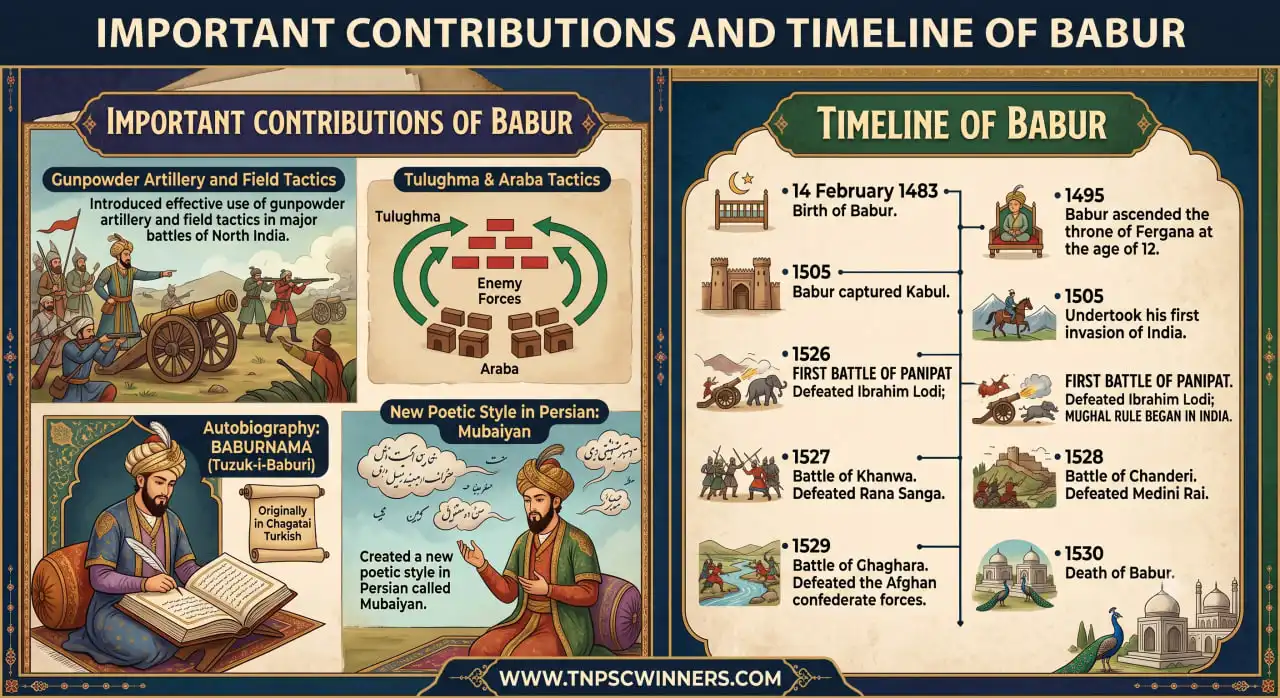
- Introduced effective use of gunpowder artillery and field tactics in the major battles of North India.
- Used Tulughma (flanking/division of forces) and Araba (cart-based defensive arrangement) tactics.
- Autobiography: Baburnama (Tuzuk-i-Baburi), originally written in Chagatai Turkish.
- Babur was also known for his interest in poetry, gardens, nature and literature.
- Created a new poetic style in Persian called Mubaiyan.
- Babur the First Mughal Emperor
Scholars’ views on Babur
- Stanley Lane-Poole = Described Babur as “the most fascinating personality in all of Eastern history.”
- Vincent Smith = Described Babur as “the most brilliant Asiatic prince of his age, worthy of a high place among the sovereigns of any age or country.”
- Annette Beveridge = Stated that Babur’s autobiography “is fit to rank with the *Confessions* of St. Augustine and Rousseau.”
Timeline of Babur
- 14 February 1483 = Birth of Babur.
- 1495 = Babur ascended the throne of Fergana at the age of 12.
- 1505 = Babur captured Kabul.
- 1505 = The year Babur undertook his first invasion of India.
- 1526 = First Battle of Panipat. Defeated Ibrahim Lodi; Mughal rule began in India.
- 1527 = Battle of Khanwa. Defeated Rana Sanga.
- 1528 = Battle of Chanderi. Defeated Medini Rai, the King of Chanderi.
- 1529 = Battle of Ghaghara. Defeated the Afghan confederate forces.
- 1530 = Death of Babur.
- Babur the First Mughal Emperor