
The Bhakti Movement in India

The Bhakti Movement in India
- The text in which the word “Bhakti” first appears is the Shvetashvatara Upanishad.
- The Bhakti movement first originated in Tamil Nadu during the 6th–7th centuries CE.
- The era of the Bhakti movement corresponds to the Pallava period.
- The three key figures of the Bhakti movement in North India were Guru Nanak, Kabir, and Raidas.
- The Bhakti movement halted the spread of Jainism and Buddhism in South India.
- In Maharashtra, the Bhakti movement branched into two streams: Varkari and Dharakari.
- The number of Jyotirlingas dedicated to Lord Shiva in India is 12.
- The founder of the “Mahanubhava” sect was Chakradhara.
- The Bhakti Movement in India
|
Philosophies |
Creators |
| Advaita Vedanta |
Shankaracharya |
|
Vishishtadvaita |
Ramanuja |
| Dvaita Advaita |
Nimbarkacharya |
|
Shuddhadvaita, Pushti Marga |
Vallabhacharya |
| Dvaitam |
Madhvacharya |
|
Achintya Bheda Abheda |
Chaitanya Mahaprabhu |
| Aupadhika Bheda abheda |
Bhaskaracharya |
|
Sivadvaita (siva-visistadvaita) |
Srikanth Acharya |
The three branches of the Bhakti movement
- Gnana Marga (Path of Knowledge)
- Karma Marga (Path of Action)
- Bhakti Marga (Path of Devotion)
Twelve Alwars
- Total number of Alvars = 12.
- Worshippers of Vishnu = Alvars.
- The person who compiled the hymns sung by the Alvars into the book “Nalayira Divya Prabandham” = Nathamunigal.
- The Bhakti Movement in India
JOIN OUR TELEGRAM CHANNEL – T.ME/TNPSC_WINNERS

Nayanmars
- There are 63 Nayanmars in total.
- They were devotees of Lord Shiva.
- The Nayanmars belonged to various social strata, ranging from the highest to the lowest castes.
- Transcending caste and religious distinctions, their sole objective was the worship of Lord Shiva.
- The Bhakti Movement in India

Shankaracharya
- Period = 788–820 CE
- Born in Kaladi, Kerala.
- Traveled across the Indian subcontinent to propagate his ideas.
- His philosophy = Advaita Vedanta.
- His path: Jnana Marga (Path of Knowledge).
- His teachings = Focused on *Maya* (illusion), *Advaita* (non-dualism), and the significance of Vedanta.
- Established four *Mathas* (monasteries) in the four cardinal directions of India.
- The four *Mathas* established by him were:
-
-
-
- Badrinath (Jyotir Pitha – dedicated to Vishnu)
- Puri (Govardhana Pitha – dedicated to Balabhadra and Subhadra)
- Sringeri (Mysore, Sringeri Pitha – dedicated to Shiva)
- Dwarka (Sharada Pitha – dedicated to Krishna)
-
-
- Works authored = Wrote commentaries on texts such as the Upanishads, the Bhagavad Gita, and Badarayana’s Brahma Sutras.
- Known as “Prachanna Buddha” (or “Hidden Buddha”): Shankaracharya.
- Known as the first proponent of the Bhakti movement: Shankaracharya.
- Lived for only 32 years.
- Philosophical works authored = *Vivekachudamani*, *Upadeshasahasri*, and *Atmabodha*.
- Devotional works authored = *Bhaja Govindam*, *Saundarya Lahari*, and *Nirvana Shatakam*.
- Formulated the theory of the three levels of reality (*Satta-trividya*), a concept of reality involving three tiers of knowledge.
Ramanuja Acharya
- Period = 1017–1137 CE
- Born in a village near Sriperumbudur, Tamil Nadu.
- A Tamil Vaishnavite saint.
- His philosophy = Vishishtadvaita.
- He emphasized surrendering to God.
- Works authored by him = *Vedanta Sangraha*; commentaries on *Sri Bhashya* (Brahma Sutras) and the *Bhagavad Gita*; as well as *Vedanta Sara* (“The Essence of Vedanta”) and *Vedanta Deepa* (“The Lamp of Vedanta”).
- The Bhakti Movement in India
Madhvacharya
- Period: 13th century CE
- He was born in 1238 CE in Udupi, Karnataka.
- His philosophy = Dvaita
- He classified the universe into two categories: *Svatantra* (independent) and *Paratantra* (dependent).
Nimbargacharya
- He lived during the 13th–14th centuries.
- A Telugu Vaishnava saint.
- A contemporary of Ramanuja.
- His philosophy = Dvaitadvaita.
- The five paths to salvation (Mukti) he prescribes:
- Karma (Righteous action)
- Vidya (Knowledge)
- Dhyana (Meditation or Upasana)
- Prapatti (Surrender to God with devotion)
- Gurupasatti (Devotion and surrender to the Guru)
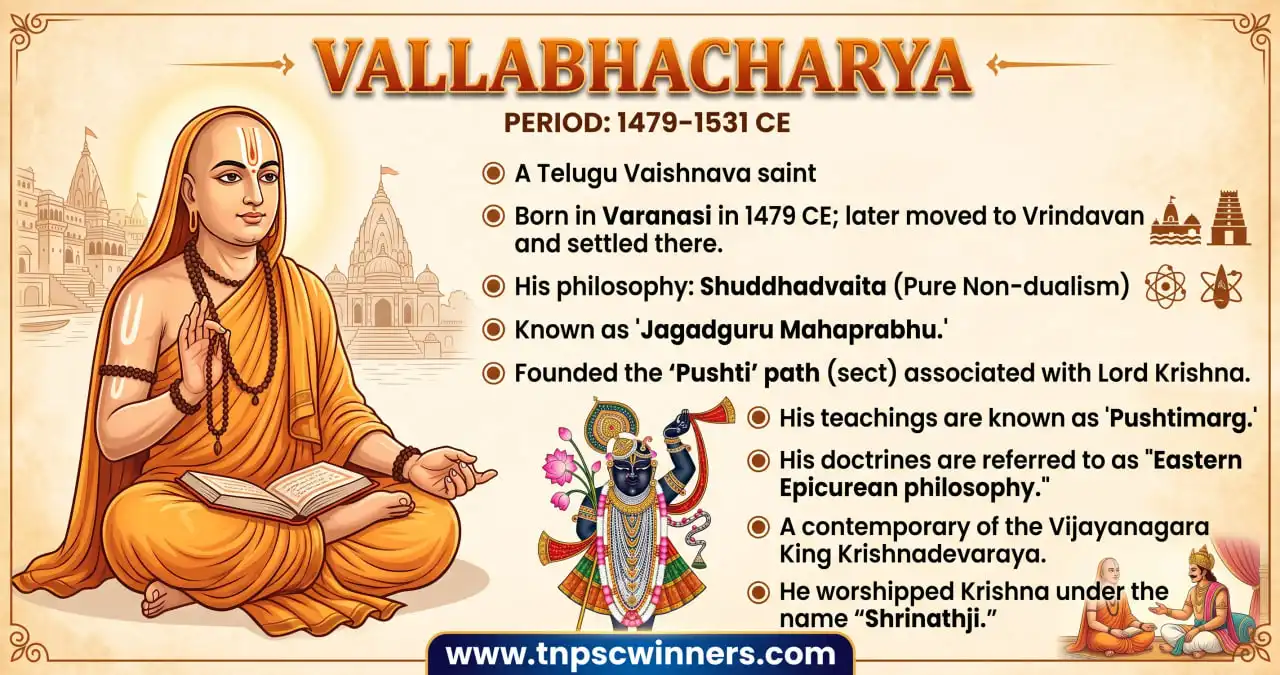
Vallabhacharya
- His period = 1479–1531 AD
- A Telugu Vaishnava saint
- Born in Varanasi in 1479 AD, he traveled to Vrindavan and settled there.
- His philosophy = Shuddha-Advaita (Pure Non-dualism)
- He was known as “Jagadguru Mahaprabhu.”
- He belonged to the *Saguna* school (devotion to Krishna).
- He founded the “Pushti” path (sect) associated with Lord Krishna.
- His teachings are known as “Pushti Marg.”
- His doctrines are referred to as “Eastern Epicurean philosophy.”
- He was a contemporary of the Vijayanagara King Krishnadevaraya.
- He worshipped Krishna under the name “Shrinathji.”
- The Bhakti Movement in India
Vidyapati
- Period: 1352–1448 CE
- A poet of the Maithili language
- Acclaimed as the “Cuckoo of Maithili”
- Works = *Bhu-parikrama*, *Varshakritya*, *Danavakyavali*
- The Bhakti Movement in India
Dadu Dayal
- Period = 1544–1603 CE
- Born to Muslim parents in Ahmedabad
- However, he was raised by a Hindu
- His teachings have been compiled into a book titled *Bani*
- The sect he founded: Brahma Sampradaya or Param Brahma Sampradaya

Kabir
- Period: 1440–1510 AD
- Profession: Weaver
- Disciple of Ramananda
- Prominent disciple: Guru Nanak
- Opposed caste, religion, and idol worship
- Advocated Hindu-Muslim unity
- Taught that Hindus and Muslims are children of the same God
- Stated that Hindus and Muslims are like pots made from the same clay
- Works: Sabada Doha, Holi, Sakhi Granth, Kabir Granthavali, Anurag Sagar
- Famous work: Bijak
- His teachings are included in the *Adi Granth*, the holy scripture of the Sikhs
- A contemporary of Guru Nanak, the founder of Sikhism
- The Bhakti Movement in India
Ramananda
- Period = 14th–15th century AD.
- A disciple of Ramanuja.
- The first saint of the Bhakti movement in North India.
- He propagated the Bhakti movement in North India.
- Order founded by him: Bairagi Sampradaya.
- His two principles = Absolute love for God and human brotherhood.
- Total number of disciples = 12.
- Kabir – Muslim weaver
- Dhanna – Jat farmer
- Pipa – Rajput prince
- Sena – Barber
- His teachings are included in the *Adi Granth*, the holy scripture of the Sikhs.
- His works (Sanskrit) = *Bhaja Bhaskara*, *Ramarchan Paddhati*.
- His works (Hindi) = *Gyan-Leela*, *Yoga Chintamani*.
- “He who acted as a bridge between the Bhakti movements of the South and the North”: Ramananda.
- He who carried the Bhakti movement from South India to North India.
- The Bhakti Movement in India

Tulsidas
- Period = 1544–1623 CE
- A *Saguna* saint (a saint who worships God with attributes/form).
- A Hindu saint belonging to the Rama *Bhakti* (devotion) tradition.
- A contemporary of Akbar.
- Works = *Ramcharitmanas*, *Kavitavali*, *Gitavali*, *Parvati Mangal*, *Janki Mangal*, *Vinaya Patrika*, *Hanuman Chalisa*.
- Built the “Sankat Mochan” temple dedicated to Hanuman in Varanasi.
- The Bhakti Movement in India
Nabatasar
- Period = 1570–1662 CE
- Born in Gwalior in 1570 CE.
- Visually impaired.
- Work = *Bhaktamal* (written in the Braj language).
- The Bhakti Movement in India
Surdas
- Period = 1478–1583 CE
- Disciple of Vallabhacharya.
- A visually impaired saint.
- Works = *Sur-Sagar*, *Sur-Saravali*, *Sahitya-Lahari*.
- Belonged to the Krishna-devotional tradition.
- The Bhakti Movement in India
Mirabai
- A female saint and devotee of Krishna.
- Period = 1498–1546 CE.
- She was a Rathore princess of Merta and the daughter-in-law of Rana Sanga of Mewar.
- Husband = Bhojraj.
- Work = *Padavali*.
- She dedicated her life to Krishna.
Chaitanya
- His period = 1486–1533 AD
- His birth name = Vishwambhar
- He hailed from the Nabadwip region of Bengal
- His Guru = Swami Ishvara Puri
- He was known as “Gaudiya Mahaprabhu” and “Chaitanya Mahaprabhu”
- He was regarded by his disciples as an “incarnation of Vishnu”
- The saint known as “Vidyasagar”: Chaitanya
- He founded = The Bengal Vaishnava movement (or Gaudiya Vaishnavism)
- His philosophy = Achintya Bhedabheda (Gaudiya Sampradaya)
- He introduced *Sankirtana* (the practice of singing hymns in praise of God in public places)
- His work = *Shikshashtaka*

Shankara Devar
- Period = 1449–1568 CE
- The organization he founded = *Eka Sharana Sampradaya* or *Mahapurushiya Sampradaya*.
- Teachings = Known as “*Bhagavati Dharma*”.
Gnanadeva
- He was known as Gnyaneshwar.
- His period = 1271–1296 CE.
- He belonged to the Krishna-bhakti tradition.
- His famous work = A commentary on the Bhagavad Gita titled “Dnyaneshwari” (or “Bhavarthadipika”).
- Another of his works = “Amrutanubhava”.
- The Bhakti Movement in India
Namedeva
- Period: 1270–1350 CE
- He was a tailor by profession.
- He opposed caste distinctions.
- He belonged to the Varkari sect.
- His writings = Devotional poems (known as “Abhangs”).
Eknath
- Period = 1533–1599 CE.
- Belonged to the Varkari sect.
- His commentary on the Ramayana = *Bhavartha Ramayana*.
- He wrote a commentary on the 11th Book of the Bhagavata Purana; this work is known as *Eknathi Bhagavata*.
Tukaram
- Period = 1598–1650 AD
- He belonged to the *Varkari* sect.
- He lived during the reign of the Mughal Emperor Jahangir.
- Writings = Devotional poems (known as “*Abhangs*”).
- A contemporary of Chhatrapati Shivaji; he held Shivaji in high regard.
Ramadass
- Period = 1608–1681 CE
- Belonged to the *Darkari* sect
- Notable work = Dasabodha.
Purandar Das
- His period = 1480-1564 AD
- He is called the “Father of Carnatic Music”
Thiagaraja
- Period = 1767–1847 CE
- A renowned saint and Carnatic music composer from Tamil Nadu.
- Famous works = His five songs known as the *Pancharatna Kritis*.
- The Bhakti Movement in India
Narsin Mehta
- A monk from Gujarat.
- Follower of Krishnaism
- He was the first to use the word “Harijan”.
- The Bhakti Movement in India